
Fast, Reliable Spray Foam Insulation Across Valinda
Spray foam insulation in Valinda runs $2.10 – $4.75 per board foot installed, with most retrofits on the 1950s – 70s tract homes landing between $2,800 and $6,900 depending on the roof deck area and whether we’re air-sealing bypasses at the same time. We serve every street in the 91744 ZIP, from Valinda Avenue south to the 60 freeway and along Amar Road. Most jobs start within three to five business days of the estimate. Call (866) 271-1602 and we’ll get a specialist out to walk your attic and give you a straight answer on what your house actually needs.
Here’s what matters for Valinda specifically: the homes weren’t built for this. They were framed in the 50s, 60s, and 70s, before California’s Title 24 insulation standards existed. The attics are shallow, the roofs are low-slope, and most still have the original fiberglass batts that have been baking under the inland San Gabriel Valley sun for five or six decades. What that means in practice: spray foam here is a retrofit problem, not a new-construction upsell. We plan every Valinda job around that reality.
Why Fontana Insulation Is Valinda’s Preferred Spray Foam Insulation Company
Noel Arredondo built our spray foam team around the unglamorous work: getting the air-sealing right before the foam goes in. That order of operations matters more in Valinda than almost anywhere else we work, because the bypasses in these older tract homes are the real problem. You can spray the best closed-cell foam on the market over a leaky top plate and still lose conditioned air through gaps around recessed lights, plumbing chases, and the wall-to-ceiling joint. We address those first, every time.
We’re an authorized installer for Icynene and Demilec spray foam, two of the most performance-tested open- and closed-cell foam lines in North America. We don’t carry them because they’re easy to stock. We carry them because they hold up under the kind of sustained attic heat Valinda dishes out from June through October. When our crews pull a permit or get a call-back on a Valinda job, it’s rarely about the foam itself. It’s usually a homeowner who wants us to come back and handle the other side of the house.
We also handle every job in-house. The person who does your estimate is on our payroll, the crew that shows up is on our payroll, and when something goes sideways (it happens, even with good planning), you’re talking to the same people who did the work. No subcontracted crews, no mysterious third parties. That’s how a local insulation specialist should operate, and it’s how we’ve operated in the San Gabriel Valley since the start.
Open Cell Spray Foam in Valinda
Open cell spray foam in Valinda is usually the right call when the goal is to bring a shallow, poorly vented attic inside the home’s thermal envelope without tearing out the existing ceiling or rebuilding the roof assembly. Because Valinda’s pre-Title 24 tract homes have shallow, unvented attics and low-slope roofs, open-cell foam applied directly to the underside of the roof deck often becomes the only way to insulate and air-seal in one pass without removing the original sagging batts. It expands into the joist bays, fills gaps around electrical penetrations, and creates an air barrier that stops the chimney effect pulling conditioned air out of the living space.
A typical open-cell roof deck retrofit in Valinda runs $2.10 – $3.10 per board foot installed, with most 1,100 – 1,400 square foot attics landing in the $3,200 – $5,400 range. That includes surface prep, masking, and a basic air-sealing pass on top plates and penetrations. If you’re on a tighter budget, we’ll tell you honestly: open-cell makes sense when air-sealing is the priority and the attic has enough depth to make it work. But we’ll also tell you when it’s the wrong material for the job, because pushing foam you don’t need is how you get a bad reputation in a small community like Valinda.
When the roof deck is the only option
Many Valinda homes have no soffit vents, or the soffits are so narrow that proper ridge-to-soffit ventilation was never actually achieved. In those cases, blowing more insulation on the attic floor just traps heat and moisture. Spraying the roof deck creates a conditioned attic, which protects ducts (a huge deal in 91744, where ductwork often runs through the hottest part of the house) and gives you a thermal boundary that actually does something.
What air-sealing has to happen first
Before any foam goes in, we seal top plates, wire penetrations, flue chases, and recessed lights if they’re present. If we skip this step, the Santa Ana wind events in autumn will pull hot, dry air through those gaps and the foam ends up insulating a leak instead of a house. It’s the single most common reason a spray foam job in Valinda underperforms.
Spray Foam Insulation Contractors in Valinda
Spray foam insulation contractors in Valinda who do this work properly are doing more than spraying product. They’re solving a moisture and air-movement problem in an attic that was never designed for modern insulation. The 1950s – 70s stucco tract homes along Valinda Avenue, Amar Road, and the side streets between them have low-slope roofs and shallow joist bays that often require working on knees or belly-crawling to reach the far corners. That’s not a fun job. But it’s the job, and we’ve done enough of them in 91744 to know what we’re going to find before we open the hatch.
We run two- and three-person crews on Valinda retrofits, and a typical open-cell roof deck job takes one to two days. Closed-cell jobs, which we’ll discuss if moisture control is a concern, add about 20 – 30% to the material cost and require a bit more cure time before we pack up. You’ll get a clear scope, a fixed number, and a schedule that actually holds. That’s the standard. If a contractor can’t give you all three, their bid doesn’t mean much.
What we flag before we spray
Shallow, unvented joist bays in Valinda homes can trap moisture if open-cell foam is sprayed without confirming the roof assembly can dry. We check for existing moisture, visible roof leaks, and whether the home has a history of condensation on the underside of the sheathing. If we see red flags, we’ll recommend closed-cell or a hybrid approach, or we’ll tell you to fix the leak first. Sometimes the right answer is not spraying this year.
Why low-slope attics change the plan
A low-pitch roof means less working room and less forgiveness in the application. Open-cell foam expands quickly, and in a tight space it’s easy to over-apply, which leads to trimming waste and uneven coverage. Our crews have done enough low-slope Valinda attics to control the application rate and depth without turning your attic into a foam cave. The goal is an even, full-depth layer that air-seals, not a spray-and-pray job.
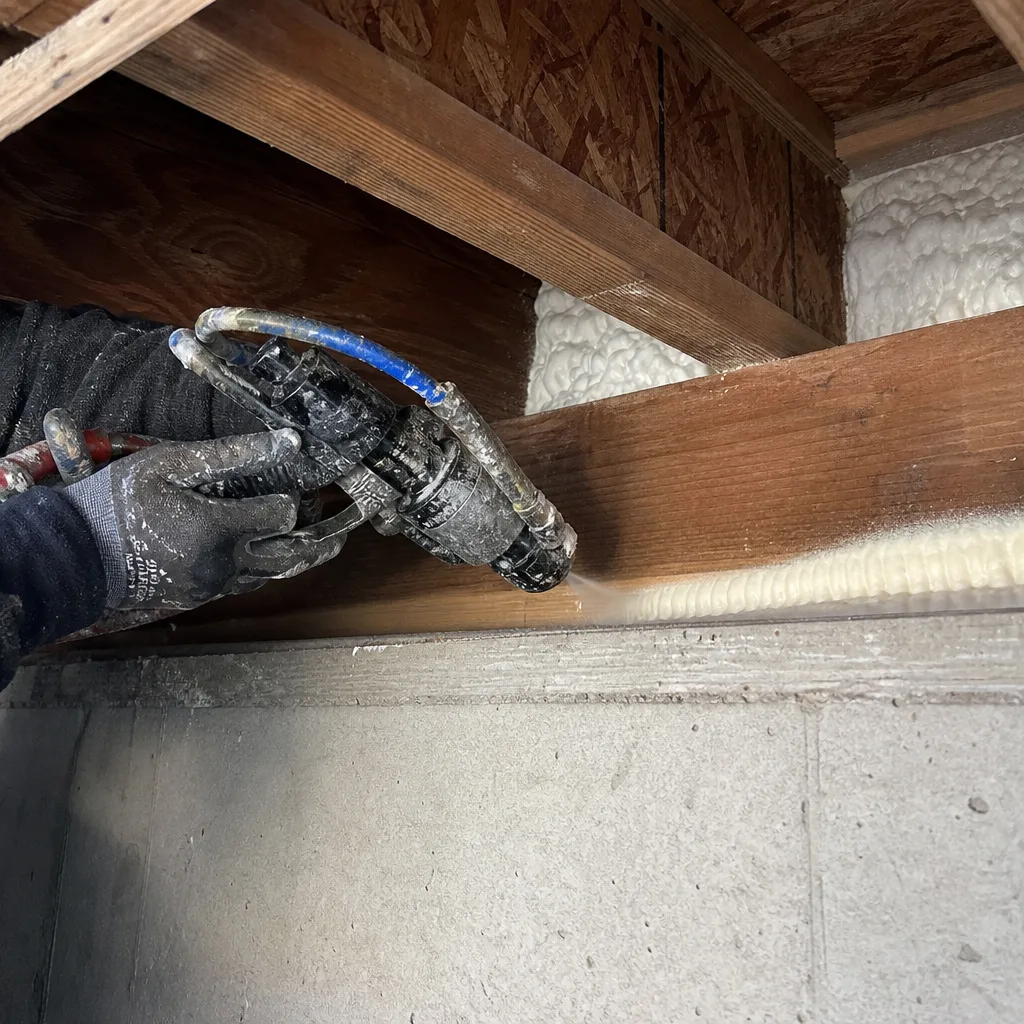
Our Spray Foam Insulation team handles everything from rim joists and garage ceilings to full roof deck retrofits. Valinda is one of the core areas we serve, and we know these houses.
Trusted Brands We Service in Valinda
We carry Icynene and Demilec spray foam lines because they’ve earned their place in the truck. Demilec’s closed-cell products perform consistently in dry inland heat, and Icynene’s open-cell formula is a workhorse for the roof deck retrofits common across Valinda. We also stock Johns Manville and CertainTeed fiberglass for hybrid approaches where a homeowner wants to combine spray foam at the roof line with blown-in coverage on the attic floor. The point is material choice, not brand loyalty. If your Valinda home needs a specific performance characteristic, like higher fire resistance or better sound dampening, we’ll steer you toward Rockwool mineral wool or another option that fits. No brand loyalty, just the best fit for the application.
Common Spray Foam Insulation Problems We See in Valinda Homes
- Baked-out original fiberglass batts. The inland sun has cooked the 50-year-old batts in most Valinda attics into flattened mats that no longer hold their rated R-value. Spray foam over a properly air-sealed surface is often the only way to recover without tearing out the entire attic.
- Undersized or missing soffit vents. Many low-slope roofs in Valinda were framed with narrow or non-existent soffit ventilation. Open-cell foam on the roof deck turns the attic into conditioned space, which sidesteps the ventilation problem entirely instead of fighting it.
- Santa Ana wind bypasses. The dry autumn winds exploit gaps around recessed lights, top plates, and plumbing penetrations. If those gaps aren’t sealed before the foam, the spray foam wraps a leaky envelope and you still feel drafts.
- Moisture trapped in shallow joist bays. Unvented, shallow attics in 1950s – 70s homes can trap condensation if open-cell foam is applied without checking the roof assembly. We verify the roof can dry before we commit to a material.
Pricing for Spray Foam Insulation in Valinda, CA
Here are the ranges we actually quote for Valinda work. Open-cell roof deck retrofits run $2.10 – $3.10 per board foot, which on a typical 1,200-square-foot attic means $3,400 – $5,300. Closed-cell runs $2.80 – $4.75 per board foot, and we typically recommend it for rim joists, garage ceilings with living space above, or any application where a vapor retarder is needed. Rim joist spray foam in a 1960s Valinda home usually lands between $900 and $1,800 depending on linear footage and access. Garage ceiling jobs run $1,200 – $2,400. Roof deck work on low-slope attics is the biggest cost driver because it’s slow, physically demanding work.
What affects your number: the size of the area, how much air-sealing is needed first, whether the old batts need removal or can stay in place, and which foam chemistry makes sense for the roof assembly. We give free written estimates for every Valinda home, and the number we quote is the number you pay. Call (866) 271-1602 to get on the schedule.
We Also Serve Cities Near Valinda
If you’re in Valinda or nearby, our crews cover the whole corridor. We regularly work in La Puente, West Covina, South San Jose Hills, and Hacienda Heights, so the roads, the building codes, and the tract layouts are familiar territory. Same team, same in-house standard whether the job is in 91744 or across the 60 freeway.
Serving Valinda, CA — Our Local Coverage Area
We’re based in the Valinda area and know this community well. Use the map below to see our service coverage — if you’re nearby, we can almost certainly help.
FAQs About Spray Foam Insulation in Valinda
Yes, and that’s actually one of the most common scenarios we handle in Valinda. When there are no soffit vents, the roof deck becomes the insulation plane and open-cell foam turns the attic into conditioned space, which protects the ducts and stops the attic heat from radiating into the rooms below. We verify the roof assembly can dry first. Call (866) 271-1602 and we’ll check your attic before recommending anything.
It depends on whether the batts are compressed and whether the air leaks are sealed. If the original fiberglass has been flattened by heat and the top plates are leaky, spraying foam on the roof deck after air-sealing can make a substantial difference, especially in the back bedrooms that bake all afternoon. If the batts are still in decent shape, we might recommend a different approach. Estimates are free, so we’ll tell you what we’d do at our own house.
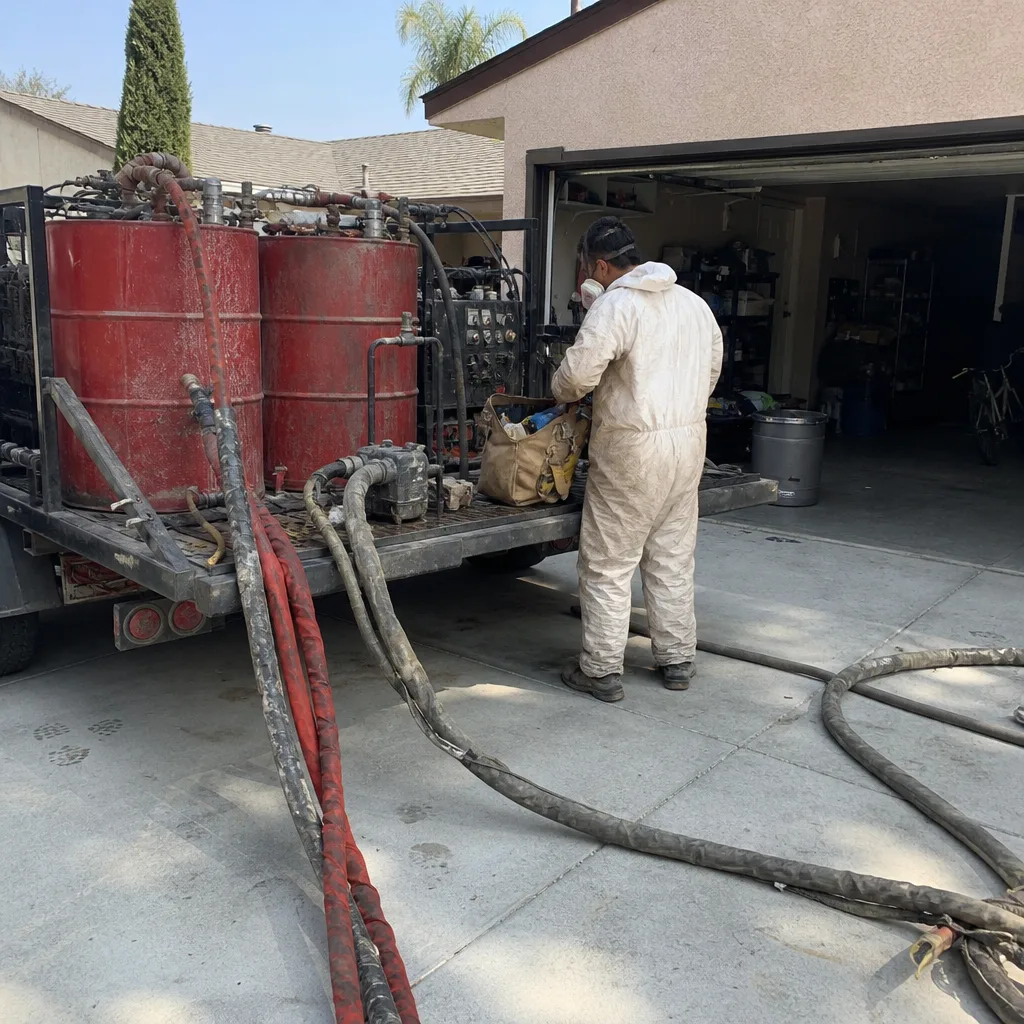
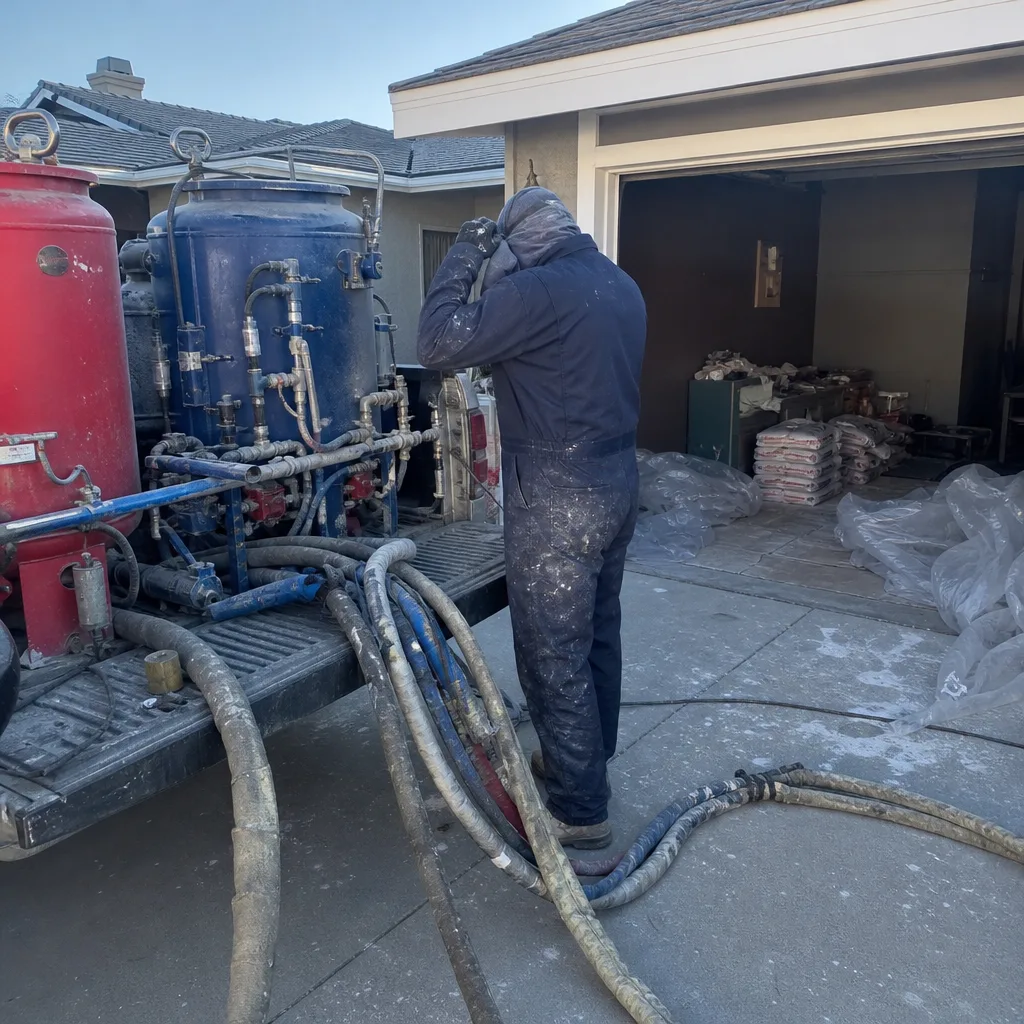
We send smaller-framed crew members into the tight spaces and stage the spray rig outside the hatch to keep hose runs short. It’s slower work than a tall attic, and we bid it accordingly, but it’s routine for us in Valinda. The bigger concern is protecting your ceiling below, so we mask and tarp everything before spraying.
Open-cell makes sense when the attic is shallow, unvented, and the primary goal is air-sealing plus a solid R-value at the roof line. Closed-cell makes sense when you need a vapor retarder or higher R-value per inch, like rim joists, or when moisture is a concern. For most Valinda roof deck retrofits, open-cell is the honest recommendation. For rim joists, closed-cell usually wins.
We use Icynene and Demilec spray foam, both of which we’re authorized to install and both of which hold up well in sustained inland heat. We also stock Johns Manville, CertainTeed, and other fiberglass lines for hybrid approaches. The brand is less important than the application, which is why we carry several options rather than pushing one. Call (866) 271-1602 and we’ll match the material to your house, not the other way around.
Written by Noel Arredondo, Owner at Fontana Insulation, serving Valinda and the San Gabriel Valley.