
Fast, Reliable Spray Foam Insulation Across El Segundo
Spray foam insulation in El Segundo costs between $2,100 and $5,800 for a typical attic or wall retrofit, depending on whether you go open-cell or closed-cell and how much old material has to come out first. Most jobs we schedule in the 90245 zip code get finished in one or two days. If you’re dealing with a drafty 1950s bungalow near Main Street or a Smoky Hollow home with balloon framing that’s been pulling damp air up from the crawlspace, call (866) 271-1602. We know exactly what your walls are doing, even when you can’t see it.
El Segundo’s marine layer changes the equation. Homes here don’t fail from extreme heat the way inland properties do. They fail from moisture. Our techs work these blocks constantly, and we’ve learned what holds up within a few hundred yards of the Pacific. That local experience matters more than any spec sheet.
Why Fontana Insulation Is El Segundo’s Preferred Spray Foam Insulation Company
Most insulation contractors in the South Bay push whichever brand they stock. We don’t work that way. Fontana Insulation carries eight nationally recognized brands across fiberglass, mineral wool, spray foam, and cellulose, so when we recommend closed-cell foam for your El Segundo attic, it’s because the application calls for it. Not because it’s the only thing on the truck. Noel Arredondo built the company around that material-agnostic approach, and it’s why remodelers and homeowners in El Segundo call us when another contractor’s bid feels more like a sales pitch than an assessment.
Our familiarity with El Segundo’s housing stock runs deep. The 1940s bungalows off Grand Avenue, the pre-war blocks near downtown, the newer infill near the aerospace corridor: each one presents different framing, different ventilation patterns, different failure points. We’ve foamed enough attics between Imperial Highway and the beach to know what’s behind the drywall before we cut into it. When you call (866) 271-1602, the person assessing your home understands that a shallow attic deck in El Segundo needs a different approach than a deep truss attic in Manhattan Beach.
We’re an authorized installer for Icynene and Demilec spray foam, two of the most performance-tested foam brands in North America. That matters when you’re sealing a balloon-framed cavity that runs three stories through salt air. We didn’t pick those brands by accident. We carry them because they earn their place in the lineup.
Closed Cell Spray Foam Insulation in El Segundo
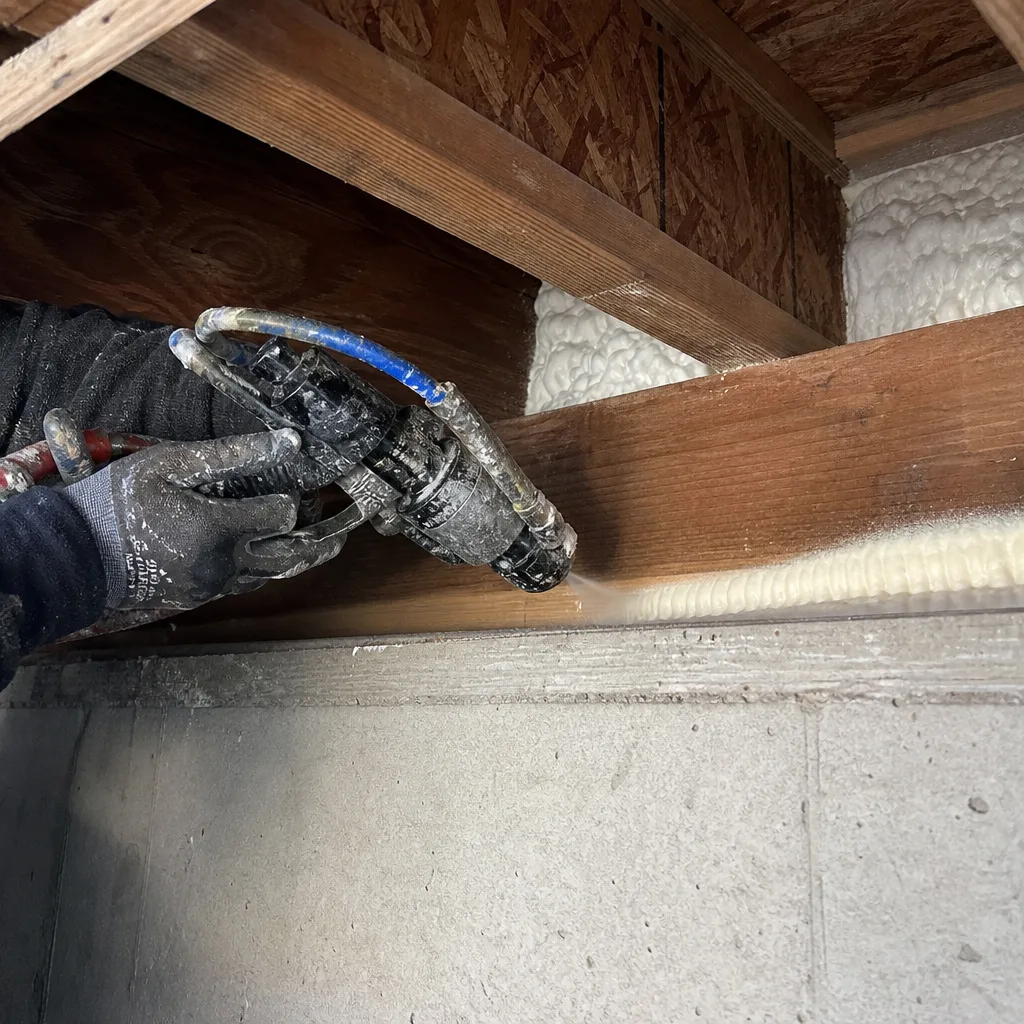
Closed Cell Spray Foam Insulation is the workhorse for El Segundo attics and rim joists because it acts as both an air barrier and a vapor retarder in a single application. Around here, where the marine layer pushes moisture into wall and roof cavities for half the year, that dual role is the difference between insulation that holds up for decades and insulation that quietly rots the framing. Closed-cell foam runs roughly $2,800 to $5,800 for a typical El Segundo attic retrofit, including removal of failed material.
Roof Deck Applications Near the Coast
We spray closed-cell directly to the underside of roof sheathing in El Segundo homes regularly. This moves the thermal boundary to the roofline and keeps the attic inside the conditioned envelope. The foam’s low vapor permeability stops marine-layer humidity from condensing against cold sheathing in winter.
Balloon-Framed Wall Cavities
In Smoky Hollow and the pre-war blocks near downtown El Segundo, open wall channels can run from foundation to attic with no fire blocking. We inject closed-cell in controlled lifts, letting each pass cure before the next goes in. That sequencing is deliberate and specific to this area’s framing, and skipping it is how you trap moisture behind a solid cured barrier.
Open Cell Spray Foam in El Segundo
Open Cell Spray Foam makes sense for El Segundo homeowners who want air sealing and acoustics without the closed-cell price tag. It expands aggressively, fills irregular framing cavities in older bungalows, and runs $2,100 to $4,200 for a typical attic application in the 90245 area. It’s vapor-permeable, which means it breathes. That’s fine in most of the South Bay’s climate zone. But in the fog belt, the wrong placement can create condensation inside the cavity.
Interior Wall and Sound Applications
When a homeowner on a tight lot near Sepulveda wants to cut noise from the neighbor’s HVAC, open-cell works well in interior partitions. It fills the stud bays completely, absorbs sound, and doesn’t require the vapor management that exterior walls do.
Where We Add a Vapor Retarder
Open-cell in a Smoky Hollow balloon-framed exterior wall needs a vapor retarder on the warm side of the assembly. Without it, marine-layer humidity migrates into the cavity and condenses against cooler surfaces. We specify this on a per-wall basis, not as a blanket rule. It’s one of the application-matching calls Noel Arredondo insists on.
Trusted Brands We Service in El Segundo
Fontana Insulation stocks and installs foam from Icynene and Demilec, along with fiberglass from Owens Corning and Johns Manville. For El Segundo homeowners, that means you’re not locked into one manufacturer’s chemistry. We can spec Icynene open-cell for an interior wall one day and Demilec closed-cell for a rim joist the next. Spray Foam Insulation is a material category where brand differences affect real-world performance in salt air, so we carry what holds up, and we’ll tell you why we’re recommending one over the other for your specific framing.
Common Spray Foam Insulation Problems We See in El Segundo Homes
- Balloon-framed walls pulling damp air from the crawlspace. Smoky Hollow and pre-war downtown homes often have open channels that run the full height of the house. Marine air moves through them constantly, and a single thick pass of foam can seal that moisture into the wall instead of stopping it.
- Closed-cell applied too thick on shallow 1940s attic decks. Passes over two inches in one lift generate heat during curing. On thin sheathing and tight rafter bays common in El Segundo bungalows, that heat can damage the deck and trap condensation against the underside.
- Open-cell in exterior walls without vapor management. Fog-belt humidity moves through vapor-permeable foam and reaches the cool sheathing. The result is a damp cavity that smells like a wet basement and eventually grows mold on the framing.
- Spray foam over old, compressed fiberglass. We find this constantly near the beach. The original fiberglass has sagged into mildew-smelling clumps, and foaming over it locks the smell and salt-damp debris in permanently. It has to come out first.
Pricing for Spray Foam Insulation in El Segundo, CA
Attic spray foam in El Segundo ranges from $2,100 to $5,800 depending on material, square footage, and how much failed insulation has to be removed before we start. Closed-cell runs higher because the material costs more per board foot and the preparation is more involved. Rim joist work typically lands between $900 and $1,800 for a crawlspace perimeter. Garage ceiling foam on a detached El Segundo garage usually falls in the $1,200 to $2,400 range. These are real ranges for this market, not national averages. Every estimate comes with a written scope. Call (866) 271-1602 and Noel Arredondo or one of our techs will assess the space and give you an exact number before any work begins.
We Also Serve Cities Near El Segundo
Our Spray Foam Insulation in El Segundo crew handles the surrounding South Bay communities regularly. We’re on the road into Lennox, Del Aire, Hawthorne, and Marina del Rey most weeks, and the same coastal moisture and framing issues that show up in El Segundo show up there in slightly different forms. If you’re within a few miles of the 90245 boundary, you’re in our service radius.
Serving El Segundo, CA — Our Local Coverage Area
We’re based in the El Segundo area and know this community well. Use the map below to see our service coverage — if you’re nearby, we can almost certainly help.
FAQs About Spray Foam Insulation in El Segundo
Yes, spray foam works in balloon-framed homes, but the application has to be sequenced differently than it would be in a modern stud wall. We inject foam in controlled lifts, letting each layer cure before the next goes in. That prevents the exothermic heat buildup that can warp thin 1940s sheathing and it stops marine-layer moisture from getting trapped behind a solid cured barrier. This is the single most important variable for older El Segundo homes. Call (866) 271-1602 for an assessment of your specific framing.
Salt air doesn’t degrade spray foam the way it degrades metal, but the moisture it carries is the real problem. The marine layer pushes humid air into wall and attic cavities for months at a time. Closed-cell foam handles this well because it’s a vapor retarder; open-cell needs a vapor retarder added when placed in exterior walls. Either way, the foam itself has to be installed over clean, dry framing, not over old insulation that’s been sitting in salt-damp conditions for decades.
Closed-cell is the right call for most El Segundo attics because it’s an air barrier and a vapor retarder in one. That matters in a fog belt where roof sheathing stays damp for weeks. Closed-cell also adds structural rigidity to old rafters. Open-cell is cheaper and works well for interior sound control, but in an exterior attic assembly exposed to marine moisture, closed-cell is the safer long-term spec. We’ll explain the trade-off in your home specifically rather than defaulting to one product.
Yes. Detached garages and workshops are common on El Segundo’s tight lots, and we spray garage ceilings and walls as standalone jobs all the time. These structures often have no ventilation to speak of and sit right at grade level where damp air collects. Closed-cell on the roof deck turns them into usable space without adding framing. A detached garage ceiling in El Segundo typically runs $1,200 to $2,400. We’ll give you an exact figure before starting.
We stock and install Icynene and Demilec spray foam products. Both are performance-tested open-cell and closed-cell formulations, and we’re an authorized installer for each. The choice between them depends on your framing, your moisture exposure, and your budget. Since we carry both brands plus fiberglass and mineral wool options, the recommendation you get is driven by your attic or walls, not by what we have in inventory. Call (866) 271-1602 and we’ll walk you through it.
Written by Noel Arredondo, Owner at Fontana Insulation, serving El Segundo and the South Bay with material-agnostic insulation since day one.