
Fast, Reliable Spray Foam Insulation Across Corona
Spray foam insulation in Corona typically costs $2,200 – $5,800 for a full attic or wall application, with rim joist jobs running $900 – $2,400. Most Corona homes we service were built between 1980 and 2005 with insulation that was marginal on day one and has only degraded since. We’re based in Fontana and drive into Corona regularly for both tract homes and the larger acreage properties in Horsethief Canyon and Eagle Glen. Call (866) 271-1602 and we’ll give you a straight answer on what your house needs, not a pitch for whatever foam we happen to overstock.
We carry open-cell and closed-cell foam from Icynene and Demilec, plus Rockwool mineral wool for fire-rated assemblies and sound control. The right material depends on your attic’s pitch, your walls’ depth, and what the last thirty years of Riverside County summers have done to your existing insulation. If you’re in Corona and tired of rooms that never cool down, this page explains what we do and what it costs.
Why Fontana Insulation Is Corona’s Preferred Spray Foam Insulation Company
Noel Arredondo built Fontana Insulation as a material-agnostic operation. We don’t push one foam brand because we only stock one. We carry eight brands across fiberglass, mineral wool, spray foam, and cellulose, so the conversation starts with your home’s actual problem, not our inventory sheet. When a Corona homeowner calls about a west-facing attic that bakes all afternoon, we walk them through closed-cell foam against air sealing, radiant barriers, and whether their existing R-19 batts are even worth keeping. That honest trade-off discussion is why remodelers in the area keep our number.
Corona specifically presents a set of conditions we know well. The tract developments in Sierra Del Oro and Chase Ranch were built fast, with R-13 walls and R-19 attics that met code in 1995 but are laughably thin by Title 24 standards today. Pile on three decades of HVAC techs crawling through attics, crushing batts, and shifting coverage, and you get hot spots that defy any quick fix. Our crews have worked through enough of these attics to know what they’ll find before the ladder goes up. That’s the local knowledge that saves you time and keeps the job to one trip.
Spray Foam Wall Insulation in Corona
Spray Foam Wall Insulation in Corona usually means retrofitting 2×4 or 2×6 walls in older tract homes, or insulating the steel-framed walls of detached workshops and garages that bake in the inland heat. The job involves drilling access holes, air sealing every penetration and seam, then injecting open-cell or closed-cell foam to fill the cavity completely. Unlike batt insulation that sags and leaves gaps, foam creates a continuous thermal and air barrier. For a typical 1,500 sq ft ranch in the 92882 zip, expect $2,400 – $4,600 depending on wall depth and whether we’re working from the interior or exterior.
Detached Workshops and Heavy-Duty Structures
Corona’s acreage properties in Horsethief Canyon and the Temescal Valley often have detached workshops, RV garages, and bonus rooms that were never insulated properly, if at all. These spaces have heavy-duty doors, oversized openers, and metal or thin-wall framing that conducts heat aggressively. Closed-cell foam works well here because it adds structural rigidity while sealing every seam. A self-reliant homeowner who wants the workshop usable in August needs a thermal envelope that holds, and that means foam applied after meticulous air sealing.
When Wall Insulation Fails
The failure pattern we see most in Corona is slow, invisible heat gain through wall cavities that were either under-insulated or have batt insulation that slumped over decades. Rooms on the west side of the house, especially those facing the afternoon sun in neighborhoods like Eagle Glen, become 10 – 15°F hotter than the rest of the house. Spray foam fixes this by filling the cavity completely and stopping air movement, not just slowing conduction. If you’re running a second AC unit or a portable cooler in a room, wall insulation is usually the root cause.
Rim Joist Spray Foam in Corona
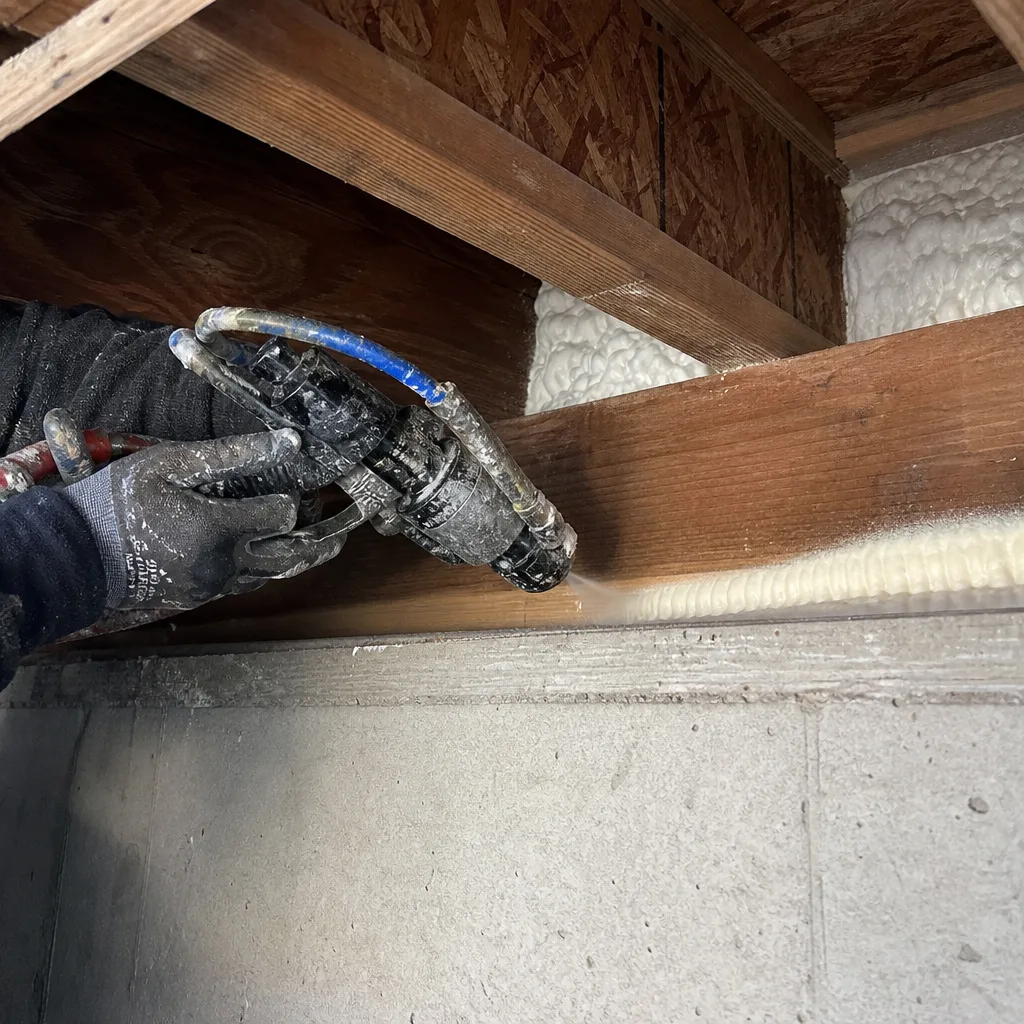
Rim Joist Spray Foam in Corona targets the junction between your foundation and your first floor, the point where outside air leaks in through a dozen small gaps the builder never sealed. In a 1980s tract home in the 92880 area, the rim joist is often nothing more than a piece of plywood with fiberglass stuffed loosely behind it. Corona’s hot, dry air pushes through those gaps all summer, and during wildfire smoke season, so does everything in the air. Sealing and insulating the rim joist with closed-cell foam costs $900 – $2,400 for a typical single-story home and makes a surprising difference in both comfort and indoor air quality.
Air Sealing Before Foam, Every Time
We refuse to spray foam over an unsealed rim joist. It’s a waste of material and it traps moisture where you don’t want it. The right sequence is to remove whatever loose fiberglass is there, air seal every penetration (electrical, plumbing, HVAC line sets) with a sealant, then apply closed-cell foam in a continuous band. In Corona’s semi-arid climate, this also stops dust and smoke infiltration that’s common during Santa Ana wind events. A properly sealed rim joist is one of the highest ROI insulation upgrades we do.
Workshops and Garage Ceilings
For Corona homeowners with a detached workshop or an oversized garage, the rim joist is often missed entirely because the space wasn’t designed for year-round use. But if you’re running power tools out there or keeping a second fridge, the thermal boundary matters. We spray the rim joists and the garage ceiling deck together, usually closed-cell Demilec foam, to create one continuous envelope. It’s the same principle we apply to full homes, just scaled to a structure where the heat gain is even more intense because the building has no shade and no thermal mass.
Trusted Brands We Service in Corona
We carry Icynene and Demilec spray foam because they’re two of the most performance-tested brands in North America, and we carry Rockwool for Corona jobs where fire resistance and sound dampening matter more than an R-value chase. If a homeowner wants mineral wool in a garage ceiling instead of foam, we can do that. If they want CertainTeed fiberglass in a wall cavity where foam isn’t practical, we can do that too. Carrying competing brands at every price tier means our recommendation matches your budget and your problem, not what’s cheapest for us to stock. Corona customers see the same brand selection as our Fontana clients, and we keep material on hand for quick turnarounds in Riverside County.
Common Spray Foam Insulation Problems We See in Corona Homes
- Foam sprayed over settled or disturbed builder-grade insulation. In Chase Ranch and Horsethief Canyon, decades of HVAC service calls have crushed R-19 batts and shifted them around the attic floor. If you spray foam directly over that mess, you get an uneven thermal layer with hidden voids. We remove or air seal around the existing insulation first, then apply foam to the actual envelope surface.
- Air sealing skipped before spraying. Foam is only as good as the seal around it. In Corona’s summer heat, gaps around rim joists, can lights, and plumbing penetrations let hot air and wildfire smoke bypass the foam entirely. Any contractor who sprays without sealing first is selling you half a job.
- Foam applied too thick in shallow roof pitches. A lot of Corona tract homes have low-slope roofs with limited attic clearance. Applying closed-cell foam too aggressively traps moisture inside the assembly, which leads to condensation and sheathing damage. The correct technique in a shallow pitch is multiple thin passes, allowing each layer to cure properly before the next.
- Low-quality foam off-gassing in high-temperature attics. Corona attics regularly hit 150°F in July and August. Cheap foams can off-gas and leave a lingering chemical odor for weeks. Icynene and Demilec foams are formulated to cure cleanly even in high heat, which is why we stock them exclusively for spray applications.
Pricing for Spray Foam Insulation in Corona, CA
Here’s what we tell Corona homeowners when they ask about cost. A full attic spray foam job (open-cell) on a 1,200 – 2,000 sq ft home runs $2,200 – $4,500. Closed-cell attic work typically runs $3,500 – $5,800 because the material cost per board foot is higher and the application is slower. Rim joist sealing and insulation for a single-story tract home is $900 – $2,400. Wall cavity spray foam retrofits land at $2,400 – $4,600 for an average ranch. Detached workshops and garage ceiling jobs in Sierra Del Oro or the Temescal Valley run $1,800 – $4,200 depending on square footage and whether we’re doing the rim joists too. Every quote includes air sealing; that’s not a line item, it’s part of doing the job right. Call (866) 271-1602 for a walkthrough and a written estimate. Free estimates, no obligation, and we’ll tell you if your money is better spent on a different material.
We Also Serve Cities Near Corona
Our crews run routes through Home Gardens, El Cerrito Corona, Eastvale, and Norco on a regular schedule. If you’re in one of those communities, call us at (866) 271-1602 and we’ll slot you into the next available trip. We handle everything from rim joist sealing to full attics to detached workshops in this corridor. You can also read more about our full Spray Foam Insulation lineup or explore our work across Corona and the surrounding neighborhoods.
Serving Corona, CA — Our Local Coverage Area
We’re based in the Corona area and know this community well. Use the map below to see our service coverage — if you’re nearby, we can almost certainly help.
FAQs About Spray Foam Insulation in Corona
Spray foam helps by creating a continuous air seal that stops both conductive heat and air movement through your attic, walls, and rim joists. In Corona’s climate, where July and August push attic temperatures past 150°F, closed-cell foam combined with air sealing keeps that heat out of your living space. When wildfire smoke settles over the 92883 and 92877 areas, a properly sealed envelope also prevents smoke from being pulled indoors through attic and rim joist gaps. Call us at (866) 271-1602 to talk about your specific house, estimates are free.
No, not directly. Spraying foam over settled or disturbed builder-grade insulation creates an uneven thermal barrier and traps the old material in place, hot spots and all. The right approach in Chase Ranch and Horsethief Canyon is to assess the existing insulation, air seal the attic floor and penetrations, then either remove the old batts and spray the proper surface or apply foam to the roofline if you’re converting to a conditioned attic. We’ll tell you which route makes sense for your home. Reach us at (866) 271-1602 for an inspection.
Closed-cell foam is almost always the right answer for detached workshops, RV garages, and barn structures in Corona. It seals tightly around steel framing and heavy-duty door openings, adds structural rigidity to thin-wall construction, and performs far better than open-cell in high-temperature structures that get direct afternoon sun. We recommend Icynene or Demilec closed-cell for these jobs. For an exact recommendation and a quote specific to your workshop, call us at (866) 271-1602.
Shallow roof pitches and unvented attics require a different spray technique and often a different foam. In a low-slope Corona attic, we apply closed-cell foam in thin passes directly to the roof deck, creating a conditioned attic space that doesn’t rely on venting. This prevents the condensation problems that plague unvented attics in semi-arid climates when insulation is installed incorrectly. The key is patience and multiple curing passes, not spraying as thick as possible in one go. Call (866) 271-1602 and we’ll inspect your roof pitch before recommending anything.
Yes, spray foam and radiant barriers actually work well together in Corona’s high solar gain environment. A radiant barrier on the underside of the roof deck reflects radiant heat away from the attic, while spray foam handles conductive heat and air movement. For west-facing attics in neighborhoods like Eagle Glen that bake all afternoon, combining a radiant barrier with open-cell foam on the attic floor or closed-cell on the roofline gives you two different heat rejection mechanisms. We can discuss whether your home would benefit from both during a free walkthrough, call (866) 271-1602.
Written by Noel Arredondo, Owner at Fontana Insulation, serving Corona and the Inland Empire.