
Fast, Reliable Spray Foam Insulation Across Venice
Spray foam insulation in Venice, CA typically runs $2,400 – $8,200 for a full wall cavity application on a 1,200 – 1,600 sq ft bungalow, with rim joist work priced separately at $1,500 – $2,800. Most Venice jobs are completed in one to two days, and closed-cell foam acts as both the air seal and the vapor barrier this marine-layer climate demands. We work on walk streets, canal-side lots, and the raised-foundation bungalows that define this city. Call (866) 271-1602 for a free Venice-specific estimate.
Why Fontana Insulation Is Venice’s Preferred Spray Foam Insulation Company
Venice homes are not the same as Santa Monica condos or Culver City slab-on-grade houses. The housing stock here runs old, raised, and unvented, which means the person spraying foam needs to understand what happens when marine air hits a 1940s plaster wall at 58 degrees. Our team has worked through enough Venice bungalows to know exactly where the moisture traps live. Noel Arredondo has walked crawlspaces under Oakwood duplexes, canal-side cottages near Dell Avenue, and walk street bungalows off Abbot Kinney. That matters because every one of those homes ages differently.
We carry Icynene and Demilec spray foam, two of the most performance-tested foam brands in North America, alongside Rockwool, Johns Manville, CertainTeed, Knauf, and others. That means when we say closed-cell is the right call for your wall cavity, it’s because the house needs it, not because it’s the only product we stock. Venice customers keep our number because the recommendation actually matches the structure.
Spray Foam Wall Insulation in Venice
Spray foam wall insulation in Venice is the job we run most often on the 1920s – 1950s bungalows and canal-side cottages that dominate this city’s housing stock. These homes were built with empty wall cavities or, at best, a thin layer of something that has long since settled. The work involves opening interior or exterior access to the stud bays, removing any failed material, addressing wiring and penetrations, then applying foam at the proper depth for the cavity. For unvented wall assemblies in Venice, closed-cell foam at roughly 2 – 3 inches delivers both an air seal and a vapor barrier, which matters more than raw R-value when the marine layer sits against your drywall every night.
Closed-Cell for Unvented Cottages
On a 1940s canal-side cottage with no vapor barrier, open-cell foam is often the wrong product. Open-cell lets moisture pass through it, and when there’s no venting and no vapor barrier, that moisture lands on the back of the drywall and blisters paint within a season. Closed-cell Icynene or Demilec stops that cycle. It’s not about filling the cavity to the brim. It’s about putting a moisture-impermeable layer exactly where the dew point hits.
Wall Cavity Retrofit Process
We typically access wall cavities through the interior plaster or drywall, pull out whatever the previous owner left in there, air-seal all penetrations, and then spray. In raised Venice bungalows, we check the rim joist area at the same time since air moving through it feeds moisture into the wall system above. A standard wall-retrofit on a 1,200 sq ft bungalow in Venice runs $2,600 – $5,400 depending on access and cavity depth.
Rim Joist Spray Foam in Venice
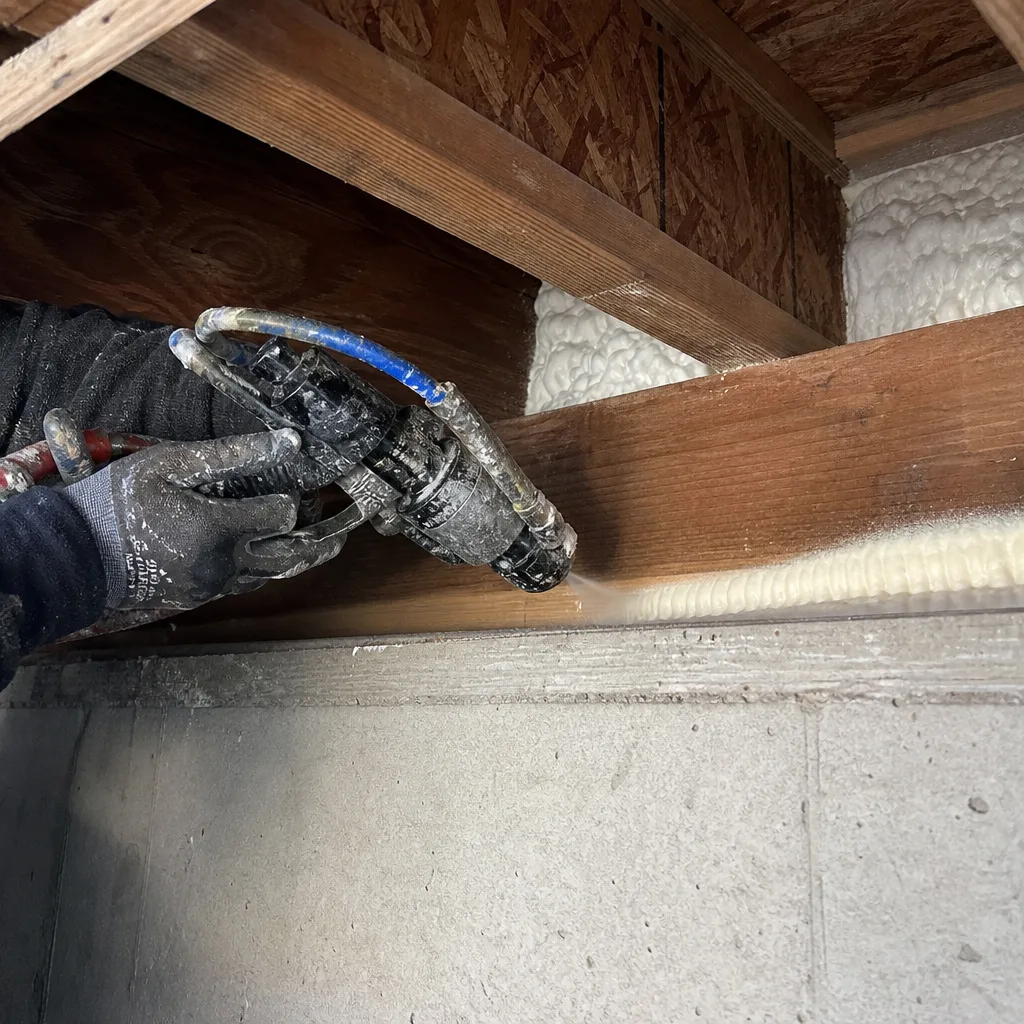
Rim joist spray foam in Venice is one of the highest-return insulation jobs a raised-foundation homeowner can do. The rim joist is the perimeter band where your floor framing meets the foundation. On the 1920s and 1930s bungalows in the President’s Row neighborhood or the duplexes off Rose Avenue, that band was never sealed. Cool, damp overnight air moves into the floor system, condenses against the subfloor, and feeds the musty smell you notice in the winter. For these homes, closed-cell foam applied at 2 inches across each rim bay seals out air and blocks that condensation path. Typical rim joist spray foam in Venice runs $1,500 – $2,800 for a standard raised bungalow.
Why Raised Foundation Homes Leak Air
Venice has thousands of homes on raised foundations. The crawlspace air under those floors is cool and damp for much of the year. When warm interior air meets the cold rim band, condensation forms inside the floor cavity. Unsealed rim joists also pull outside air into the home every time the wind picks up off the Pacific. We seal the rim bays from inside the crawlspace or through the basement where accessible, and the difference shows up as drier floors and fewer musty smells.
Rim Joists Plus Wall Cavities
We frequently bundle rim joist sealing with wall cavity spray foam because the two systems interact. A wall retrofit without rim work leaves the lower thermal boundary open, and air migration keeps pulling moisture into the wall above. Bundle pricing for rim plus wall on a Venice bungalow typically lands between $4,000 and $7,000 total. It’s the most complete air-sealing scope for these older homes.
Trusted Brands We Service in Venice
The brand matters less than the chemistry, but we stock Icynene and Demilec because both run consistent, performance-tested closed-cell formulations that hold up in coastal moisture conditions. For Venice attics we also pull from Rockwool when fire resistance and sound control matter, and Knauf or CertainTeed when a hybrid approach fits better. Since we stock eight insulation brands across four material categories, we’re not married to one product. That means your recommendation is driven by your wall cavity, your foundation, and your budget, not by what’s sitting in our warehouse with a sales quota attached. Spray Foam Insulation is one part of our broader material-agnostic practice.
Common Spray Foam Insulation Problems We See in Venice Homes
- Moisture trapping in unvented wall cavities. In canal-side cottages and walk street bungalows built without attic or wall venting, open-cell foam sprayed into the stud bays wicks marine-layer moisture and blisters interior paint, usually within the first damp season. The fix is closed-cell foam applied as both the air seal and vapor barrier.
- Foam installed over original knob-and-tube wiring. Many 1920s – 1950s Venice bungalows still carry knob-and-tube conductors. Spraying foam directly over live legacy wiring traps heat against aging insulation and creates a fire hazard. The wiring must be decommissioned or rerouted before foam goes in, and we flag this on every pre-1925 home we quote.
- Unsealed rim joists on raised foundations. Raised bungalows throughout Venice let cool, damp crawlspace air migrate up into the floor system. Homeowners notice cold floors the first night the marine layer rolls in, and sometimes subfloor condensation. Closed-cell foam on the rim bays ends both problems.
- West-facing wall heat gain with no radiant control. Rooms facing the ocean get a strong afternoon sun load, and original Venice cottages have no radiant barrier and thin walls. Closed-cell foam in west-facing wall cavities measurably cuts that afternoon heat transfer, especially on flat-roof remodels with large glass facing the water.
Pricing for Spray Foam Insulation in Venice, CA
We Also Serve Cities Near Venice
Beyond Venice, our crews cover Santa Monica, Culver City, Ladera Heights, and Century City, with the same local attention to legacy housing and marine-layer moisture. Each of those cities has its own mix of postwar construction and modern remodels, and we quote each one based on the actual structure, not a zip code average.
Serving Venice, CA — Our Local Coverage Area
We’re based in the Venice area and know this community well. Use the map below to see our service coverage — if you’re nearby, we can almost certainly help.
FAQs About Spray Foam Insulation in Venice
Because Venice’s persistent marine layer keeps unvented wall cavities near dew point for much of the year, so any insulation that lets vapor through will eventually wet the back of the drywall. Closed-cell spray foam solves this by acting as the vapor barrier the original builders never installed. It’s a moisture fix first and an R-value upgrade second. Call (866) 271-1602 if your cottage smells musty after damp nights.
No, and no reputable contractor should. Foam traps heat against aging conductors and creates a fire hazard. The wiring has to be decommissioned and replaced before foam goes into those wall cavities. We inspect for knob-and-tube on every pre-1925 Venice home and include any necessary remediation in the quote.
Yes, with the right foam. Closed-cell spray foam acts as its own vapor barrier and does not require venting the way fiberglass or open-cell does. On unvented canal-side and walk street cottages, closed-cell Icynene or Demilec at 2 – 3 inches is the material we recommend specifically because it handles moisture without needing airflow the house doesn’t have. Call (866) 271-1602 and we’ll walk your specific cottage.
Rim joists on raised bungalows are the most common unsealed air path we find in Venice. Sealing them with closed-cell foam stops moist crawlspace air from condensing on the subfloor and ends the cold-floor problem in winter. It’s typically a one-day job and runs $1,500 – $2,800 for a standard raised home.
Yes. Closed-cell foam in west-facing wall cavities reduces the heat that conducts through the wall during afternoon sun, and it works even better when combined with a radiant-barrier layer on the attic-side of the assembly. On remodeled flats with large west glass, wall and roof deck foam together make a measurable difference in afternoon room temperature.
Get a Free Venice Spray Foam Estimate
If your Venice bungalow has cold floors, peeling paint by the windows, or a musty smell that comes and goes with the marine layer, the problem is usually air and moisture movement, not just missing insulation. We’ll inspect the wall cavities, rim joists, and any legacy wiring before recommending a material. Our team is led by Noel Arredondo, and every quote is based on the actual structure, not a generic spec sheet. Call (866) 271-1602 for a free estimate in Venice, 90291 and 90294.
Written by Noel Arredondo, Owner at Fontana Insulation, serving Venice and the westside since day one.