
Fast, Reliable Spray Foam Insulation Across South San Jose Hills
Spray foam insulation in South San Jose Hills usually runs from $2.50 to $6.00 per board foot for open-cell and $3.50 to $7.50 per board foot for closed-cell, depending on depth and access. Most homes in the 91792 zip code have 1960s and 70s ranch attics where the low-side roof deck is too shallow for standard batt work, which is exactly why foam makes sense here. Our crew knows the tight sloped lots, the knee walls, and the places where old R-11 fiberglass got compressed to almost nothing over the decades. If you’re dealing with a hot upstairs or a drafty rim joist, call us at (866) 271-1602 for a straight answer and a free estimate.
Why Fontana Insulation Is South San Jose Hills’s Preferred Spray Foam Insulation Company
South San Jose Hills homes are not like the flat-lot tract houses in West Covina or Rowland Heights. The grading here runs steep, so attics often have one side with workable headroom and another side where the roofline drops to a crawl. That changes how insulation gets installed. Our crews have worked these hillside tracts enough to know that a standard batt chart rarely works on a 1968 ranch with a partial cathedral ceiling and a low eave that traps heat. We measure the cavity, not the square footage, then match the foam type to what the space actually needs.
Noel Arredondo runs our team, and his approach is simple: carry the right materials from the start and don’t make a homeowner pay for something they don’t need. That’s why we stock open-cell and closed-cell spray foam from Icynene and Demilec alongside fiberglass and mineral wool options. When a South San Jose Hills attic needs air-sealing more than raw R-value, we say so. When a rim joist needs closed-cell for moisture control, we recommend that. The recommendation is driven by the house, not by what we have the most of in the truck.
We also work directly with homeowners and remodelers in the 91792 zip code who have had insulation disturbed by roof replacements or whole-house fan installs. That’s the trigger for a lot of the spray foam work we do up here. You call, we come out, we look at the actual attic, and we give you a number that covers the work. No subcontractors, no material games.
Spray Foam Wall Insulation in South San Jose Hills
Spray Foam Wall Insulation in South San Jose Hills is typically a solution for exterior walls that were never insulated to begin with, or walls that lost their original fiberglass to settling and rodent damage over 50-plus years. On the 1970s stucco ranch homes common in the 91792 tract, exterior walls were often built with minimal or no cavity insulation, and once the drywall is open for a remodel, foam is the fastest way to bring the wall to a proper air barrier. Homeowners doing kitchen or bath remodels behind Nogales High School often call us at that exact stage, because the wall is already open and the opportunity is right there. Expect to pay around $2.50 to $4.50 per board foot for open-cell in wall cavities and $3.50 to $6.00 per board foot for closed-cell where moisture could be a concern.
When Open-Cell Makes Sense in South San Jose Hills Walls
Open-cell spray foam fills a standard 2×4 or 2×6 stud bay completely, expands to seal every gap around electrical boxes and plumbing, and adds R-value while doubling as an air barrier. For interior walls or non-moisture-facing exterior walls in dry San Gabriel Valley conditions, it’s often the practical choice. It’s also less expensive than closed-cell, which matters on a full-house wall job.
Closed-Cell for Garage and Band Areas
Closed-cell adds structural rigidity and resists moisture, which makes it a stronger candidate for garage walls, rim joists, and the lower portions of exterior walls on sloped lots where drainage runs toward the foundation. On hillside homes in South San Jose Hills, we see enough runoff and soil-side moisture against lower wall plates that closed-cell earns its cost.
Rim Joist Spray Foam in South San Jose Hills
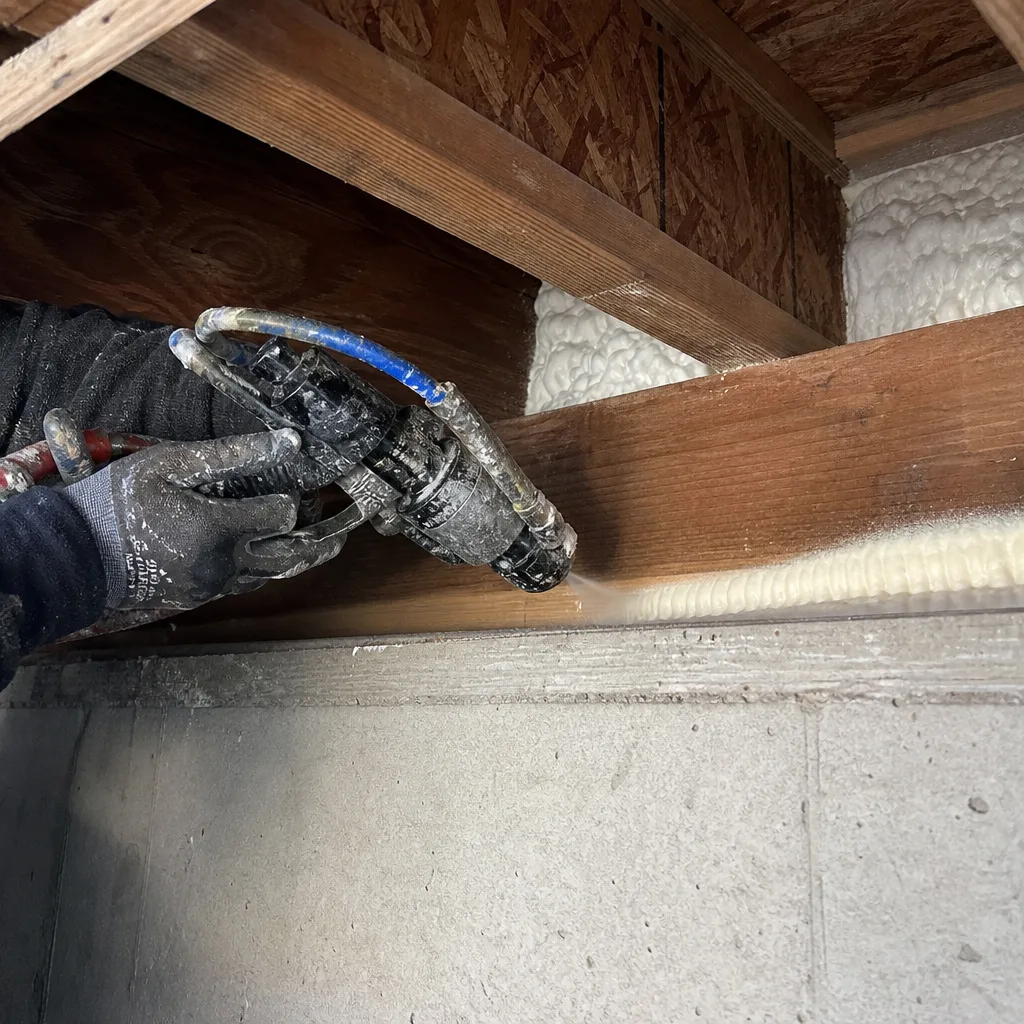
Rim Joist Spray Foam in South San Jose Hills is one of the most reliable upgrades for older ranch homes, because the rim joist, which is the band of framing where the floor meets the foundation, was almost never insulated when these houses were built in the 60s and 70s. On a cold winter morning, or during a hot Santa Ana stretch, those rim joist bays leak outdoor air directly into the floor system. Spray foam seals the entire bay in one pass, including the hard-to-reach edges that fiberglass batts can’t cover. Most rim joist jobs in the 91792 area run from $1,500 to $3,200 for a typical single-story home, depending on how many linear feet of rim are exposed and accessible from the crawl space or basement side.
Why Batts Fail at the Rim
Fiberglass batts cut to fit a rim joist leave gaps at the framing edges, and those gaps are exactly where heat moves. Dust, humidity, and pest activity also degrade batt material in the crawl space. Closed-cell spray foam adheres to the wood, stops air movement, and eliminates condensation against the rim board, which matters more on sloped South San Jose Hills lots where crawl spaces can hold more soil humidity than the homes on flatter ground in West Covina.
Santa Ana Winds and Rim Joist Air Movement
The dry northeast winds that hit the San Gabriel Valley every fall push outside air through rim joist gaps hard enough that homeowners notice floor drafts and dust build-up. Sealing the rim with two inches of closed-cell foam eliminates that pathway and also helps keep the first floor noticeably more stable in temperature, which a lot of people in South San Jose Hills mention after the work is done.
Trusted Brands We Service in South San Jose Hills
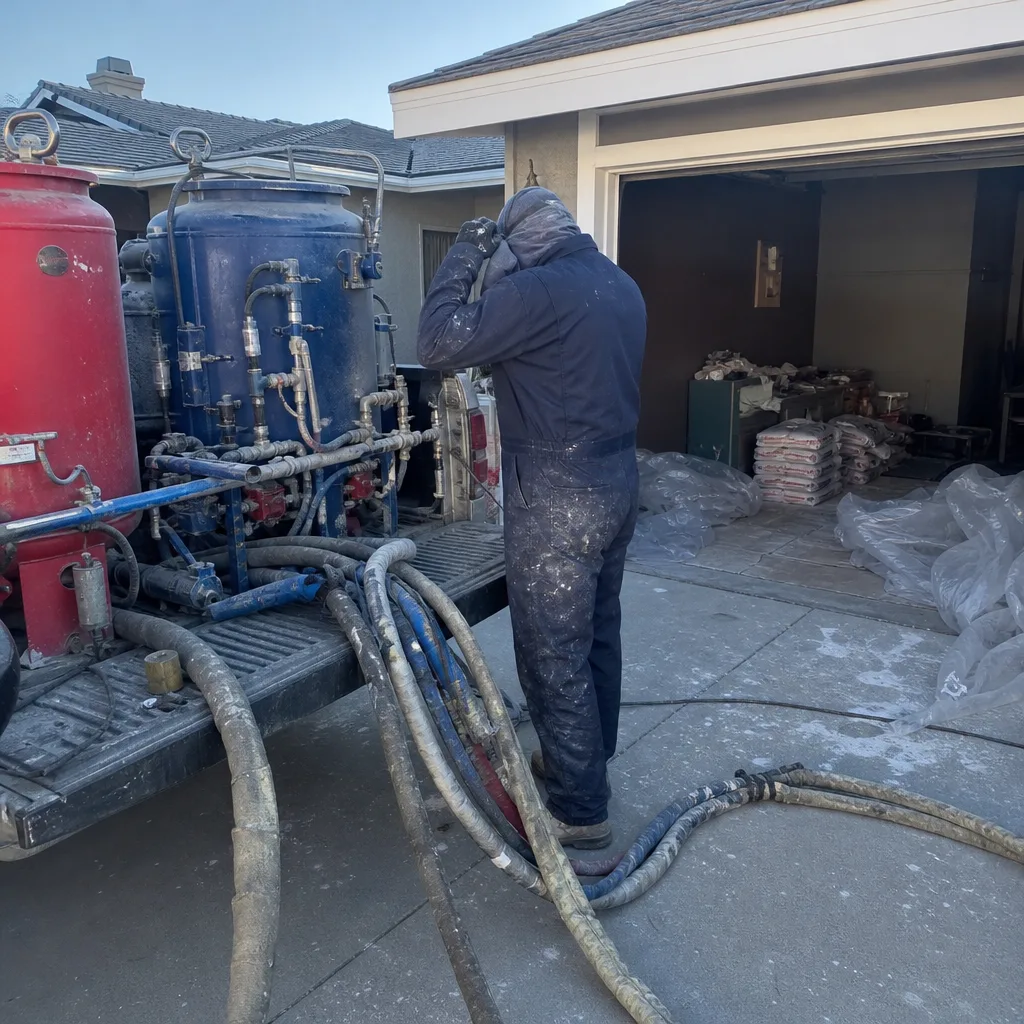
We carry Icynene and Demilec spray foam because those two brands have the longest performance testing in the industry, and they give South San Jose Hills homeowners a choice between open-cell and closed-cell systems that genuinely hold up. For homes where the conversation turns to mineral wool, we stock Rockwool right alongside the foam, because some attics and walls in this area benefit from fire resistance and sound-dampening more than air sealing. We also carry CertainTeed and Johns Manville fiberglass for projects where the budget or the building structure calls for batt work. The point is that no brand loyalty drives the recommendation. The house drives it. Call (866) 271-1602 and we’ll explain the trade-offs in plain language, not a sales deck.
Common Spray Foam Insulation Problems We See in South San Jose Hills Homes
- Crushed batts at the low-side eave. On the shallow side of a hillside roof, there’s often less than 6 inches of clearance, and the original R-11 or R-13 fiberglass gets compressed flat after decades of gravity and roof work. Spray foam is the only material that fits that cavity and actually insulates it.
- Gaps after tile roof replacement. A tile roof replacement tears off the underlayment and disturbs whatever insulation was touching the roof deck. Homeowners behind Nogales High School routinely call us right after the roofer leaves, because the attic suddenly lost its seal and the house heats up faster.
- Whole-house fan bypasses. A homeowner-installed fan cut into the ceiling without sealing the surrounding framing leaves a permanent hole for attic air to pull down. Foam sealing around the fan housing and the surrounding penetrations fixes it in one pass.
- Vaulted ceiling voids. A lot of the 1960s and 70s ranch homes up here have partial vaulted or cathedral ceilings with no cavity depth for batts, especially near the exterior walls. In those sections, spray foam applied to the underside of the roof deck is the functional way to build a thermal boundary.
Pricing for Spray Foam Insulation in South San Jose Hills, CA
Spray foam insulation in South San Jose Hills typically runs from $2.50 to $7.50 per board foot depending on whether you use open-cell or closed-cell, with most full attic jobs landing between $4,800 and $11,000. Wall cavity work runs on the lower end of that range per board foot, while rim joist work is usually quoted as a fixed price based on linear footage. The slope and access conditions on these hillside lots matter, because a crew working in a 3-foot-high attic on the low side moves slower than one working a flat West Covina tract house. We’ll give you a fixed, written estimate before any work starts. Call (866) 271-1602 and we’ll walk the house with you, no charge.
We Also Serve Cities Near South San Jose Hills
Our Spray Foam Insulation crews work throughout the eastern San Gabriel Valley, so if you’re in Valinda, Walnut, Rowland Heights, or West Covina, we can run the same evaluation and give you the same brand-neutral recommendation. Spray Foam Insulation in South San Jose Hills is our core focus because of the hillside housing stock, but the surrounding zip codes share enough of the same construction that we know what to expect before we arrive.
Serving South San Jose Hills, CA — Our Local Coverage Area
We’re based in the South San Jose Hills area and know this community well. Use the map below to see our service coverage — if you’re nearby, we can almost certainly help.
FAQs About Spray Foam Insulation in South San Jose Hills
Yes, spray foam works in the shallow low-side attic and knee wall cavities where standard batts cannot be cut to fit without leaving gaps or compressing to near-zero depth. In these spaces, open-cell or closed-cell foam expands to fill the odd slope and odd framing, then seals to the wood to create an air barrier in a cavity that batt insulation was never designed to handle. We do this type of work constantly in the 91792 tract, and the improvement in upstairs comfort is usually immediate. Call (866) 271-1602 and we’ll take a look at your specific roofline.
Yes, right after a tile roof replacement is the single best time to upgrade insulation in South San Jose Hills, because the attic is already open and the roof deck is accessible in a way it won’t be again for decades. The tear-off process almost always displaces or compresses old fiberglass, and the newly exposed underside of the roof deck is where spray foam goes on clean. If the roof is already off, we can move fast and give you a sealed attic before the summer heat returns. Call (866) 271-1602 to coordinate while the roofer is still on site.
Yes, a whole-house fan creates a large unsealed penetration in the ceiling plane, and if it wasn’t installed with proper sealing around the housing, it will pull attic air down every time the house is under negative pressure. Spray foam is the fastest way to seal around the fan housing, the framing, and the wiring penetrations, so the fan can still work without compromising the thermal boundary. We see this problem regularly on the older South San Jose Hills ranch homes where owners added fans in the 1980s and 90s.
Wall insulation is for the vertical wall cavities, usually addressed during a remodel when the drywall is open, while rim joist spray foam is for the horizontal band between the floor and the foundation, accessible from the crawl space or basement. Most South San Jose Hills ranch homes need the rim joist work more urgently because those bays leak air directly into the living space year-round. If your walls were never insulated, doing them together is the most cost-effective full-envelope upgrade. We’ll tell you which one actually moves the needle after we see the house.
The 140°F-plus summer attic temperatures in this area punish fiberglass batts, which lose effectiveness as the temperature differential rises, while spray foam maintains its R-value and also stops the air movement that carries that heat into the living space. During dry Santa Ana events, the wind pressure against the hillside pushes dust and hot air through every unsealed penetration, and foam’s adhesion seals those gaps permanently. That combination of high attic heat and wind-driven air movement is the reason foam performs so differently up here compared to a coastal city with mild temperatures.
If you’re in South San Jose Hills and tired of a hot second story, drafty floors, or an attic that never holds temperature, call Noel and the crew at Fontana Insulation at (866) 271-1602. We’ll come out, evaluate the actual house, and give you a fixed number. No pressure, no brand agenda, just the right material for the way your hillside house was built.
Written by Noel Arredondo, Owner at Fontana Insulation, serving South San Jose Hills since day one.