
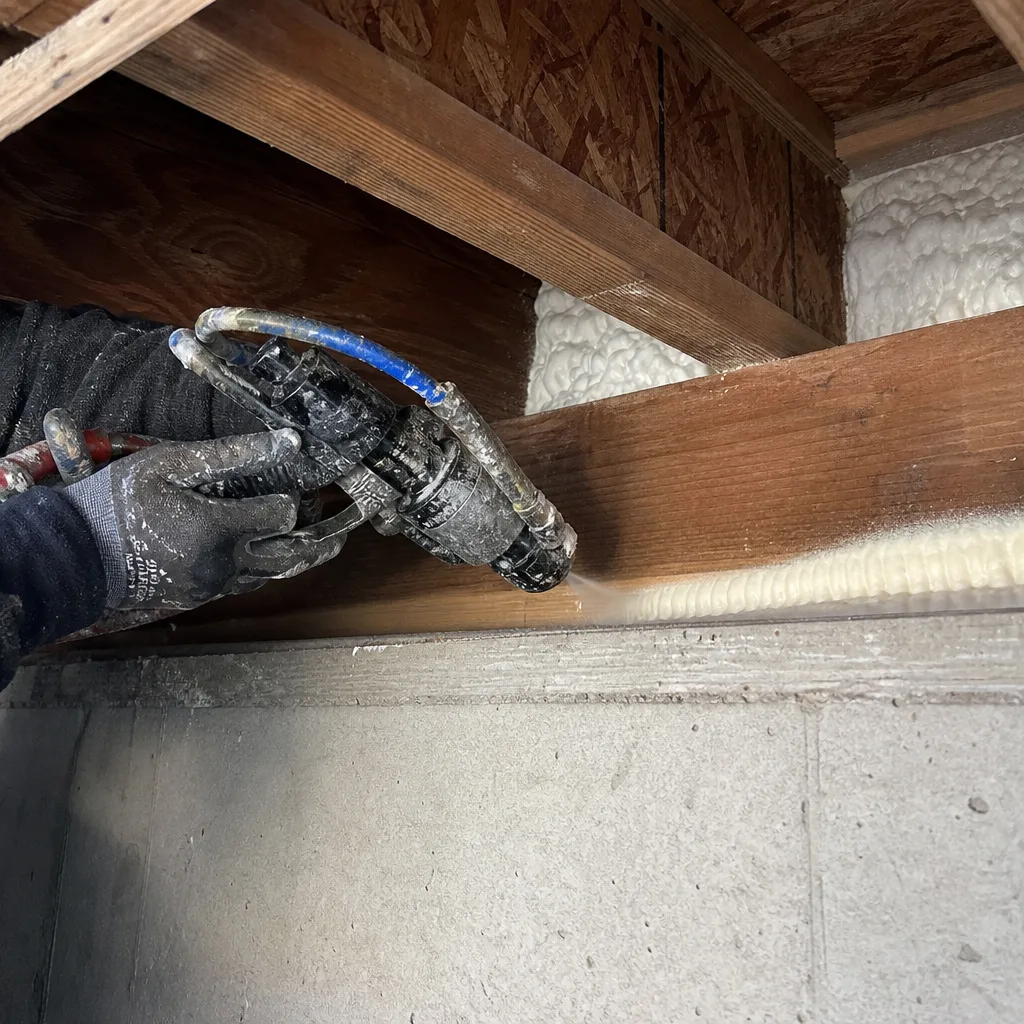
Fast, Reliable Spray Foam Insulation Across Fontana
Spray foam insulation in Fontana typically runs $2.50 to $6.50 per square foot installed, depending on whether you need open-cell or closed-cell foam and how much prep work your attic or rim joist requires. Most jobs in Fontana are completed in one to two days. We know the difference between a 1962 steel-mill tract home off Merrill Avenue and a 2005 subdivision up near Summit Heights, and we spec the foam accordingly. Our crews live and work in Fontana, so when you call (866) 271-1602, you’re talking to someone who knows exactly what your attic is dealing with in July.
Fontana’s heat isn’t a mild inconvenience. Sustained 100°F-plus stretches, hot dry winds screaming through the Cajon Pass, and attics that turn into ovens by 10 a.m. every summer day – that’s the environment your insulation has to fight. Generic insulation advice written for coastal Los Angeles doesn’t apply here. What works in Santa Monica fails in Fontana. The fix starts with air-sealing and spray foam that can actually handle this specific heat load.
We’re a material-agnostic insulation specialist, not a spray-foam-only shop. That matters because sometimes the right answer for your south Fontana ranch is open-cell foam on the roof deck plus a radiant barrier, and sometimes it’s closed-cell at the rim joist and blown-in fiberglass everywhere else. We carry eight brands so we can have that conversation honestly. Noel Arredondo built Fontana Insulation around one idea: recommend the material your house actually needs, not the one sitting in our warehouse.
Here’s what you should know before you call anyone:
- Fontana attics routinely hit 140°F or higher in summer. Spray foam’s air-sealing matters as much as its R-value.
- Homes built before 1980 in Fontana were never required to meet modern insulation standards. Most need air-sealing before anything else.
- Open-cell foam is usually the right call for Fontana attic roof decks. Closed-cell makes more sense for rim joists, crawlspaces, and garage ceilings where moisture and air infiltration are the bigger problems.
- We install Spray Foam Insulation using Icynene and Demilec products, two of the most performance-tested foam brands in North America.
The Fontana Heat Problem Most Insulation Companies Ignore
Fontana sits at the base of the Cajon Pass, and that’s not just a geography fact – it’s the single most important variable in how we spec insulation here. Hot, dry winds funnel through that pass all summer, scouring loose-fill and thin batt insulation into settled, compressed piles. The result is bare spots under your roof deck where attic heat pours straight into your living space. We walk into south Fontana attics every week that read R-11 or less, not because the original builder cheaped out (though they did), but because 50 years of Cajon Pass wind has physically moved the insulation out of place.
Wind washout is a Fontana-specific failure mode. A contractor from Orange County might not even look for it. We do, because we see it all the time. Loose-fill fiberglass gets blown into drifts. Batt insulation pulls away from the top plates. The attic looks insulated from the hatch, but walk ten feet toward the eaves and you’ll find bare drywall with nothing between you and the sun-baked roof deck. That’s why air-sealing and spray foam work so well together here. The foam adheres to the roof deck and doesn’t move, no matter how hard the wind blows through the pass.
On a steel-mill-era tract street in south Fontana, our crew opened an attic that read R-11 with settled, wind-scoured batts. We sealed the top plates and recessed fixtures, then sprayed open-cell foam to bring the roof deck into spec. We capped it with a radiant-barrier layer to blunt Cajon Pass heat gain, and the homeowner’s upstairs rooms stopped spiking past 100°F every afternoon. That’s the kind of result you only get when the insulation is matched to Fontana’s specific conditions, not a generic California spec.
Why Fontana Insulation Is Fontana’s Preferred Spray Foam Insulation Company
Most insulation contractors push one product line because that’s what they stock. We carry eight brands across four material categories: fiberglass from Owens Corning, Johns Manville, Knauf, and CertainTeed; Rockwool mineral wool; Icynene and Demilec spray foam; and GreenFiber cellulose. That means when we recommend open-cell foam for your Fontana attic, it’s because open-cell foam is genuinely the right application for your roof deck and heat load, not because it’s the only foam we sell.
We’re an authorized installer for Icynene and Demilec spray foam. Both are performance-tested brands with long track records in extreme-climate applications. But we’ll also tell you straight up when foam isn’t the answer. If you’ve got a 1963 ranch in south Fontana with original framing and you’re on a tight budget, blown-in GreenFiber cellulose over air-sealed penetrations might deliver 85% of the comfort improvement at half the cost. We’ll show you the numbers and let you decide.
Noel Arredondo set the company up this way on purpose. Brand-neutral consultation means the recommendation comes from your home’s condition, your budget, and Fontana’s climate realities. Not inventory pressure. We handle every installation in-house too – attic insulation, spray foam, and blown-in, no subcontracting. The crew that quotes your job is the crew that installs it.
When you call about spray foam in Fontana, you’re not getting routed to a call center. You’re talking to people who know where the steel-mill tract homes are, which neighborhoods have the worst wind washout, and what a 1950s ridge vent looks like versus a 1990s one. That local knowledge changes how we spec the foam. Zip code matters when the climate is this extreme.
Open Cell Spray Foam in Fontana
Open Cell Spray Foam in Fontana is the workhorse material for attic roof decks and exterior walls in our climate. It’s a lower-density foam that expands aggressively to fill cavities, seals air leaks at the top plates and wiring penetrations, and delivers roughly R-3.5 per inch. For a Fontana attic, we typically recommend open-cell foam applied directly to the underside of the roof deck, which moves the thermal boundary to the roofline and keeps your ductwork inside conditioned space.
Why does open-cell make sense for Fontana specifically? Because our cooling load dominates. Open-cell foam is an excellent air barrier and a solid insulator, and its slightly lower R-value per inch compared to closed-cell is more than offset by its air-sealing performance in old leaky tract homes. Fontana houses built before 1980 leak air through top plates, can lights, plumbing chases, and electrical penetrations. You can pile R-38 fiberglass on top of those leaks and still bake upstairs. Seal the leaks with open-cell foam first, then the R-value actually does its job.
Typical open-cell spray foam installation in Fontana runs $2.50 to $4.50 per square foot, depending on depth and access. A standard 1,200-square-foot attic roof deck usually lands between $3,000 and $5,400. That’s a wide range because every Fontana attic has different obstacles: some have low slopes that make spraying difficult, some need old insulation removed first, some have HVAC equipment blocking the deck.
Attic Roof Deck Application
This is where we spray open-cell foam directly onto the underside of the roof sheathing, usually 5 to 7 inches thick to hit R-20 to R-25 once cured. The foam expands into every gap, crack, and seam, creating a continuous air barrier that loose-fill or batts simply can’t match. For Fontana’s wind-wash problem, this is the most effective fix we know. The foam doesn’t settle, doesn’t blow around, and doesn’t leave bare spots.
Wall Cavity Retrofit
In older Fontana homes, wall cavities are often empty or filled with settled, degraded material. Open-cell foam can be injected into existing walls through small access holes, though it’s more common during renovations when the drywall is already down. We pair this with attic air-sealing to create a complete thermal envelope. Without the attic work, wall foam alone won’t stop the heat pouring down from above.
Spray Foam Insulation Contractors in Fontana
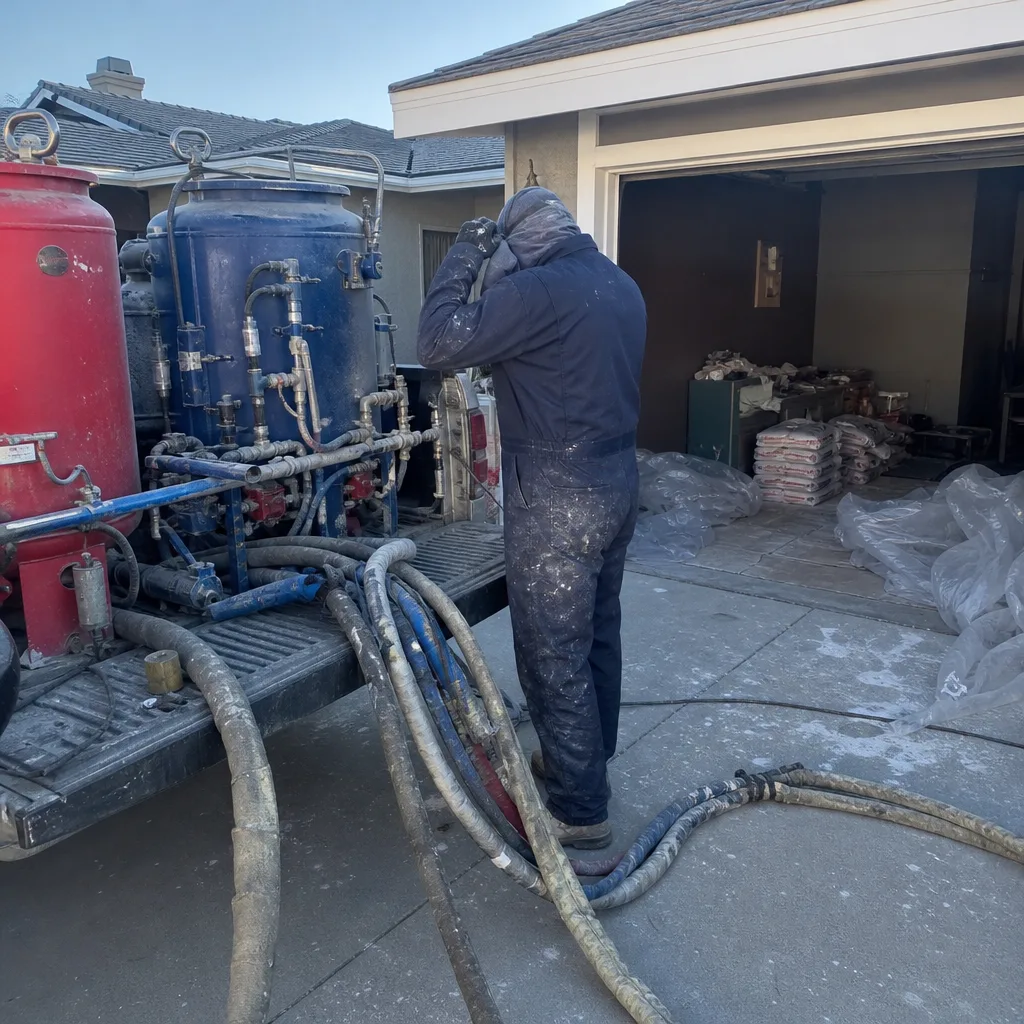
Spray Foam Insulation Contractors in Fontana aren’t all the same, and the difference shows up in the details: whether they pull the old wind-scoured material first, whether they seal the top plates and can lights before spraying, and whether they spec the foam depth for Fontana’s actual summer heat load rather than a coastal reference chart. We’ve been working in Fontana long enough to know which south-side tracts have the worst attic conditions and which north-side subdivisions already have decent insulation and just need rim joist work.
A proper spray foam job in Fontana starts with an inspection that most contractors skip. We physically get into the attic, measure the existing insulation, check for wind washout and settling, identify air leaks at penetrations, and look at the existing ventilation setup. Then we recommend a foam system based on what we actually found. If your attic already has R-38 fiberglass but leaks like a screen door, the fix is air-sealing plus targeted foam at the rim joist, not a full roof-deck spray. That honest assessment saves Fontana homeowners thousands.
Rim joist spray foam jobs in Fontana typically run $800 to $1,800 for a single-story home, depending on linear footage and access. Garage ceiling spray foam usually lands between $1,200 and $2,500. Full attic roof deck applications run $3,000 to $8,000 depending on square footage, foam depth, and how much prep work the old insulation requires. We always provide a written quote before work starts, and estimates are free.
Testing Before We Spray
We check the existing insulation condition, look for wind scour along the eaves, and identify air leaks at the plates, can lights, and vent penetrations. This matters in Fontana because the wind-wash problem in older attics changes where we need to focus the foam. A roof deck that looks fully insulated from the hatch can be bare at the eaves.
Crew Experience and Equipment
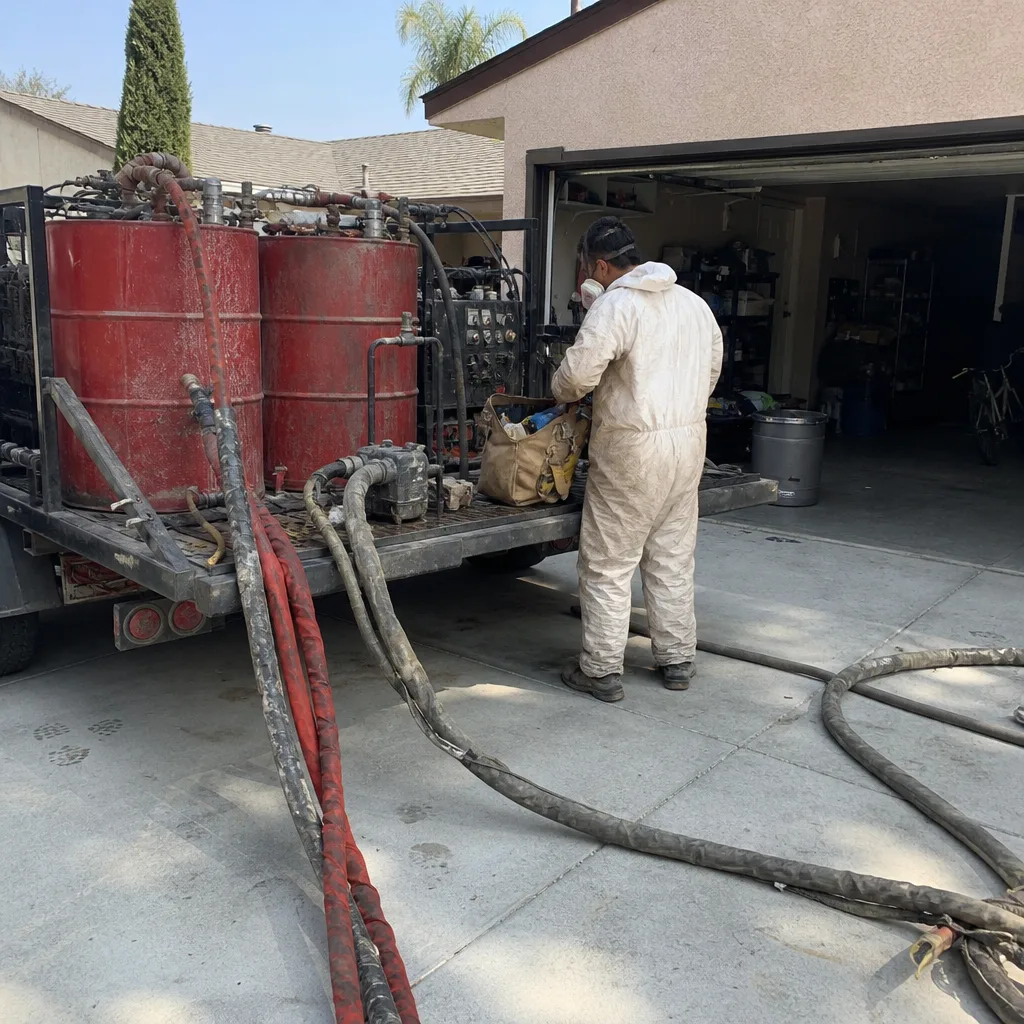
Spray foam installation is a technical job, and the equipment matters as much as the crew. We run heated spray rigs so the foam applies evenly on cooler mornings, and we monitor foam temperature and pressure throughout the job. That attention to detail is why our foam jackets fit tight to the deck without gaps or missed spots. No subcontractors, no day labor. The same team handles your job from prep to cleanup.
Trusted Brands We Service in Fontana
We install Icynene and Demilec spray foam because both brands have proven performance in high-heat, wind-driven climates like Fontana’s. Icynene’s open-cell formulations expand reliably in tight attic cavities and provide excellent air-sealing at the density we spec for roof decks. Demilec closed-cell foam gives us a high-performance option for rim joists, crawlspaces, and garage ceilings where moisture resistance and higher R-value per inch matter. We also carry Rockwool mineral wool for Fontana homeowners who want fire-resistant, sound-dampening insulation in interior walls or bonus rooms. Because we stock multiple brands, we can spec your foam system without brand loyalty getting in the way of the right product for your house’s condition. If you’re weighing options for Spray Foam Insulation in Fontana, we’ll walk you through what each material does well and where each one underperforms.
Common Spray Foam Insulation Problems We See in Fontana Homes
- Wind-washed attic insulation: Hot, dry winds through the Cajon Pass scour loose-fill and thin original batts into settled piles, leaving bare spots under the roof deck. We fix this by removing the compromised material and applying open-cell foam directly to the deck where it can’t move.
- Unsealed steel-mill-era envelopes: 1950s-1970s tract homes around south Fontana were built before California’s modern Title 24 insulation standards, so we find leaks at top plates, can lights, and wiring penetrations everywhere. Foam over those leaks without sealing them first means the R-value gain gets wasted.
- Radiant-barrier gap: Foam alone still lets Fontana’s brutal inland sun load the roof deck, so older south-side attics need barrier performance matched to our 100°F-plus stretches. Without it, the foam insulates against conductive heat but the radiant heat still pushes through.
- Undersized foam depth in existing attics: Some Fontana homes got spray foam installed years ago at only 2 to 3 inches thick, which doesn’t meet current performance targets for our heat load. We often remove or supplement this under-spec’d foam to bring attics up to what the climate actually requires.
Pricing for Spray Foam Insulation in Fontana, CA
Let’s talk real numbers for Fontana spray foam work. Open-cell attic roof deck applications run $2.50 to $4.50 per square foot installed, which means a typical 1,200-square-foot attic lands between $3,000 and $5,400. Closed-cell foam, which we spec for rim joists, crawlspaces, and garage ceilings, runs $4.50 to $6.50 per square foot. A rim joist project on a single-story Fontana home typically falls between $800 and $1,800. Garage ceiling spray foam usually lands between $1,200 and $2,500.
What moves the price: how much old insulation has to be removed, attic access and ceiling height, how much air-sealing prep is required, and whether we’re pairing the foam with a radiant barrier. Fontana’s older tracts often need more prep work than newer subdivisions because the original insulation is settled, dirty, or wind-scoured. We give you a written quote broken down by line item before any work starts. Call (866) 271-1602 for a free estimate, and we’ll walk your attic with you if you want to see what we’re seeing.
We Also Serve Cities Near Fontana
Our crews work throughout the Inland Empire, including Bloomington, Rialto, Glen Avon, and Pedley. If you’re in one of those communities and dealing with the same Cajon Pass heat and wind washout we see in Fontana, we can help. Call (866) 271-1602 and we’ll schedule an inspection.
Serving Fontana, CA — Our Local Coverage Area
We’re based in the Fontana area and know this community well. Use the map below to see our service coverage — if you’re nearby, we can almost certainly help.
FAQs About Spray Foam Insulation in Fontana
Fontana needs a radiant barrier alongside spray foam because our summer sun doesn’t just heat the attic air, it bakes the roof deck itself with radiant heat, and foam alone only slows conductive heat transfer. A radiant barrier reflects that radiant load before it ever reaches the foam, which means your attic stays dramatically cooler and your cooling system doesn’t work as hard. In 100°F-plus stretches, this combination is what keeps upstairs rooms from spiking into the 90s and 100s. Call (866) 271-1602 and we’ll assess whether your roof deck is a good candidate for both layers.
Yes, spray foam works extremely well in 1960s Fontana homes, but the prep matters more than in newer construction. Your top plates, can lights, and wiring penetrations have been leaking air for 60 years, and the original insulation is likely wind-scoured and settled well below R-11 in spots. We seal those leaks first, remove the compromised material, then apply open-cell foam to the roof deck. The age of your house isn’t the problem. The air leaks are. We handle both.
We install Icynene and Demilec spray foam, two of the most performance-tested brands in North America. We carry both because they serve different applications here: Icynene’s open-cell foam gives us reliable, full-cavity expansion for attic roof decks and wall cavities, while Demilec closed-cell is our go-to for rim joists, crawlspaces, and garage ceilings where moisture resistance is critical. We’ll spec the brand and formulation based on your home’s specific condition, not a stock preference.
Open-cell foam handles Fontana’s attic heat gain well when it’s applied at the correct depth and paired with a radiant barrier on the roof deck. The foam’s air-sealing is the first win, because it stops superheated attic air from leaking into your living space through penetrations. Then the insulation slows conductive heat transfer. For Fontana’s specific wind-and-heat profile, open-cell at 5 to 7 inches on the deck with a barrier above it is a proven combination. For rim joists and garages, we typically spec closed-cell instead.
During a spray foam inspection in Fontana, expect us to physically enter your attic, measure the existing insulation depth, check for wind scour and settling, identify air leaks at the top plates and penetrations, and look at your current ventilation. We’ll take photos and show you what we find. Then we’ll give you a written quote that breaks down the foam system, prep work, and any supplemental measures like a radiant barrier. The inspection takes 45 minutes to an hour, and it’s free. Call (866) 271-1602 to schedule one.
If you’re tired of upstairs rooms that hit 100°F every summer afternoon, spray foam might be the right fix. Or it might be air-sealing, or a radiant barrier, or blown-in cellulose. We’ll tell you honestly which one matches your Fontana home’s condition and budget. Call (866) 271-1602 for a free estimate, and we’ll walk you through exactly what your attic needs and what it’ll cost.
Written by Noel Arredondo, Owner at Fontana Insulation, serving Fontana and the surrounding Inland Empire communities.