
Fast, Reliable Spray Foam Insulation Across Pedley
Spray foam insulation in Pedley homes typically runs $2,200 to $6,800 depending on the area treated, and most jobs are completed in one day. The real problem we solve in this part of Jurupa Valley isn’t just heat, it’s wind. Pedley sits in an inland Riverside heat zone where summer afternoons push past 100°F and Santa Ana events scour attics in ways most insulation contractors never diagnose. If your home was built between 1965 and 1985 and the west-side rooms spike by noon while the east side holds steady, you’re dealing with a wind-migration problem, not just thin insulation. Call (866) 271-1602 and we’ll tell you exactly what’s happening in your attic before we quote a single square foot.
Why Fontana Insulation Is Pedley’s Preferred Spray Foam Insulation Company
We work in Pedley constantly. Not occasionally, not “we cover your area” from an office two counties away. Our crews know Pedley Road, Limonite Avenue west of the river, and the ranch-lot streets off Granite Hill Drive because those are the routes we drive every week. Noel Arredondo has built our team around a material-agnostic approach: we stock eight brands across four insulation categories, which means we recommend what your specific house needs, not what we’re incentivized to push this quarter. For Pedley’s older ranch homes, that usually means air sealing first, then spray foam where it earns its cost.
We’re authorized installers for Icynene and Demilec, two of the most tested spray foam brands in North America. But we also carry Johns Manville and CertainTeed fiberglass when a Pedley homeowner wants targeted retrofit work without the full foam scope. The point is leverage: you get an honest material recommendation backed by the full toolbox, not a single-product pitch dressed up as expertise.
Local knowledge matters in Pedley because the housing stock is specific. These are 1970s and 1980s single-story tract homes and ranch houses on unincorporated lots, most with original or thin R-value attic insulation and vented soffits on both ends. That construction interacts with Santa Ana wind in a way we’ve documented across dozens of Pedley attics. A contractor from Orange County won’t understand why your attic has six inches of fiberglass on one slope and bare drywall on the other. We do.
Rim Joist Spray Foam in Pedley
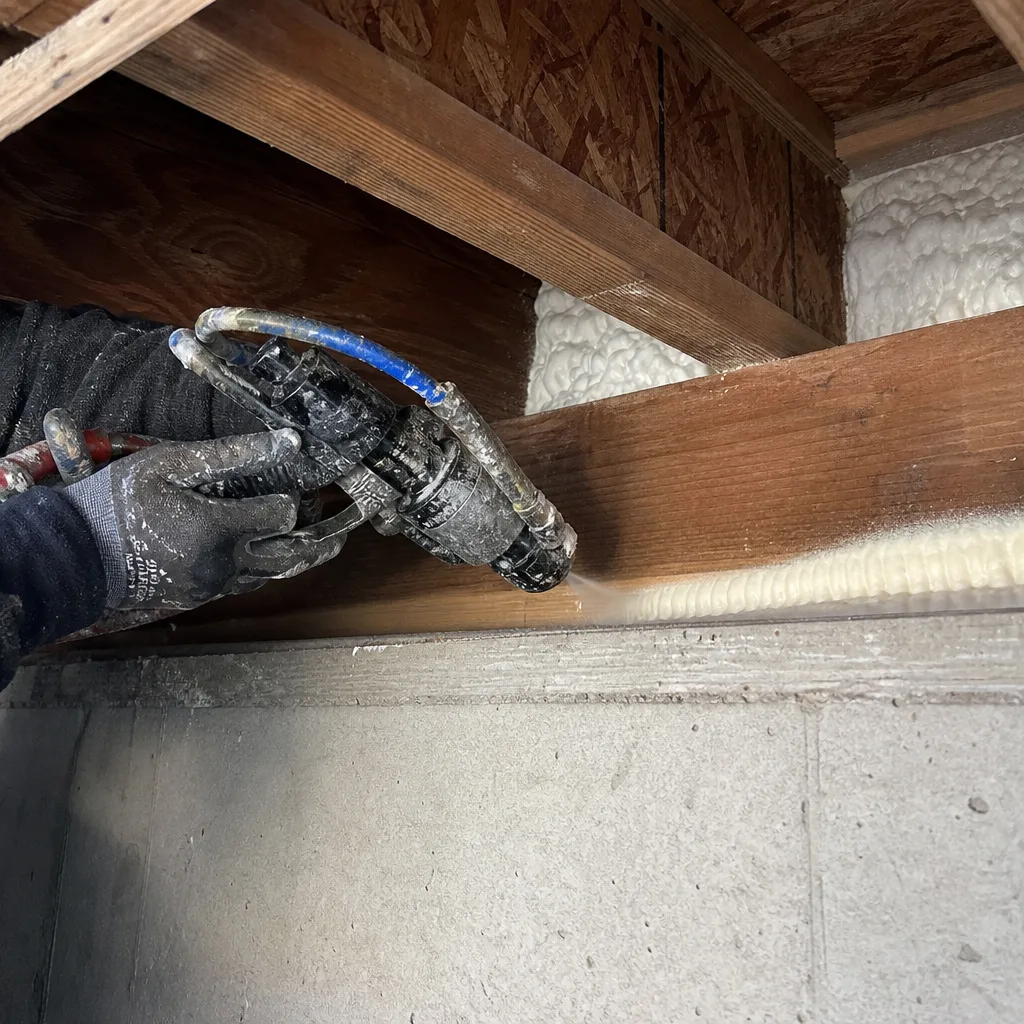
Rim joist spray foam in Pedley is one of the highest-value retrofits we do on the older ranch houses that dominate this area, because the rim joist is where wind-driven dust and outside air push into the floor cavity, and sealing it transforms the first floor’s temperature stability. The job involves spraying closed-cell foam into the band joist area where the foundation meets the floor framing, typically accessible from the crawl space or basement side. In Pedley’s 1970s wood-frame construction, the rim joist was rarely insulated at all, and original fiberglass batts, where they exist, have compacted into near uselessness after 40 years of wind cycling.
Most Pedley rim joist jobs run $1,400 to $2,400 depending on accessible linear footage. Homes on the larger unincorporated lots with generous crawl clearance run toward the lower end; homes with tight or partially obstructed crawls run higher because access takes longer.
Air Sealing Before Foam
We don’t spray rim joists in isolation. The reason a Pedley home with a dust-coated crawl space still feels drafty after attic insulation is that air sealing never happened. We seal the top plates, the rim joist penetrations, and the plumbing chases first, then apply the foam. That sequencing is what makes the west-side rooms hold temperature through August afternoons.
Dust Infiltration in Vented Crawls
Pedley’s vented crawl spaces act like wind tunnels during Santa Ana events. Dust, fine silt from the Santa Ana River corridor, and outside air pour through foundation vents, then rise through rim joist gaps into the living space. Closed-cell foam at the rim joist stops that path. We’ve pulled back fiberglass batts in Pedley crawls and watched owners recognize ten years of accumulated grit sitting in what should have been a thermal barrier.
Crawl Space Spray Foam Insulation in Pedley
Crawl space spray foam insulation in Pedley matters because homes here sit on large, unincorporated lots where foundation heights vary and moisture comes from both irrigation runoff and Riverside’s dry-wind cycle, meaning the crawl space is either humid and muggy or bone-dry and dust-choked, rarely in between. We most often recommend closed-cell foam on the foundation walls and rim joist as a combined scope: the wall foam creates a thermal break against the earth, and the rim joist foam stops wind wash from outside. Together, they convert a vented, leaking crawl into a stable conditioned zone.
A typical Pedley crawl space encapsulation with closed-cell spray foam runs $4,500 to $8,500 depending on square footage and access height. Larger ranch houses with 1,400-square-foot-plus crawls go higher; compact crawls on 1970s tract homes run lower. The cost is not small, but neither is the problem: uninsulated rim joists and bare dirt floors in Pedley are the reason your floors read 15 degrees colder in winter than the air in the room.
Closed-Cell on Foundation Walls
We apply two inches of closed-cell Demilec or Icynene foam directly to the stem wall, which acts as both thermal barrier and air barrier. For Pedley homes with high water tables near the river corridor, closed-cell’s resistance to moisture absorption matters more than open-cell. The foam won’t wick, won’t sag, and won’t become a mold substrate the way fiberglass batts in a humid crawl will.
When a Vapor Barrier Isn’t Enough
A 6-mil vapor barrier stops ground moisture but does nothing for cold-air transfer through the rim joist or wall. Pedley homeowners who lay plastic over the dirt and call it done still get cold floors and dust infiltration. We pair the barrier with spray foam at the thermal boundary, which is the only way to actually stop the wind path.
Trusted Brands We Service in Pedley
We’re not loyal to any one manufacturer, because no single brand solves every Pedley attic. We carry Icynene and Demilec for open- and closed-cell spray foam applications where air-sealing performance is the priority. We stock Johns Manville and CertainTeed fiberglass for the targeted retrofit jobs on 1970s tract homes where the budget is tight and the problem is isolated to one slope. We also carry Rockwool mineral wool, which matters to Pedley homeowners near the river corridor or the railroad tracks who want fire resistance and sound dampening alongside thermal performance. For a free assessment of which material fits your house, call (866) 271-1602.
Common Spray Foam Insulation Problems We See in Pedley Homes
- Lopsided loose-fill from Santa Ana wind scour. Vented soffits on both ends of the attic mean wind cycles through and pushes fiberglass toward the downwind eaves. After a few seasons, one slope is full depth and the other is scraped bare, and most homeowners have no idea until we pull the hatch.
- Wind-driven dust infiltrating through top-plate gaps. Even a house with “enough” attic insulation leaks air at every top-plate seam, and Pedley’s dust loads are heavy enough that the evidence shows up as gray streaks on the rafters and dust films on the insulation surface. Foam air sealing stops the path before more insulation is added.
- Thin original batts in 1970s wood-frame walls. The walls in older Pedley tract homes were built with R-11 fiberglass at best, and often nothing in the rim joist or knee-wall zones. Spray foam on the underside of the roof deck helps, but wall heat gain still passes through unless air sealing is done first.
- Single-pane or failing early dual-pane glass negating foam gains. We’ve foam-sealed Pedley attics only to watch heat still pour through original aluminum-frame windows. The insulation and the window retrofit have to work together, and a good foam scope should always include an assessment of the glazing.
Pricing for Spray Foam Insulation in Pedley, CA
Here’s what Pedley homeowners actually pay, based on the jobs we’ve completed in the 92509 zip code. Open-cell attic roof deck spraying runs $2,800 to $5,500 for a typical 1,300-square-foot single-story ranch. Closed-cell rim joist work runs $1,400 to $2,400. Crawl space encapsulation with closed-cell runs $4,500 to $8,500. Garage ceiling spray foam on a two-car garage runs $1,100 to $1,900. The variables are access height, how much wind scour has to be corrected first, and whether the existing fiberglass has to be removed before foam goes in. Call (866) 271-1602 for a free estimate with actual measurements, not a per-square-foot guess.
We Also Serve Cities Near Pedley
Our crews run Spray Foam Insulation jobs throughout the Jurupa Valley corridor and west Riverside County. In addition to Spray Foam Insulation in Pedley, we cover Glen Avon, Sunnyslope, Rubidoux, and Riverside with the same in-house crew and the same material-agnostic approach.
Serving Pedley, CA — Our Local Coverage Area
We’re based in the Pedley area and know this community well. Use the map below to see our service coverage — if you’re nearby, we can almost certainly help.
FAQs About Spray Foam Insulation in Pedley
Yes, but only if the air sealing happens first. The lopsided attic you’re describing is Santa Ana wind scour, where vented soffits let wind cycle through the attic and push loose-fill toward the downwind eaves. We remove or redistribute the drifted fill, seal the top plates and penetrations with spray foam, then lock the remaining insulation or new foam to the deck so it can’t migrate again. Call (866) 271-1602 and we’ll inspect the actual pattern in your attic.
Because your rim joist is a direct air path from the crawl space into the first floor, and attic insulation does nothing to stop it. Pedley’s older ranch homes were built with uninsulated rim joists, and the Santa Ana wind pressurizes the crawl space enough to push dust and outside air straight through. Rim joist spray foam seals that boundary, which is why west-side rooms finally hold temperature after we do it.
It’s usually both, but in different ways. The crawl space gets closed-cell foam on the foundation walls and rim joist to stop wind wash and ground moisture. The attic gets air sealing first, then open- or closed-cell foam on the roof deck or top plates depending on whether the attic is vented or unvented. We assess both zones before recommending scope, because doing one without the other leaves the wind path half-open.
No, and we won’t. Spray foam applied over old fiberglass doesn’t adhere properly, and the layered material traps dust and moisture that defeats the foam’s air-sealing value. In Pedley’s scoured attics, we remove or redistribute the drifted fiberglass first, then spray directly onto the sheathing or top plates where the foam can actually bond. It’s more work, but it’s the only way the retrofit lasts.
When the existing insulation has migrated, compacted, or been dust-coated to the point where the attic’s air path hasn’t been sealed. Topping off over a wind-scoured, leaky attic adds R-value but does nothing for the air leakage that’s driving most of your discomfort. Retrofit with air sealing and foam is the right call on any Pedley home built before about 1990. Call (866) 271-1602 for an honest read on whether your attic qualifies.
If your Pedley home is fighting the wind every summer and losing, we can tell you exactly where the leaks are and what it costs to stop them. One inspection, no obligation. Call (866) 271-1602.
Written by Noel Arredondo, Owner at Fontana Insulation, serving Pedley and the Jurupa Valley.