
Fast, Reliable Spray Foam Insulation Across Eastvale
Spray foam insulation in Eastvale typically runs $2.50 to $6.50 per board foot installed, with most whole-attic or garage ceiling projects landing between $2,800 and $7,500 depending on foam type and square footage. We work throughout the 92860 zip code, from the neighborhoods off Archibald Avenue to the newer sections east of the I-15, and our crews know exactly what these tract homes need. Noel Arredondo built Fontana Insulation around a simple idea: carry every major insulation material, understand each one’s strengths, and recommend what actually fits the house, not what we happen to have in the warehouse. Call (866) 271-1602 for a free estimate, and we’ll walk you through what your Eastvale attic or garage actually needs.
Why Fontana Insulation Is Eastvale’s Preferred Spray Foam Insulation Company
Most Eastvale homes share the same DNA. They were built between 2005 and 2015 by large production builders, and the insulation spec was almost always the same: fiberglass batts in the walls, thin blown-in or batt insulation in the attic, and no air sealing at the garage-to-house boundary. We know those assemblies because we’ve foamed hundreds of them. When a homeowner near Roosevelt High School calls about a bonus room that won’t cool below 82 degrees in August, we already know what we’re going to find before we climb into the attic.
We’re material-agnostic, which matters more than it sounds on a page. Fontana Insulation stocks eight brands across fiberglass, mineral wool, spray foam, and cellulose, so we’re not trying to sell you foam because it’s the only thing on our truck. We recommend Spray Foam Insulation when the problem is air leakage, radiant heat gain, or an unconditioned garage adjacent to living space. If the better answer is Rockwool or blown-in fiberglass, we’ll tell you that too. Our Eastvale customers tend to hear about us from neighbors, because when one house on a street gets its garage ceiling foamed, the next three usually follow within a year.
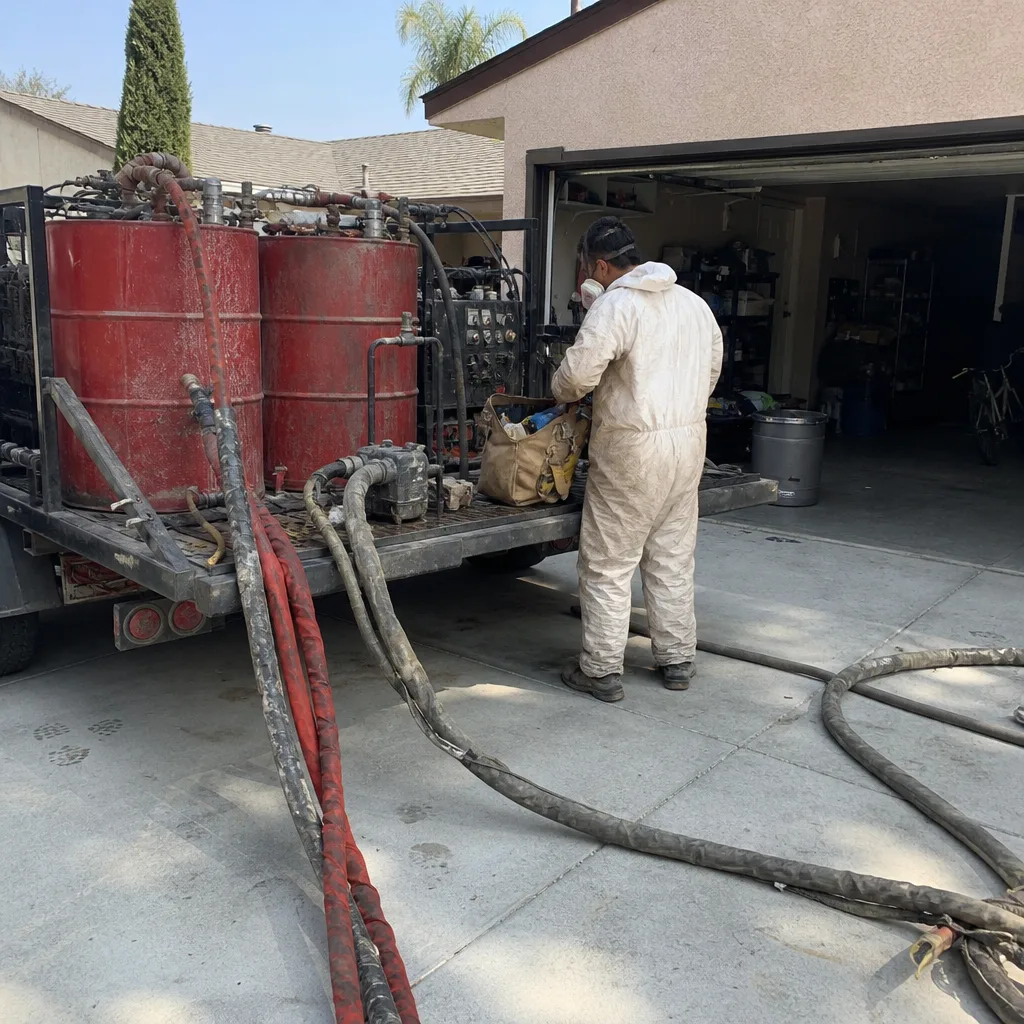
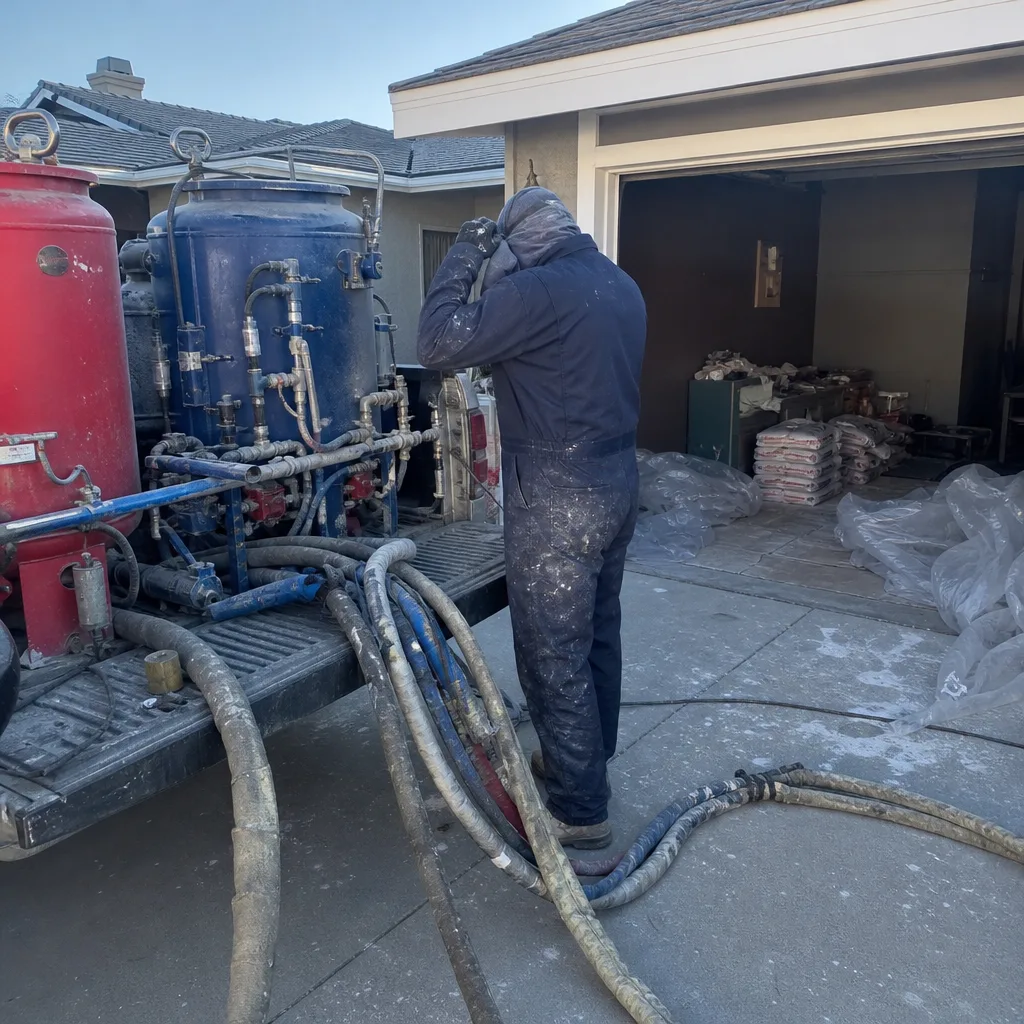
We’re an authorized installer for Icynene and Demilec, two of the most performance-tested spray foam brands in North America. That authorization means factory training, proper equipment calibration, and a product warranty that holds up. For Eastvale homeowners comparing bids, it’s worth asking whether your contractor is factory-authorized or just renting an HFO rig. The difference shows up in foam consistency and long-term adhesion.
Garage Spray Foam Insulation in Eastvale
Garage Spray Foam Insulation in Eastvale addresses a problem nearly every production home here shares: the builder attached the garage to the house but never air-sealed the boundary between them. Heat builds in that unconditioned garage all afternoon, then presses through the drywall into the adjacent living room or the bedroom above the garage. Closed-cell foam on the garage ceiling and the shared wall stops that thermal transfer at the source. In an Eastvale tract home, it’s usually the missing piece the original R-13 batts never covered.
A garage ceiling foam job in Eastvale runs $1,400 to $3,200 for a typical two-car garage, depending on ceiling area and foam depth. We usually apply closed-cell to the ceiling and open-cell to the shared wall when sound is also a concern.
Attached Garage Ceiling and Shared Wall
Eastvale’s home plans almost always attach the garage to the main living space, often below a second-story room. The ceiling cavity is where the thermal boundary should live, but builder-grade batts don’t seal airflow. Foam creates that boundary. Upstairs rooms above garages are consistently the hottest rooms in these houses because the garage ceiling never got the attention it needed.
When the Garage Hosts a Workshop or Gym
Some Eastvale homeowners convert part of the garage into a workshop, gym, or storage for heat-sensitive items. In that case, the foam work shifts from just ceiling and shared wall to a full garage envelope. That changes both the material choice and the project scope, and it’s worth a conversation rather than a one-size-fits-all quote.
Closed Cell Spray Foam Insulation in Eastvale
Closed Cell Spray Foam Insulation in Eastvale is the right tool when air and moisture control matter as much as thermal resistance. At roughly R-6.5 to R-7 per inch, closed cell packs more insulating power into less space than any other common residential material. For Eastvale’s hot, dry summers, that matters because attic depth in these low-pitch tract roofs is often limited. You simply can’t fit 18 inches of blown-in fiberglass into a shallow vaulted deck over a bonus room, but 2 to 3 inches of closed cell does the same thermal job and air-seals at the same time.
Closed cell typically costs more than open cell, with Eastvale projects starting around $4.50 per board foot and going up based on depth and surface access. We’re honest about that gap because the material earns its keep in specific applications: rim joists, vaulted ceilings, unconditioned garage boundaries, and anywhere moisture vapor could condense inside the assembly.
Vaulted Great Room and Bonus Room Decks
Eastvale’s production plans love a vaulted great room ceiling, and those vaulted decks are usually where the worst radiant heat intrusion happens. Closed cell applied directly to the underside of the roof deck turns that vault into a sealed thermal boundary, keeping the July heat outside the building envelope instead of letting it bake through the drywall.
Rim Joist and Band Board Sealing
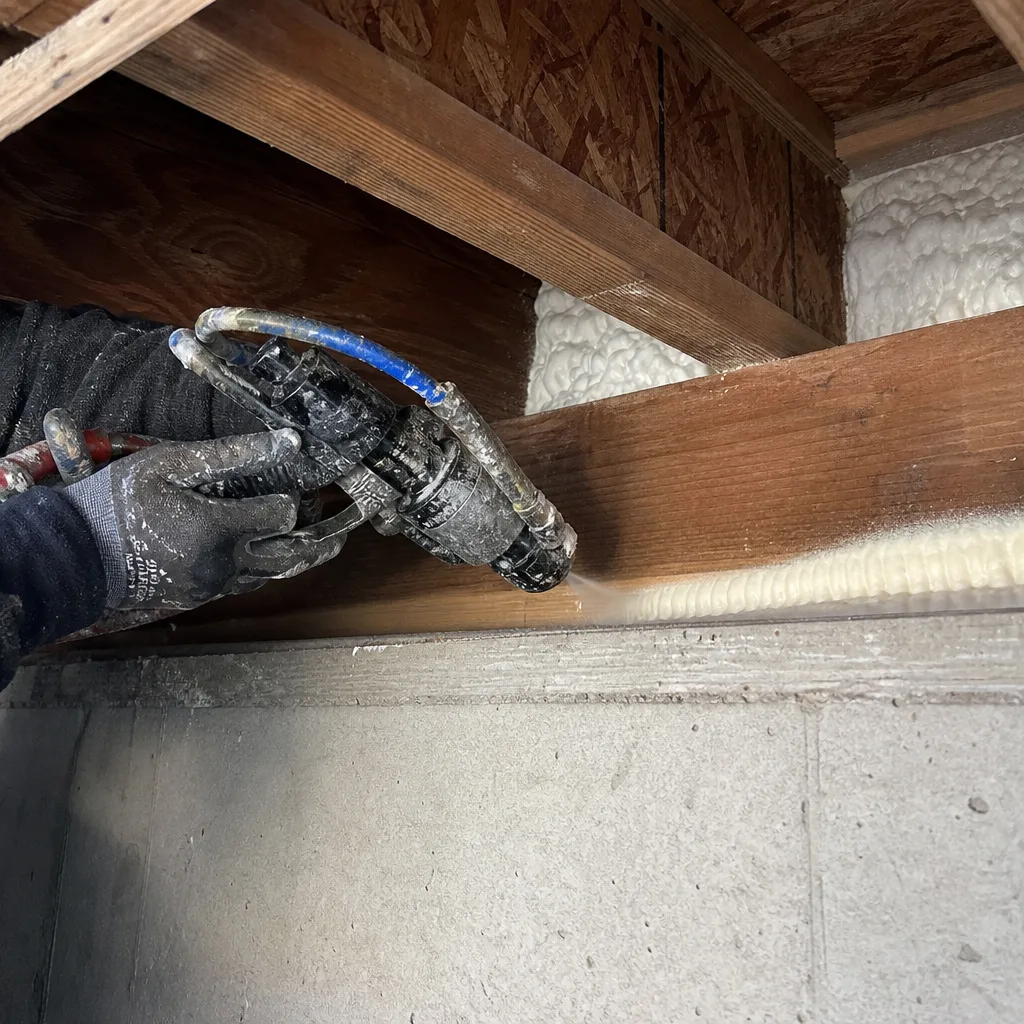
Rim joists are another builder-corner-cut spot in Eastvale homes. The band board above the foundation is often hollow, letting outside air flow freely into the floor assembly. Two inches of closed cell across the rim joist eliminates that air path, which matters for both summer cooling and dust control in Riverside County’s dry, windy months.
Trusted Brands We Service in Eastvale
Spray foam is only as good as the chemistry inside the canister, which is why we stock and install Icynene and Demilec products. Both brands have decades of third-party testing behind them, and both hold up in Southern California heat without the off-gassing issues you get with bargain foams. For Eastvale customers who want alternatives to spray foam, we also carry Rockwool mineral wool and CertainTeed fiberglass from our Fontana warehouse. Having all of it on hand means we’re never pushing foam into a situation where another material makes better sense. If foam is the right call, our Eastvale crews arrive with factory-fresh product and the equipment to spray it properly.
Common Spray Foam Insulation Problems We See in Eastvale Homes
- Builder-grade batts sagging in vaulted ceilings. The facing staples loosen, the batts pull away from the deck, and suddenly the great room ceiling is radiating Inland Empire heat. We see this in nearly every pre-2020 tract home we inspect in Eastvale.
- Unconditioned garages over-pressurizing the wall cavity. Hot air pushes into the living space through outlet boxes and baseboards. The air path was never sealed because the builder’s spec didn’t call for it.
- Thin blown-in attic insulation below the roofline. These 2000s-era homes often have R-19 or less at the ceiling, and in Eastvale’s triple-digit summers, that’s simply not enough thermal mass between you and the roof deck.
- Bonus rooms over garages that run 8 to 10 degrees hotter. The garage ceiling is the culprit, not the HVAC system. Adding foam there usually fixes what rebalancing registers never will.
On a two-story tract home off the I-15 corridor in Eastvale, our crew foamed the attached unconditioned garage ceiling and the bonus room above it after the homeowner reported the upstairs thermostat couldn’t keep up through the first July heat wave. We applied closed-cell spray foam to seal the garage-to-living boundary and the vaulted attic deck, then verified the upstairs bonus room finally held its setpoint. The fix was less about adding thickness than about closing the air paths the builder-left batts never sealed.
Pricing for Spray Foam Insulation in Eastvale, CA
Spray foam jobs in Eastvale fall into fairly predictable ranges because the housing stock is so consistent. A garage ceiling in a standard two-story tract plan runs $1,400 to $3,200. A rim joist package for a 2,000 to 3,000 square foot home lands between $900 and $1,800. A full attic deck application, including vaulted sections and bonus room ceilings, starts around $4,500 and can reach $9,000 on larger two-story homes off Limonite Avenue or Sumner Avenue. Open cell costs less per board foot but doesn’t give you the same R-value per inch or the same air-sealing in the spaces where Eastvale homes leak most. We quote each job after walking the attic, because the square footage of roof deck in these plans varies even between identical-looking floor plans. Call (866) 271-1602 for a free, no-pressure estimate.
We Also Serve Cities Near Eastvale
Our crews regularly work throughout Eastvale and the surrounding Riverside County communities. If you’re in Norco, Home Gardens, Corona, or Jurupa Valley and dealing with the same production-builder insulation issues, we can schedule an attic walkthrough the same week. The housing stock is similar, the climate is identical, and the solutions carry over without re-learning the problem.
Serving Eastvale, CA — Our Local Coverage Area
We’re based in the Eastvale area and know this community well. Use the map below to see our service coverage — if you’re nearby, we can almost certainly help.
FAQs About Spray Foam Insulation in Eastvale
Your bonus room sits either above the unconditioned garage or under a vaulted roof deck, and both of those boundaries were left with builder-minimum insulation and zero air sealing. Heat radiates through the ceiling and pushes through the floor from the garage below. Spray foam on the garage ceiling and the underside of the roof deck closes those paths, which is why a foamed bonus room in Eastvale can hold its thermostat setpoint on a 100-degree day. Call (866) 271-1602 and we’ll inspect both boundaries before recommending anything.
Yes, because the issue in these homes isn’t always thickness, it’s air sealing. Your existing fiberglass batts slow conductive heat but do nothing to stop hot air from moving through gaps, can lights, outlet boxes, and the garage-to-house boundary. In Eastvale’s dry heat, that convective heat load is what overwhelms upstairs HVAC. We’ve seen foam added to homes that already had R-38 in the attic and watched the upstairs temperature drop 6 to 8 degrees in the same week.
If any living space shares a wall or a ceiling with your garage, yes. Your builder almost certainly did not air-seal that boundary, and that means everything happening in the garage, heat in summer, cold air you run the car in winter, dust and fumes, is pressing into your home. Closed cell foam on the garage ceiling and shared wall creates a sealed thermal and air boundary. We recommend it on nearly every Eastvale two-story plan we inspect.
Eastvale’s climate is hot and dry with long triple-digit summer afternoons, and that favors an air-sealing insulation over a purely thermal one. Fiberglass slows heat conduction but allows air movement, which is a problem when your attic hits 130 degrees and the upstairs rooms are trying to hold 74. Closed cell foam stops both heat and air movement in one application. Fiberglass still has its place in flat, deep attics, but for vaulted decks, bonus rooms, and garage boundaries, foam is the better fit in this climate.
Usually yes, and in Eastvale production homes the improvement is measurable within a day of application. The upstairs zones run hot because the thermal boundary above and below them leaks air and radiant heat. Once the vaulted deck and garage ceiling are foamed, the HVAC system isn’t fighting a losing battle anymore. Some Eastvale homeowners also need HVAC balancing afterward, but the foam is the foundation. Call (866) 271-1602 and we’ll talk through your floor plan specifically.
Schedule Your Eastvale Spray Foam Insulation Estimate
If your Eastvale home runs hot in July, or your garage heats up the room next to it, the fix is probably simpler than you think. Noel Arredondo and our crew at Fontana Insulation work these 2000s-era tract homes every week, and we know exactly which weak spots to check in your floor plan. Call (866) 271-1602 for a free estimate, and we’ll walk the attic with you, explain what we find, and give you a straight answer on whether spray foam is the right material for your house.
Written by Noel Arredondo, Owner at Fontana Insulation, serving Eastvale and the surrounding Inland Empire.