
Fast, Reliable Spray Foam Insulation Across Cabazon
Spray foam insulation in Cabazon typically costs $2,400 – $6,800 depending on whether it’s an attic air-seal package, a full roof deck application, or rim joist work, and most residential jobs are completed in one to two days. If you live off Main Street, around the 92230 corridor, or in one of the older neighborhoods near Morongo Trail, we can usually have a technician out within 48 hours for an assessment. Call (866) 271-1602 and we’ll talk through what your home actually needs before anyone climbs a ladder.
Cabazon isn’t like coastal Southern California. The San Gorgonio Pass funnels wind between the San Bernardino and San Jacinto mountains, and that changes everything about how insulation performs. We’ve worked in enough homes here to know that a foam job done without air sealing first is money left on the table. Noel Arredondo built Fontana Insulation around the idea that material choice should follow the house, not the other way around. That’s why we carry eight brands across fiberglass, mineral wool, spray foam, and cellulose, and why we’ll tell you honestly when Spray Foam Insulation is the right call, and when it isn’t.
Why Cabazon Homeowners Call Fontana Insulation for Spray Foam
We’re not a one-truck operation that drives through Cabazon once a month. Fontana Insulation has built a steady presence serving the Pass area, and our techs know the housing stock here. That means we’ve seen the mid-century ranchers south of the 10, the mobile home parks with factory ducts and thin wall cavities, and the newer builds up toward the hills where code requirements changed everything about roof deck insulation.
What separates us from the spray foam contractor who quotes you over the phone is the brands we’re authorized to install. Icynene and Demilec both have rigorous installer training programs, and we carry both open-cell and closed-cell product lines. We don’t push one foam chemistry on every job. On a Cabazon roof deck where diurnal temperature swings hit 40 degrees, closed-cell usually wins. In an interior wall cavity where you want sound dampening without the cost, open-cell makes more sense. We’ll walk you through that decision in plain language.
Customer feedback from Cabazon consistently mentions two things: we show up when we say we will, and we’re honest when a cheaper material would do the job. In a market like the Pass, where wind-driven heat loss makes under-insulated homes feel drafty even on mild days, that honesty matters more than a slick sales pitch.
Closed Cell Spray Foam Insulation in Cabazon
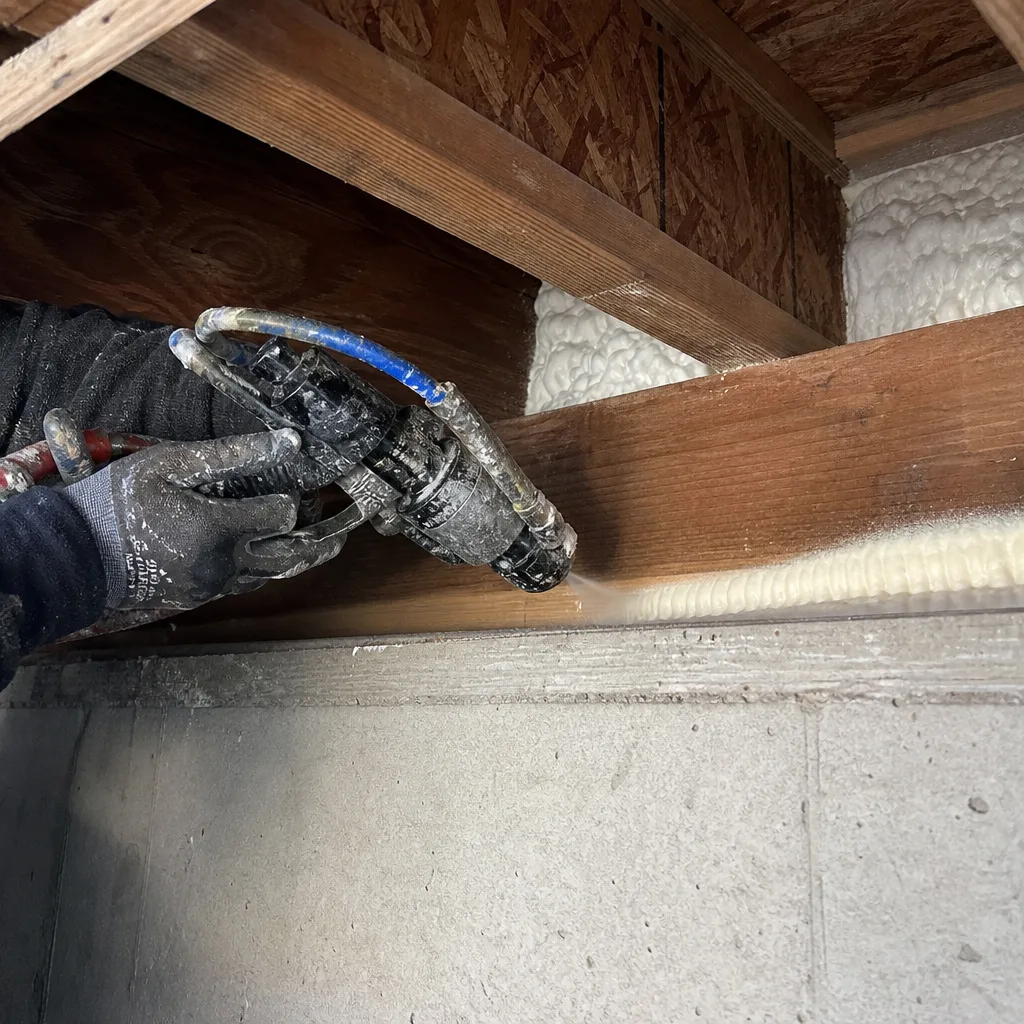
Closed Cell Spray Foam Insulation is the workhorse for Cabazon homes because it creates an air, vapor, and thermal barrier in a single pass. At roughly R-6.5 per inch, it delivers the highest R-value per inch of any insulation we install, and its rigid structure adds structural strength to roof decks and walls. For a Cabazon homeowner fighting the Pass wind, closed-cell is frequently the answer at the roofline, on rim joists, and in any crawlspace where moisture or rodent entry is a concern.
A typical closed-cell roof deck application in Cabazon runs $4,100 – $6,800 for a 1,200 – 1,600 square foot attic. Rim joist sealing in a raised foundation home usually lands between $1,400 and $2,800. These are real numbers from our work in the Pass, not national averages pulled from a website. The exact figure depends on access, prep work, and whether we’re removing old insulation first.
Roof Deck Applications in the Pass
In Cabazon’s manufactured homes and smaller older houses, roof deck foam turns the attic into conditioned space. That matters when daytime heat pushes attic temperatures past 140°F and ducts are running through that space. Closed-cell at the deck stops the heat before it reaches your ductwork.
Rim Joist and Crawlspace Sealing
Wind finds every gap in a Cabazon foundation. Closed-cell foam on rim joists and sill plates cuts the convective loop that pulls conditioned air out of the house and replaces it with outside air. We see this constantly in older homes near the Morongo Casino area where original fiberglass batts have been wind-washed flat.
Open Cell Spray Foam in Cabazon
Open Cell Spray Foam is the quieter, lower-cost sibling to closed-cell, and in the right Cabazon application it’s the smarter buy. At around R-3.7 per inch, it doesn’t match closed-cell’s thermal punch, but it excels at sound dampening and air sealing in interior wall cavities and cathedral ceilings where the temperature differential is less extreme. For a homeowner near the 10 freeway who wants road noise reduced, or a remodeler closing up a wall between bedrooms, open-cell is often the right material.
Pricing for open-cell in Cabazon generally runs $2,400 – $4,800 for a full attic floor application, and $3,900 – $5,900 for walls or vaulted ceilings. It’s typically 25 – 35% less expensive than closed-cell on a board-foot basis. The trade-off: open-cell is vapor-permeable, so in a Cabazon climate with wind-driven moisture considerations, we don’t recommend it alone on roof decks or in flood-prone crawlspaces.
Interior Soundproofing
Open-cell foam’s open structure absorbs sound in a way closed-cell can’t match. For Cabazon homes near the 10 freeway or industrial areas off Apache Trail, an open-cell application in exterior-facing walls drops transmitted noise substantially. Pair it with Rockwool in the interior wall cavities and you get a sound profile most production builders never deliver.
Attic Air Sealing Packages
When we’re doing an air-seal-first sequence in a Cabazon attic, open-cell on the floor over sealed top plates can be the budget-friendly choice, provided the roof deck isn’t part of the thermal boundary. But here’s the honest part: in this wind, we usually push closed-cell at the deck instead. The Pass doesn’t forgive shortcuts.
Trusted Brands We Service in Cabazon
Fontana Insulation is brand-agnostic in the truest sense: we carry Johns Manville, Knauf, Rockwool, and CertainTeed across fiberglass and mineral wool categories, alongside Icynene and Demilec for spray foam. That means when a Cabazon homeowner calls us, the recommendation comes from a full toolbox, not from whatever we happen to have in the warehouse. We carry Johns Manville because its fiberglass line hits the mid-range price point without sacrificing consistency. We stock Rockwool because Cabazon’s fire-risk zone demands mineral wool options for exterior walls and sound-dampening applications. CertainTeed is in the lineup because its warranty program is something we can stand behind when we put our name on the installation. No brand loyalty, just the best fit for your attic, walls, or crawlspace.
Common Spray Foam Insulation Problems We See in Cabazon Homes
- Wind-washed batts that looked fine from the hatch. In older single-family homes around the 92230 corridor, we regularly open attics to find fiberglass batts blown flat toward the downwind eave. The homeowner paid for R-38, but the wind through the San Gorgonio Pass has been stripping heat through the top plates for years. Foam over unsealed framing won’t fix this. Air sealing comes first.
- Foam sprayed directly over dusty sheathing or old batts. We’ve seen open-cell applied on top of blown-in cellulose without proper prep, and within a year the foam starts delaminating. Cabazon’s 40-degree daily swings expand and contract materials constantly. If the substrate isn’t clean and dry, the bond fails.
- Open-cell foam on roof decks where the daily dew point swings demand closed-cell. In manufactured homes and small older houses, open-cell at the deck can absorb moisture during cold winter nights and not dry fast enough. We see this most often in homes near the wind corridors where the roof gets constant air movement. Closed-cell at the deck is what the climate demands here.
- Recessed can lights and unsealed top plates sabotaging an otherwise good foam job. A homeowner near Morongo Trail called us after another contractor sprayed open-cell on the attic floor and the house still felt drafty. We found six old can lights leaking air, and top plates that had never been sealed. Once pass wind has a path, foam can’t do its job.
Pricing for Spray Foam Insulation in Cabazon, CA
Here’s what we’re quoting in Cabazon right now. A rim joist seal package on a raised-foundation home runs $1,400 – $2,800. A full open-cell attic floor application in a 1,200 square foot home runs $2,400 – $4,800. Closed-cell roof deck applications for the same size home land between $4,100 and $6,800. Wall cavity spray foam for a remodel runs $3,900 – $5,900 for open-cell, and $5,200 – $7,400 for closed-cell. The biggest cost drivers: whether we’re removing old insulation, how much prep the sheathing needs, and whether you’re adding a fire barrier per Cabazon building code requirements. Call (866) 271-1602 and we’ll give you a line-item estimate for your square footage. Estimates are free, and we’ll tell you if a cheaper material would actually serve you better.
We Also Serve Cities Near Cabazon
Fontana Insulation works throughout the San Gorgonio Pass and the surrounding mountain communities. We serve Spray Foam Insulation in Cabazon and extend service to Banning, Idyllwild, Idyllwild-Pine Cove, and Garnet. If you’re just outside Cabazon and wondering whether we cover your address, call and ask. If we can’t get there same week, we’ll tell you before you waste a morning waiting.
Serving Cabazon, CA — Our Local Coverage Area
We’re based in the Cabazon area and know this community well. Use the map below to see our service coverage — if you’re nearby, we can almost certainly help.
FAQs About Spray Foam Insulation in Cabazon
Spray foam installed without air sealing first still leaves the thermal boundary full of holes. In Cabazon specifically, the wind that blows through the San Gorgonio Pass drives convective loops through top plates, can lights, and wall-to-attic transitions, so the foam’s R-value gets undermined from underneath. The fix is a continuous air-sealed envelope: seal the plates and penetrations, then apply foam. Call (866) 271-1602 and we’ll explain what that looks like in your attic.
In most Cabazon houses and manufactured homes, closed-cell foam is the better choice at the roof deck or in any area exposed to wind-driven moisture and extreme temperature swings. Open-cell makes sense for interior walls and sound control where the thermal demand is lower. If you’re in a mobile home with thin wall cavities, we usually recommend closed-cell for maximum R-value per inch, plus an air seal. Call us and we’ll assess what your specific structure needs.
No. Spray foam needs a clean, dry substrate to adhere properly, and spraying over old batts or dusty sheathing causes adhesion failure, which the desert temperature swings accelerate. We remove the old material, air seal the top plates and penetrations, then apply foam as a continuous layer. It’s more work up front, but it’s the only sequence that holds in the Pass wind.
A 40-degree daily temperature swing expands and contracts every material in your attic, from the foam itself to the framing members and roof deck. Closed-cell foam handles those stresses better than open-cell because its rigid structure doesn’t flex as much, and its vapor-barrier properties prevent condensation cycles. The material choice matters more in Cabazon than in a mild coastal climate. Call (866) 271-1602 and we’ll walk through what your roofline and walls can handle.
Yes, and the plan starts with air sealing before foam application. The wind through the San Gorgonio Pass doesn’t stop in winter, and it will find any gap in your envelope and strip heat through it. A properly air-sealed and foamed attic in Cabazon will hold heat on windy winter nights in a way that fiberglass batts simply cannot. We include air sealing in every spray foam quote we write for homes in the Pass.
If you’re in Cabazon and tired of an attic that fights you every season, call (866) 271-1602 for a free estimate. We’ll inspect your attic, explain what we’re seeing, and give you a written quote with material options matched to your home’s actual conditions. No pressure, no brand loyalty, just an insulation specialist who knows the Pass wind better than most.
Written by Noel Arredondo, Owner at Fontana Insulation, serving Cabazon and the San Gorgonio Pass area.