
Spray Foam Insulation in Azusa, CA: What It Costs and Why It Works Here
Spray foam insulation in Azusa typically costs $2.50 to $6.00 per square foot installed, with most attic projects landing between $3,500 and $9,000 depending on foam type and square footage. Open-cell foam runs $2.50 to $4.00 per square foot, while closed-cell runs $4.00 to $6.00 because it delivers roughly double the R-value per inch and acts as its own vapor barrier. Call (866) 271-1602 for a free, on-site estimate with exact numbers for your home’s roofline and attic configuration.
Most Azusa homeowners don’t realize their real problem until July hits. Attic temps climb past 140°F, the AC runs nonstop from noon to midnight, and bedrooms facing the San Gabriels still feel stuffy at 10 p.m. That’s the diurnal swing at work – the canyon air cools fast after sunset, but a poorly insulated attic keeps radiating stored heat into living spaces for hours, which is why Reflectix repair in Azusa alone often isn’t enough without addressing the full thermal boundary. Spray foam changes that equation because it seals the thermal boundary, not just slows heat transfer. For homes along the northern edge near Foothill Blvd and the canyon mouths, it also becomes an ember-resistance upgrade, which matters more every fire season.
The team at Fontana Insulation knows Azusa’s housing stock because we work it weekly. From the 1950s-60s tract homes near downtown with original sagged fiberglass batts to the newer 1990s-2000s two-story infill west of Citrus Ave, the pattern repeats: leaky attic envelopes, under-ventilated tile roofs, and comfort problems that get blamed on the HVAC when the real culprit is the thermal boundary above the ceiling. As an eight-brand insulation specialist, we stock both Icynene and Demilec spray foam systems, so the recommendation comes from your home’s specific situation, not what’s left in the warehouse.
Fast, Reliable Spray Foam Insulation Across Azusa
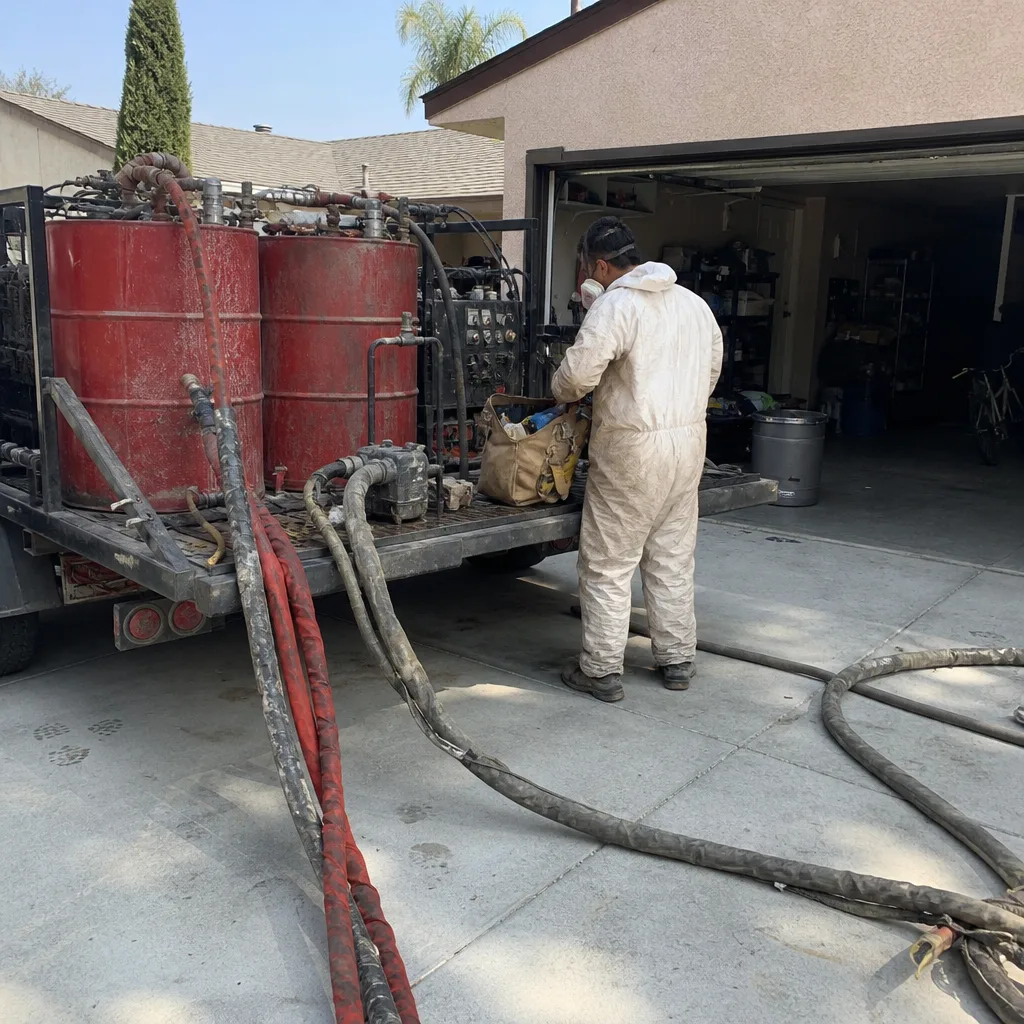
When an Azusa homeowner calls about a hot second floor or a garage that never cools down, they usually want two things: a straight answer on cost and a crew that can get there before the next heat wave. We deliver both. Our techs are in the 91702 zip code regularly – from Canyon City Park up toward the foothill neighborhoods, and south through the older tracts along Azusa Ave. We know which houses have the tricky low-pitch rooflines, which attics have barely enough headroom for a spray rig, and which tile roofs need extra masking before foam application.
Local expertise means we arrive prepared. We know the difference between a 1955 tract home with original rafters and a 2005 infill build with truss spacing that changes how foam lifts and cures. We know that Santa Ana wind days make overspray control a different animal, and we schedule interior work accordingly. You’re not getting a crew that’s learning Azusa on the day of your install. You’re getting a team that knows the city, knows the housing stock, and knows how to get the job done without damaging stucco exteriors or leaving foam residue on your tile roof.
Need us out this week? Call (866) 271-1602 and we’ll confirm an arrival window that works with your schedule. Estimates are free, and we’ll walk you through material options before you commit to anything.
Why Fontana Insulation Is Azusa’s Preferred Spray Foam Insulation Company
Most insulation contractors in the San Gabriel Valley push one material and one method. They sell what they stock, and if your attic really needs open-cell for the roofline but they only carry closed-cell, they’ll frame closed-cell as the upgrade. Fontana Insulation works the opposite way. Noel Arredondo built the company around material-agnostic consultation, because an honest recommendation only happens when the contractor actually carries competing brands at multiple price points.
We stock eight insulation brands across four material categories – fiberglass from Owens Corning, Johns Manville, Knauf, and CertainTeed; mineral wool from Rockwool; open- and closed-cell spray foam from Icynene and Demilec; and cellulose from GreenFiber. Nobody in Azusa needs all eight. But you need the right two or three for your specific roofline, budget, and fire-safety goals, and we can actually quote you options instead of steering you toward whatever’s on the truck. Azusa homeowners tell us this is the first time a contractor explained the trade-off between open-cell’s lower cost and closed-cell’s higher R-value-per-inch and moisture resistance, then let them choose.
Our Azusa jobs range from small rim joist sealing in crawlspaces to full attic encapsulation under tile roofs. The recurring feedback is about straightforward pricing and crews who don’t leave a mess. We protect floors, mask soffit vents, and clean up overspray the same day. For a home near the foothills with ember exposure concerns, we’ll also flag whether your existing attic vents are the older plastic style that melts and opens the attic to ember intrusion – something standard energy audits miss but fire-hardening assessments catch.
Crawl Space Spray Foam Insulation in Azusa
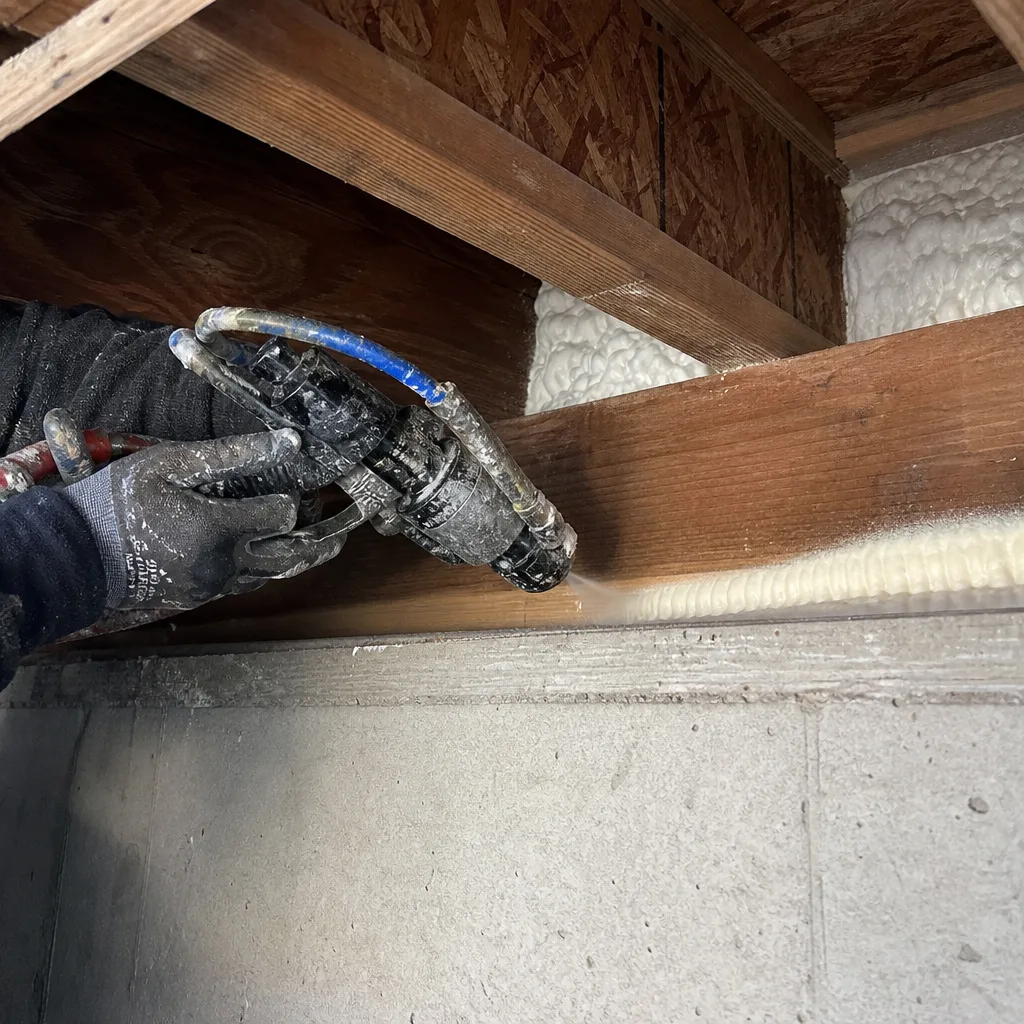
Crawl Space Spray Foam Insulation is a frequent call for Azusa homeowners with older pier-and-beam foundations, common in the pre-1960 sections of the city near Azusa Ave and the downtown grid. The job involves sealing the crawlspace perimeter – rim joists, foundation walls, and sometimes the subfloor underside – to stop outside air from drafting through the house and to control the moisture that feeds musty odors and wood rot.
A typical Azusa crawlspace with open rim joists runs $3,500 to $7,500 for closed-cell foam, depending on access clearance and total linear footage. Open-cell runs less but doesn’t provide the same vapor control, which matters because Azusa’s cool canyon nights can push humid air into crawlspaces and condense against floor framing. If you’re noticing cool floors in winter or a persistent damp smell near the foundation vents, this is usually the fix.
We also carry Spray Foam Insulation expertise for applications beyond the crawlspace, but this section is specifically about the under-floor work that changes how an old Azusa house behaves in both winter and summer.
Rim Joist Sealing
The rim joist is the single leakiest spot in most crawlspace homes, including the older stock around Azusa. We see open cavities where the floor framing meets the foundation wall, letting canyon air pour in all night. Closed-cell foam at 2 to 3 inches cuts that infiltration dramatically and stiffens the floor assembly at the same time.
Vapor and Moisture Control
Azusa’s wide temperature swing creates condensation at the crawlspace perimeter when warm daytime air cools against concrete foundation walls. Closed-cell spray foam acts as a vapor retarder while also insulating, which open-cell can’t match in this application. For homes where moisture is already an issue, we recommend addressing drainage first, then encapsulating the crawlspace perimeter.
Garage Spray Foam Insulation in Azusa
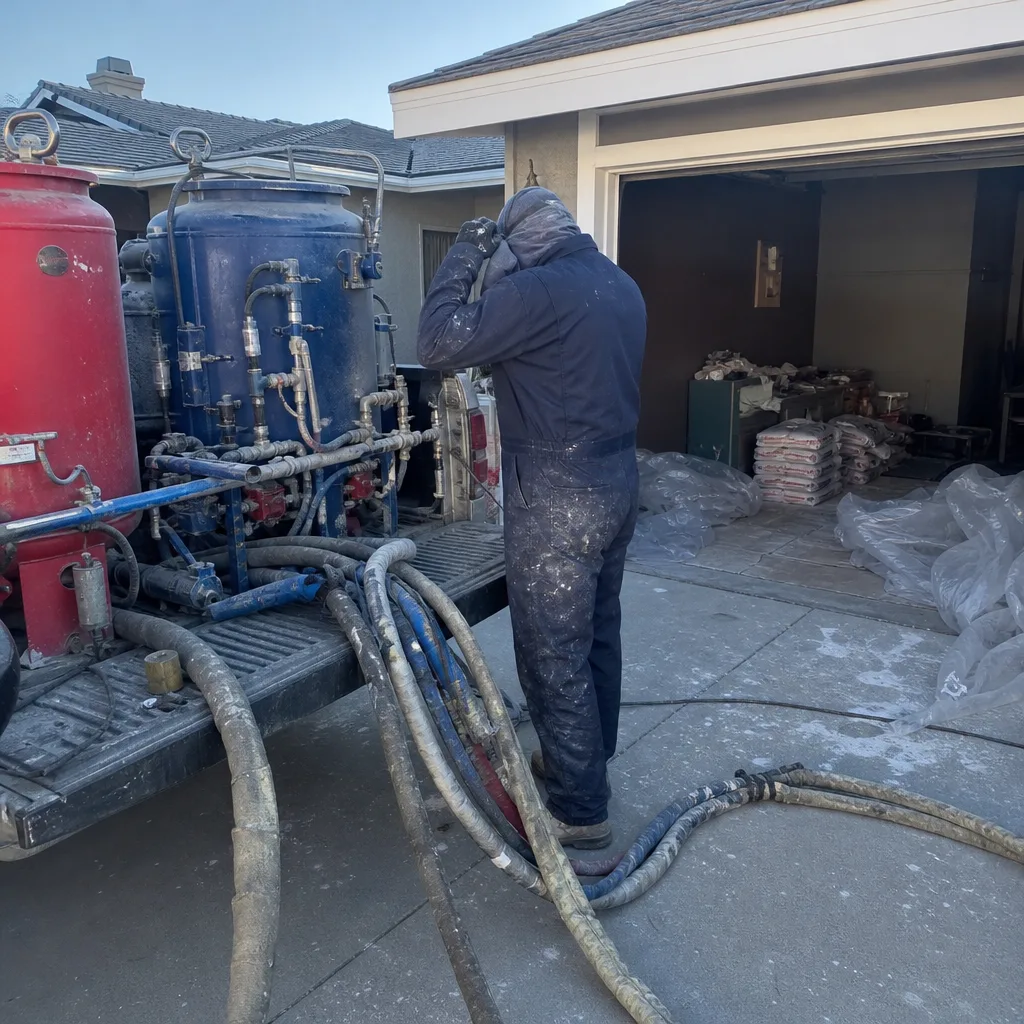
Garage Spray Foam Insulation solves a specific problem for Azusa homeowners who’ve converted garage space into workshops, home gyms, or ADU-style living areas. The job usually means spraying the garage ceiling and shared wall with the house, plus sealing the garage door perimeter where heat pours in during summer afternoons when west-facing garages bake in direct sun.
A standard attached two-car garage in Azusa runs $2,800 to $5,500 for ceiling and shared-wall foam, with the ceiling being the critical surface because that’s where attic heat transfers into the garage. Closed-cell at 2 inches on the ceiling delivers roughly R-13 plus an air seal, which is enough to drop garage temps from 120°F to the mid-80s on a 100°F day. For garage ceiling work, we typically recommend closed-cell because the air barrier matters more than the R-value alone when the space above is a vented attic.
If your garage has a room above it or you’re planning to finish the garage as living space, building code considerations change, and we’ll walk you through what Azusa’s inspectors typically require for thermal barrier coverage over foam. That’s the kind of detail that comes from doing this work in Azusa repeatedly, not from a generic installation manual.
Thermal Barrier Code Compliance
Any spray foam in a garage that connects to living space needs a thermal or ignition barrier, and Azusa inspectors enforce this consistently. We apply an intumescent coating or drywall cover as part of the scope, so the job passes the first time and doesn’t trigger a re-inspection.
Door Perimeter Air Sealing
Garage doors in Azusa’s older tract homes often have gaping daylight gaps at the top and sides, which lets hot exterior air pour in. We seal the perimeter around the door opening with closed-cell foam and install new weatherstripping, which is a small add-on that makes the ceiling work actually hold its temperature difference.
Trusted Brands We Service in Azusa
For Azusa customers, we stock spray foam from Icynene and Demilec because both have decades of third-party performance testing behind them, and both offer formulations that perform consistently across the temperature range Azusa delivers – 40°F winter nights up to 105°F summer afternoons. We also carry Johns Manville and Knauf fiberglass for hybrid applications where foam handles the air sealing and a fiberglass layer handles the R-value, plus Rockwool mineral wool for homeowners who want the fire-resistance profile that matters at Azusa’s foothill edge. Every material we install in Azusa is stocked locally, so if a job runs short mid-install, we don’t put your project on hold waiting for a truck from Fontana.
Common Spray Foam Insulation Problems We See in Azusa Homes
- DIY foam failures in retrofit attics: Homeowners in Azusa’s 1950s-60s tract homes sometimes attempt DIY foam kits on their own, and we regularly get called to fix uneven lifts, cracked foam, and missed rim joist cavities. The cost to remove and redo a botched DIY job is usually double what professional installation would have cost originally.
- Ember-vulnerable soffit vents near the foothills: Homes along the northern edge of Azusa, especially near Foothill Blvd and the canyon mouths, often have older plastic soffit vents that melt or ignite under ember exposure. When we spray an attic in these neighborhoods, we flag these vents and recommend metal mesh replacements as part of fire hardening.
- Sagging or settled fiberglass in low-pitch attics: Many original Azusa attics have barely 18 to 24 inches of clearance at the eaves, and the original fiberglass batts have slumped away from the roofline. Spray foam fixes this because it bonds to the deck and seals the cavity regardless of pitch or access clearance.
- Roof deck condensation in mild winters: Azusa’s cool, damp canyon nights and warm daytime sun create condensation risk at the roof deck when someone adds insulation without air sealing. We see this most often in homes where a previous contractor blew fiberglass over the existing batts without addressing attic ventilation. Closed-cell foam eliminates the condensation surface entirely.
Pricing for Spray Foam Insulation in Azusa, CA
Based on recent Azusa projects in 91702, here’s what our customers paid for common scopes. Open-cell spray foam for a full attic roofline: $4,500 to $8,000 depending on square footage. Closed-cell attic encapsulation: $6,500 to $12,000. Rim joist sealing in a crawlspace: $1,800 to $3,500. Garage ceiling and shared wall: $2,800 to $5,500. A hybrid approach – closed-cell at the roofline plus fiberglass on the attic floor – lands between $3,800 and $7,000 and works well for Azusa homes where ventilation is adequate and fire hardening isn’t the priority.
What moves the number is foam type, total board feet, and access difficulty. Tile roofs take longer to mask. Tight attics take longer to spray. Two-story homes need more scaffolding. We quote all of this line-item, so you see exactly where the money goes before we start. Call (866) 271-1602 and we’ll schedule a free on-site estimate, usually within a few days, with a written scope and pricing you can compare against anyone else.
We Also Serve Cities Near Azusa
Our Azusa crews cover the surrounding foothill communities, so if you’re in Citrus, Irwindale, Covina, or Glendora, the same material options and pricing apply. We run the San Gabriel Valley daily, and our Azusa work brings us through those neighboring cities constantly. We also handle Attic Insulation in Azusa, which pairs well with spray foam for hybrid thermal boundary projects.
Serving Azusa, CA — Our Local Coverage Area
We’re based in the Azusa area and know this community well. Use the map below to see our service coverage — if you’re nearby, we can almost certainly help.
FAQs About Spray Foam Insulation in Azusa
We can typically get a tech to any 91702 address within two to four business days, and we offer free estimates with a written scope and pricing. Call (866) 271-1602 to get on the schedule this week.
Yes, we work across all of 91702, including the downtown tract areas, the foothill neighborhoods north of Foothill Blvd, the canyon-adjacent communities near the San Gabriel Mountains, and the newer infill developments west of Citrus Ave.
For situations like a storm-damaged attic or a rim joist failure causing rapid heat loss, we prioritize emergency calls and can often reach Azusa within 48 hours. Call (866) 271-1602 and describe the situation, and we’ll move the schedule to get someone out.
Azusa pricing runs nearly identical to Citrus, Irwindale, Covina, and Glendora because we use the same material costs and labor rates across the San Gabriel Valley. The only Azusa-specific cost factor is tile roof masking, which adds a bit to some attic jobs. Call (866) 271-1602 for an exact quote on your property.
We offer manufacturer warranties on all spray foam installs in Azusa, typically covering material defects for the product’s rated lifespan, and our workmanship is backed by a labor warranty. We’ll outline both in writing before installation, so you know exactly what’s covered. Call (866) 271-1602 to discuss your project.
Written by Noel Arredondo, Owner at Fontana Insulation, serving Azusa with material-agnostic insulation expertise.