
Fast, Reliable Spray Foam Insulation Across Torrance
Spray foam insulation in Torrance solves a specific problem: marine-layer moisture working its way into older attics and walls. We install open-cell and closed-cell foam in 90501, 90503, 90504, and the Southwood tract, and we schedule most Torrance jobs within a week. If you’re tired of a clammy attic or drafty mid-century walls, call (866) 271-1602 and we’ll walk you through what your home actually needs.
Torrance isn’t like inland LA. The salt air, the morning overcast, the cool damp that sits over the South Bay from May through July – it all changes how insulation should be specified. We’ve worked enough attics between Old Town and the 405 to know the difference between an R-value problem and a moisture problem. Most Torrance homes have both.
Why Fontana Insulation Is Torrance’s Preferred Spray Foam Insulation Company
Most insulation contractors carry one or two foam brands and sell whatever’s on the truck. That’s not how we work. Fontana Insulation stocks eight brands across four material categories, including Icynene and Demilec spray foam, because a 1953 Southwood ranch needs a different assembly than a 2015 build near Del Amo Fashion Center. Noel Arredondo built the company around material-agnostic recommendations. If open-cell is right for your interior walls and closed-cell for your rim joists, that’s what we quote. No brand loyalty. Just the right fit for the job.
The marine layer doesn’t wait for a generic insulation company to figure out venting. We know Torrance attics: the clogged soffits on 1950s tracts, the paint overspray blocking ridge vents, the salt film on sheathing. When you call us, you’re getting a crew that’s solved those exact problems on Torrance streets.
Closed Cell Spray Foam Insulation in Torrance
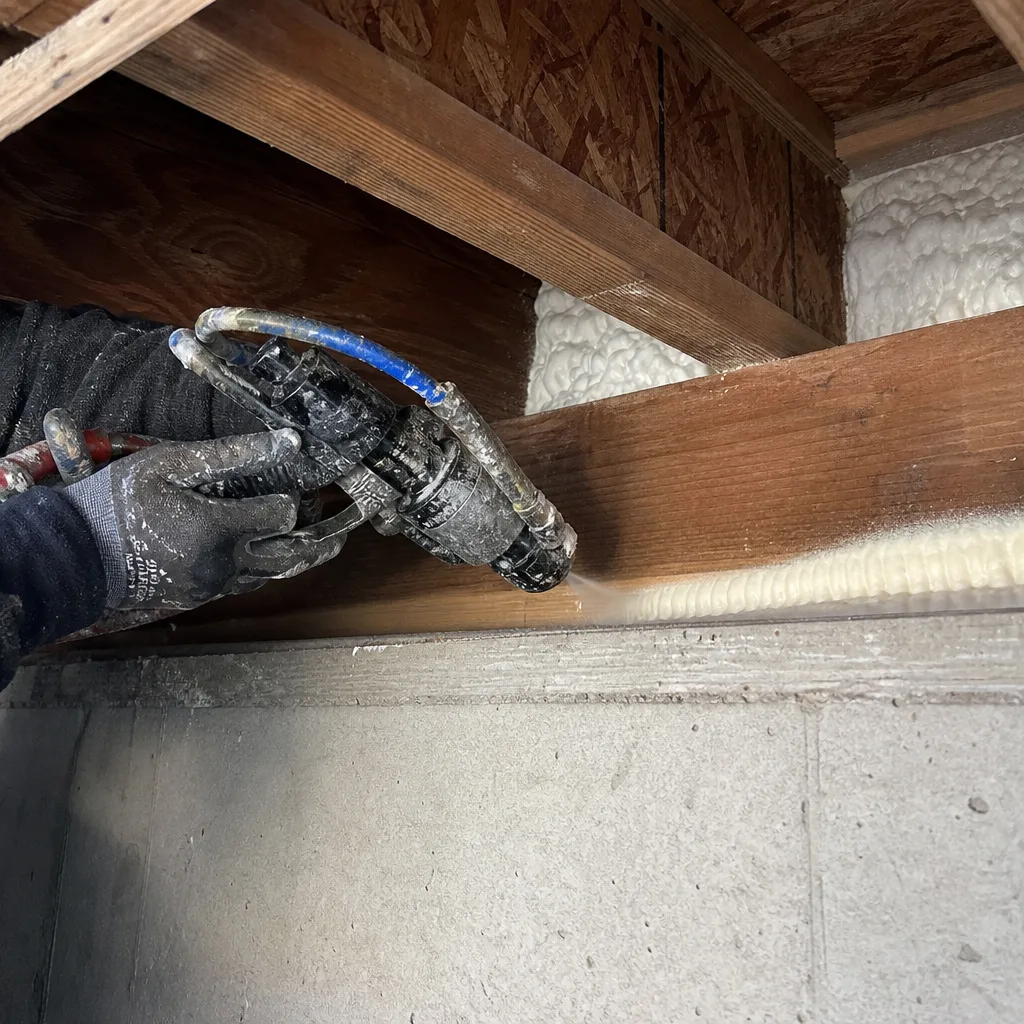
Closed cell spray foam insulation is the workhorse for Torrance homes where moisture intrusion and structural rigidity both matter. It’s a dense, rigid foam that expands to roughly 2 inches of R-value per inch and acts as its own vapor barrier. In Torrance’s marine-layer conditions, that vapor barrier behavior is why we use it on sloped rooflines, rim joists, and garage ceilings. A typical closed-cell job in Torrance runs $2.00 to $3.50 per board foot installed, with most whole-attic applications landing between $3,800 and $7,200 depending on square footage and access.
Moisture-Tolerant Roofline Sealing
Torrance’s morning overcast keeps roof sheathing damp until noon for much of the year. Closed-cell foam, applied correctly after vents are cleared, stops that moisture from condensing on rafters. The foam bonds directly to the sheathing and won’t absorb water the way fiberglass batts do.
Rim Joist and Flood-Prone Crawlspace Work
Homes near the 90502 corridor and older parts of 90501 often have crawl spaces that stay musty from soil moisture and salt air. Sealing rim joists with closed-cell cuts that humidity at its entry point. It also stiffens the floor assembly, which you notice in older Torrance homes with bouncy floors.
Open Cell Spray Foam in Torrance
Open cell spray foam is the better choice when you want air sealing and sound reduction without the higher cost of closed-cell. It’s a lighter, spongier foam that expands aggressively into cavities and lets moisture pass through, which makes it safer in wall assemblies that need to breathe. In Torrance, open-cell jobs typically run $1.20 to $2.00 per board foot, with standard attic ceiling applications from $2,500 to $5,400 depending on depth and prep work.
Sound Dampening for Freeway-Adjacent Homes
If you live north of Torrance Boulevard near the 405 or west of Western near the 110, you know the constant hum. Open-cell foam is our go-to recommendation for those homes because it deadens airborne noise far better than fiberglass. The foam’s open structure absorbs sound waves instead of letting them pass through the ceiling plane.
Wall Cavity Fill for Older Tract Homes
Most 1950s Torrance ranch homes have uninsulated wall cavities. Open-cell foam can be injected from the exterior or interior with minimal disruption, filling those voids completely. It stretches with minor settling, so the seal stays intact as the house moves through temperature cycles.
Trusted Brands We Service in Torrance
We carry Icynene and Demilec spray foam because both brands have decades of performance testing in coastal climates. Icynene’s open-cell formulation handles the moisture-pass-through we want in Torrance wall cavities. Demilec’s closed-cell lines hold up to salt air exposure on rim joists and rooflines. We also stock Rockwool mineral wool, CertainTeed fiberglass, and GreenFiber cellulose for hybrid assemblies where foam isn’t the whole answer. If we quote a Torrance job on Tuesday, the material’s on our truck by Thursday.
Common Spray Foam Insulation Problems We See in Torrance Homes
- Damp sheathing under closed-cell foam. When foam is sprayed directly over clammy, salt-laden roof sheathing, it traps that moisture against the wood. Rot follows. We always dry the surface and clear venting before foaming.
- Clogged soffit and ridge vents. Decades of salt film and paint overspray seal off attic airflow in 1950s Southwood and Old Town homes. Foam alone can’t fix a dead vent system – it makes condensation worse.
- Knob-and-tube-adjacent wiring hazards. Many original Torrance homes still have active or abandoned knob-and-tube runs in the attic. Spray foam encases that wiring and can cause overheating. We require wiring inspection before foaming those areas.
- Sound leakage through rim joists. Homes along the freeway corridors hear tire noise through unsealed rim joists long before they notice attic heat loss. A narrow band of closed-cell at the rim joist cuts that noise measurably.
Pricing for Spray Foam Insulation in Torrance, CA
Open-cell spray foam in Torrance runs $1.20 to $2.00 per board foot. Closed-cell runs $2.00 to $3.50 per board foot. A 1,200-square-foot attic with open-cell typically lands around $3,200 to $4,800. The same attic with closed-cell brings $4,800 to $7,200. What moves those numbers: access (crawlspace vs. walkable attic), prep work (venting clearance, wiring protection), and depth. Our Spray Foam Insulation team quotes by the board foot, so you know exactly what you’re paying for. Call (866) 271-1602 for a free site estimate – Noel or a lead tech will walk the space with you and explain the recommendation in plain English.
We Also Serve Cities Near Torrance
Fontana Insulation runs crews through Torrance weekly, and we cover the surrounding South Bay and Harbor areas: Lomita, West Carson, Rolling Hills Estates, and Manhattan Beach. If you’re on the edge of town or just over a city line, the same marine-layer expertise applies. Call and we’ll tell you when our next truck is in your neighborhood.
Serving Torrance, CA — Our Local Coverage Area
We’re based in the Torrance area and know this community well. Use the map below to see our service coverage — if you’re nearby, we can almost certainly help.
FAQs About Spray Foam Insulation in Torrance
Torrance sits in the South Bay marine layer belt, where cool, salt-laden air pushes inland every morning and keeps attic surfaces damp for hours. Inland LA attics dry out by 9am; Torrance attics stay clammy until afternoon. That means spray foam must be paired with active venting and vapor management. Skip that step and you’re sealing moisture into the structure. We clear soffit and ridge vents before any foam touches the sheathing, and we spec moisture-tolerant assemblies on every coastal job.
No, and you shouldn’t let anyone do that. The original fiberglass in Torrance’s 1950s tract homes is almost always damp and matted from years of marine-layer condensation. Foam over that traps the moisture against the ceiling drywall and framing. We remove the old material, dry the cavity, clear the venting, then apply foam to a clean surface. It’s more work, but it’s the only way the seal holds. On a 1953 ranch in Southwood (90505), our crew found the original fiberglass batts damp and matted, with soffit vents clogged by paint overspray. We pulled the soggy batts, cleared the soffit and ridge vents, and applied closed-cell foam to the sloped roofline. The morning clamminess was gone the next day.
For Torrance, we typically recommend Demilec closed-cell on rooflines and rim joists where moisture tolerance and rigidity matter, and Icynene open-cell in wall cavities where breathability and sound control are priorities. Both brands hold up to salt air and humidity cycles better than cheaper formulations. That said, the right answer depends on your home’s age, venting, and whether you’re on the freeway side or the quieter south end of town. We carry both brands and let the house tell us which one fits. Call (866) 271-1602 and we’ll give you a straight answer.
Spray foam reduces freeway noise in two ways. Open-cell foam in the attic floor or ceiling cavity absorbs airborne sound, cutting the constant hum that penetrates through fiberglass. Closed-cell at the rim joist blocks sound flanking through the wall-to-floor connection, which is the path most 405-adjacent homes in 90501 and 90503 struggle with. Homes within a quarter mile of the freeway see the biggest difference, especially with open-cell at roof deck level and a closed-cell rim joist band.
Not without prep work. Knob-and-tube wiring was designed to dissipate heat into open air. Encasing it in foam traps that heat and can push the conductors past safe operating temperature. That’s a genuine fire hazard. On Torrance homes with original or abandoned knob-and-tube in the attic, we require a licensed electrician to inspect and reroute or protect the wiring before we foam. No exceptions. It’s the same rule we apply everywhere in the South Bay, and it’s written into every quote. Call (866) 271-1602 if you’re unsure what’s in your attic – we’ll tell you what we see.
Written by Noel Arredondo, Owner at Fontana Insulation, serving Torrance and the South Bay with material-agnostic insulation expertise.