
Fast, Reliable Spray Foam Insulation Across San Joaquin Hills
Spray foam insulation in San Joaquin Hills typically runs $2.50 to $6.50 per board foot installed, and the real driver here isn’t winter cold; it’s the inland foothill sun baking southwest-facing stucco walls and attic decks from June through October. We’re Fontana Insulation, and we spec open- and closed-cell spray foam for homes across the 92657 ZIP code where heat gain control matters more than R-value alone. If your second floor runs eight degrees hotter than your first, that’s a fixable problem. Call (866) 271-1602 and we’ll tell you exactly what’s going on in your attic.
Our crews know the custom and semi-custom homes along Newport Coast Drive, Ridge Park Road, and the Summit and Harbor Ridge communities. These aren’t tract homes. Tile roofs, cathedral ceilings, stucco exteriors, and original fiberglass batts that have been compressed or displaced by years of HVAC work create heat problems most coastal homes never see. We respond to San Joaquin Hills calls with a crew that already understands the construction type before we pull up.
Why Fontana Insulation Is San Joaquin Hills’s Preferred Spray Foam Insulation Company
We carry eight insulation brands across four material categories; fiberglass, mineral wool, open- and closed-cell spray foam, and cellulose. That’s the difference. Most contractors in this area push one product line because it’s what they stock. We stock Icynene and Demilec for spray foam applications, but we’ll also tell you when Rockwool mineral wool or a blown-in fiberglass from CertainTeed makes more sense for your specific house. No brand loyalty. Just the right fit for your attic, walls, or crawlspace.
Noel Arredondo leads our team, and his approach is straightforward: match the material to the problem, not to our inventory. For San Joaquin Hills hillside homes with heat-soaked southwest exposures, that often means closed-cell spray foam on the roof deck and rim joists. For a garage ceiling below a bonus room, open-cell may be the better call. We’ll explain the trade-offs in plain language and give you a written scope before any foam leaves the truck.
Afternoon sun in San Joaquin Hills is relentless. We’ve measured attic temperatures above 140 degrees in August on homes along Ridge Park Road. When we apply foam, we’re solving for radiant heat, air sealing, and moisture control together, not just adding R-value on a spec sheet.
Garage Spray Foam Insulation in San Joaquin Hills
Garage Spray Foam Insulation in San Joaquin Hills usually targets the ceiling cavity between the garage and the finished space above it. On custom homes with integrated smart-home systems, that garage ceiling often carries wiring, audio components, and battery backup hardware. Open-cell foam handles this well; it air-seals the thermal boundary, cuts sound transmission from garage doors and chargers, and still allows the cavity to dry if moisture ever finds its way in. A typical garage ceiling application in San Joaquin Hills runs $1,800 to $4,200 depending on square footage and whether we’re also treating the rim joist band.
When a Garage Ceiling Warrants Foam
The trigger is usually a bonus room or second-floor bedroom directly above the garage that never cools down in summer. Heat rises from the garage slab, gets trapped in the joist cavities, and radiates upward through the floor. Open-cell spray foam at 5.5 to 6.5 inches breaks that heat path. We’ve done this work on homes near the Summit community, and the temperature difference in the room above is noticeable within a day.
Air Sealing the Rim Joist Band
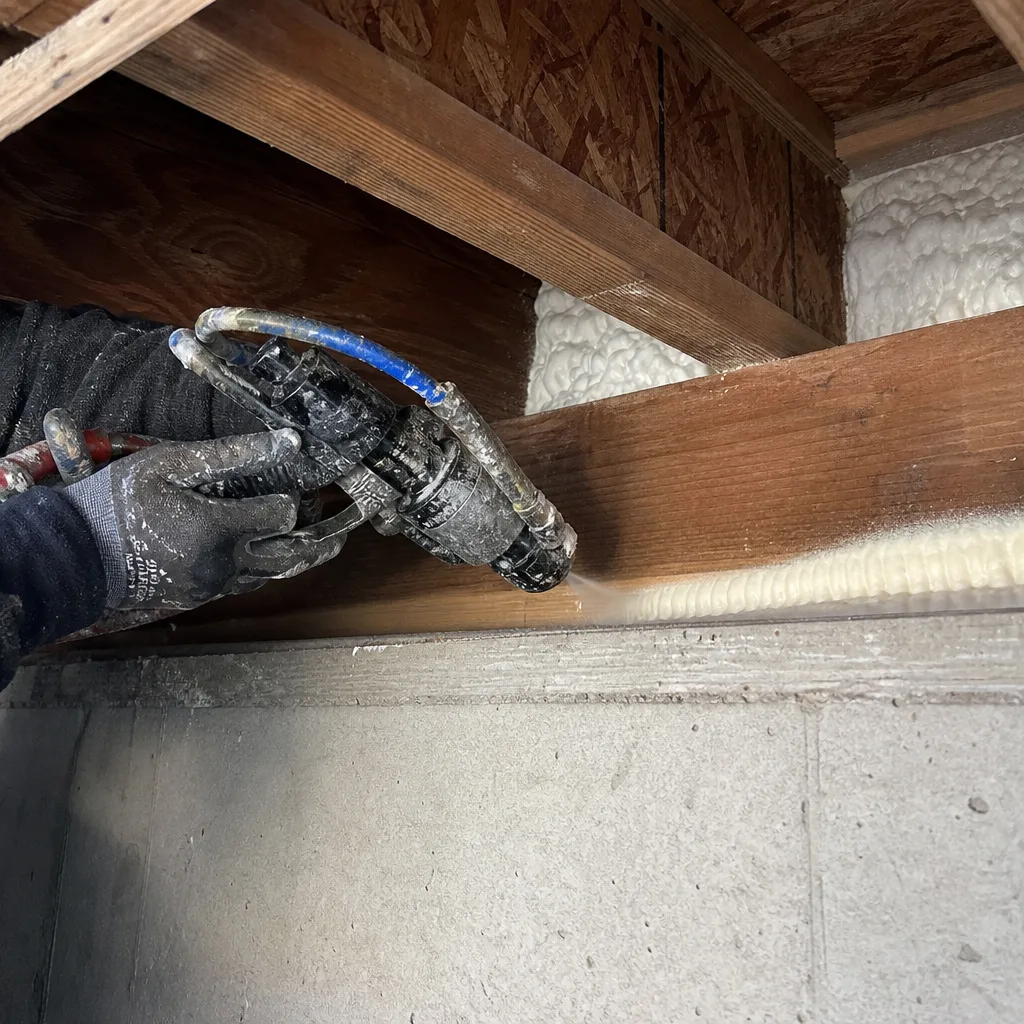
The rim joist where the garage ceiling meets the exterior stucco wall is a known air leakage point. On hillside lots, wind-driven air pushes through that band and into the joist cavities. We seal it with closed-cell foam; about an inch and a half creates both an air barrier and a vapor retarder. This is a small add-on, typically $500 to $900 on a three-car garage, and it stops the drafts that make garage-adjacent rooms feel clammy.
Closed Cell Spray Foam Insulation in San Joaquin Hills
Closed Cell Spray Foam Insulation in San Joaquin Hills is the go-to spec for attic roof decks on southwest-facing hillside homes. At roughly 2 inches, it delivers an R-value near 13 and, more importantly, an air and vapor barrier in one pass. For stucco homes in the 92657 ZIP code where the marine layer burns off by mid-morning, closed-cell on the underside of the roof deck keeps attic temperatures closer to the living space and blocks the radiant heat that would otherwise soak through the ceiling. Expect to pay $4.00 to $6.50 per board foot installed, which translates to $8,000 to $18,000 for a full attic deck treatment on a typical 2,500 to 3,500 square foot San Joaquin Hills home.
Cathedral Ceilings and Heat Gain
Many San Joaquin Hills homes have cathedral ceilings in the great room or master suite. The original cavity is often fiberglass batt with no continuous air barrier. Hot air from the attic side pushes through every seam and recessed light. Closed-cell foam sprayed directly against the roof deck above that ceiling eliminates the air channel entirely. It’s the difference between a room that hits 80 degrees by 3 p.m. and one that holds at 74 with the same AC setting.
Stucco Wall Retrofit on Southwest Exposures
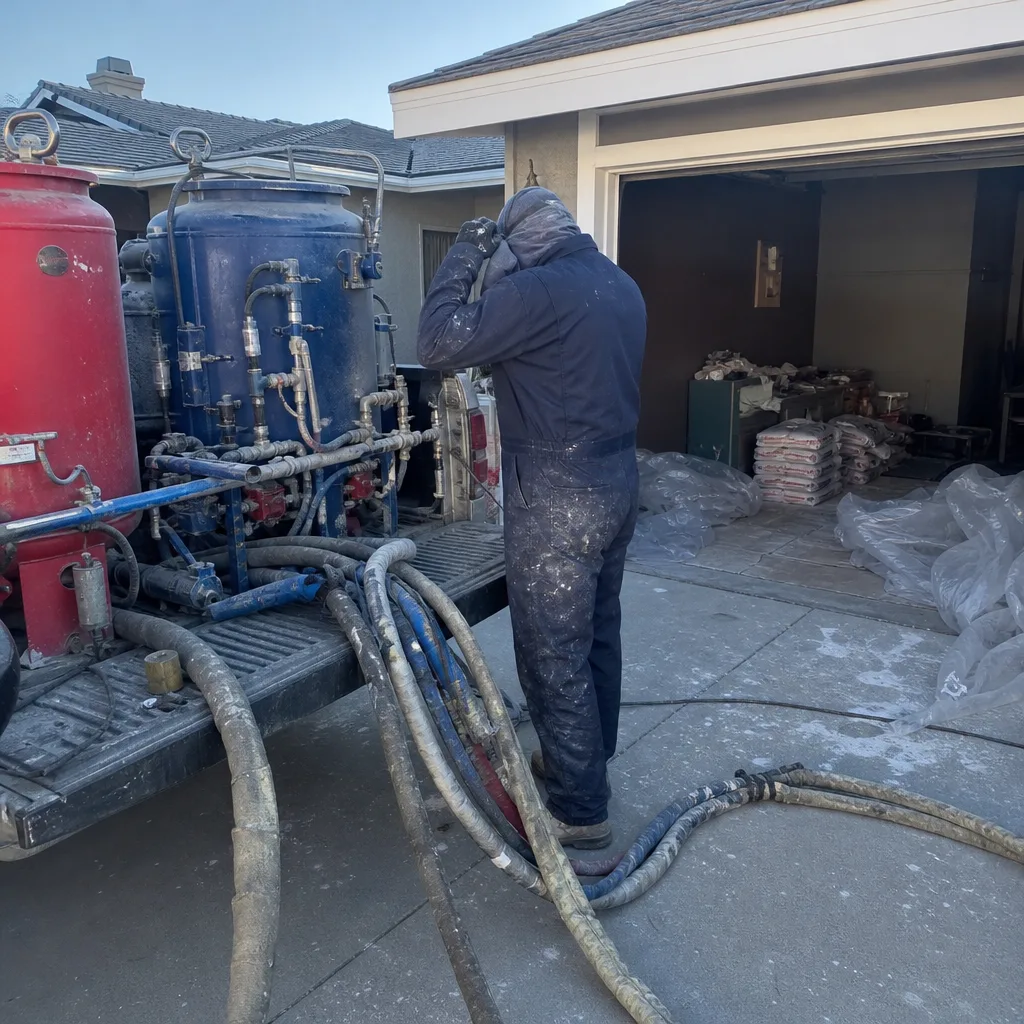
When we’re treating southwest-facing walls, surface preparation is non-negotiable. Stucco that’s chalky or dusty won’t hold foam long-term. We clean and, where needed, prime before application. On a custom home in the Summit community, our crew addressed second-floor hot spots caused by compressed fiberglass batts displaced during an HVAC retrofit. We applied closed-cell spray foam (Icynene) to the southwest-facing attic deck and rim joists, then sealed duct penetrations with Demilec foam, eliminating the temperature differential between floors. That’s the kind of surgical fix this housing stock calls for.
Trusted Brands We Service in San Joaquin Hills
We’re an authorized installer for Icynene and Demilec, the two Spray Foam Insulation brands we lean on for San Joaquin Hills projects where air-sealing and vapor control are the priority. We also stock Knauf and CertainTeed fiberglass and Rockwool mineral wool for homes where the budget or the application calls for a different approach. Because we carry competing brands at every price tier, the recommendation we give a homeowner in San Joaquin Hills is based on the wall assembly, the roof configuration, and the comfort complaint, not on what’s cheapest to stock. We keep local project files for the 92657 area, so a follow-up call never starts from zero.
Common Spray Foam Insulation Problems We See in San Joaquin Hills Homes
- Foam sprayed over compressed fiberglass without removal. Some contractors will leave old batts in place and spray over them. The fiberglass keeps absorbing heat, the foam can’t bond to the substrate, and the whole assembly underperforms. We remove or remediate the existing material before spraying.
- Inadequate attic ventilation paired with roof-deck foam. Sealing the attic without addressing intake and exhaust ventilation traps moisture against the roof sheathing. On San Joaquin Hills homes with tile roofs and limited ridge venting, this shortens foam lifespan and invites condensation. We check ventilation before quoting any roof-deck job.
- Delamination on stucco walls from poor surface prep. Southwest-facing stucco in this microclimate gets blasted by sun and then cools sharply at night. Foam applied over dusty or poorly bonded stucco will eventually peel. We clean, score, and prime as needed.
- Hot spots from HVAC retrofits that displaced batts. When a contractor adds a new air handler or re-routes ductwork, the original fiberglass gets shoved aside. The second floor turns into a sauna. Spray foam on the affected cavities and rim joist band restores the thermal barrier.
Pricing for Spray Foam Insulation in San Joaquin Hills, CA
Open-cell spray foam in San Joaquin Hills runs $2.50 to $4.00 per board foot. Closed-cell runs $4.00 to $6.50 per board foot. A garage ceiling job lands between $1,800 and $4,200. A full attic roof deck on a 3,000 square foot home typically falls between $9,000 and $18,000, depending on depth, roof pitch, and how much existing insulation has to be removed. Rim joist sealing runs $500 to $900 on a standard three-car garage. Tile roofs and tight attic access add labor. Every quote includes a written scope, material spec, and target R-value. Call (866) 271-1602 for a free estimate; we’ll come out, inspect, and give you numbers you can actually compare against other bids.
We Also Serve Cities Near San Joaquin Hills
Our crews work throughout the inland foothill corridor. If you’re in San Joaquin Hills proper or nearby Aliso Viejo, Newport Beach, Laguna Beach, or Irvine, we can schedule an inspection the same week. Call (866) 271-1602 and mention your neighborhood; we’ll route the closest crew to you.
Serving San Joaquin Hills, CA — Our Local Coverage Area
We’re based in the San Joaquin Hills area and know this community well. Use the map below to see our service coverage — if you’re nearby, we can almost certainly help.
FAQs About Spray Foam Insulation in San Joaquin Hills
Yes. Closed-cell spray foam on the underside of the roof deck or inside southwest-facing wall cavities blocks radiant heat before it enters the living space. In San Joaquin Hills, where the marine layer burns off early and afternoon sun heats stucco exteriors well above ambient air temperature, this is the single most effective fix we install for second-floor overheating. Call (866) 271-1602 for a heat-gain assessment.
No, not properly. Foam needs a clean, solid substrate to bond to. Applying it over compressed fiberglass batts traps heat in the old material and prevents a continuous air barrier from forming. We remove the existing fiberglass, inspect the decking, and then spray. It’s more labor upfront, but it’s the only way the foam works as specified.
Hot spots happen when HVAC installers move or compress the original batts to make room for new ductwork. The thermal barrier gets torn open. We spray closed-cell foam into the compromised cavities and along the rim joist band, sealing the air path and restoring the heat barrier. On a recent Summit community job, this eliminated a seven-degree difference between first and second floors in one day.
Yes. Open-cell foam on the garage ceiling both insulates the space above and dampens sound from garage door openers, EV chargers, and home battery systems. Because open-cell breathes, it won’t trap moisture around the low-voltage wiring and smart-home hubs that often run through that cavity. Expect to pay $1,800 to $4,200 for a typical two- or three-car garage ceiling.
Closed-cell foam is usually the better spec here because it blocks radiant heat, acts as an air and vapor barrier, and holds up in the dry, hot attic conditions common to the inland foothills. Open-cell makes sense in garage ceilings and interior sound-control applications. The right answer depends on your roof pitch, wall assembly, and budget; call (866) 271-1602 and we’ll walk through the options for your specific house.
Written by Noel Arredondo, Owner at Fontana Insulation, serving San Joaquin Hills and surrounding foothill communities.