
Fast, Reliable Spray Foam Insulation Across Mayflower Village
Spray foam insulation in Mayflower Village typically runs $2.50 – $6.50 per square foot installed, depending on whether the job calls for open-cell in an interior wall or two-pound closed-cell at the rim joist. Most homes here fall into two camps: original 1920s – 1960s bungalows with empty wall cavities, or those same homes with 1980s – 2000s stucco additions layered on top. We scope both assemblies separately because they behave differently under Mayflower Village’s dry foothill heat. Call (866) 271-1602 and we’ll walk the house with you before we quote anything.
Why Fontana Insulation Is Mayflower Village’s Preferred Spray Foam Insulation Company
Mayflower Village’s housing stock is not uniform, and neither is our approach to it. The original blocks off Mayflower Avenue and Duarte Road are mostly 1920s – 1950s single-story bungalows and ranch homes with plaster walls and knob-and-tube-era framing. Many still carry the original newspaper-and-sawdust fill or bare joists. On top of that sits a wave of 1980s – 2000s additions and stucco remodels that were insulated, if at all, to a completely different standard. Our Spray Foam Insulation team has scoped enough of these two-part houses to know the air leaks rarely live where homeowners expect them.
Noel Arredondo built Fontana Insulation around a material-agnostic model: we carry eight brands across four material categories because Mayflower Village homes present wildly different retrofit situations. One house needs closed-cell at the rim joist. The next needs open-cell in a knee wall. We’re not married to a single product line, so the recommendation comes from what the structure needs, not what’s cheapest to stock. That matters when you’re dealing with a 1948 bungalow that’s been added onto twice and re-roofed once.
We work the full Mayflower Village area within the 91006 ZIP code, from the bungalow blocks near the Arcadia line to the newer stucco additions climbing toward Monrovia. Local knowledge means we already know your attic probably has unsealed recessed cans and aluminum sliders leaking air before we step through the door.
Spray Foam Wall Insulation in Mayflower Village
Spray Foam Wall Insulation in Mayflower Village is most commonly a retrofit job for the original plaster-wall bungalows that dominate the neighborhood’s older blocks. These cavities were often filled with newspaper-and-sawdust insulation or left completely bare, and after 70 to 100 years of San Gabriel Valley summers, they’re not doing much. We scope each wall assembly before quoting because the 1980s – 2000s stucco additions create a second target under the same roof. Spray foam wall insulation here typically runs $2.50 – $5.00 per square foot of wall area depending on cavity depth and access.
Open-cell for interior stop-gaps
When the goal is slowing air movement through interior walls and knee-wall cavities, open-cell foam makes sense. It’s lighter, more affordable per board foot, and does a solid job of filling irregular plaster-and-lath cavities. On a 1940s Mayflower Village bungalow we foamed near Mayflower Avenue, the knee-wall cavities were the main culprit pulling attic heat into the living room past aluminum sliders. Open-cell closed that path without overbuilding the assembly.
Closed-cell where moisture or structure matters
Closed-cell foam is the right call for wall assemblies that face moisture or need structural racking strength, and it’s priced higher for good reason. We carry Demilec and Icynene closed-cell products because both brands have the testing history to back their R-value claims in real retrofit conditions. When a Mayflower Village wall cavity shows signs of old water staining or sits against a shallow crawl space, we recommend two-pound closed-cell without hesitation.
Rim Joist Spray Foam in Mayflower Village
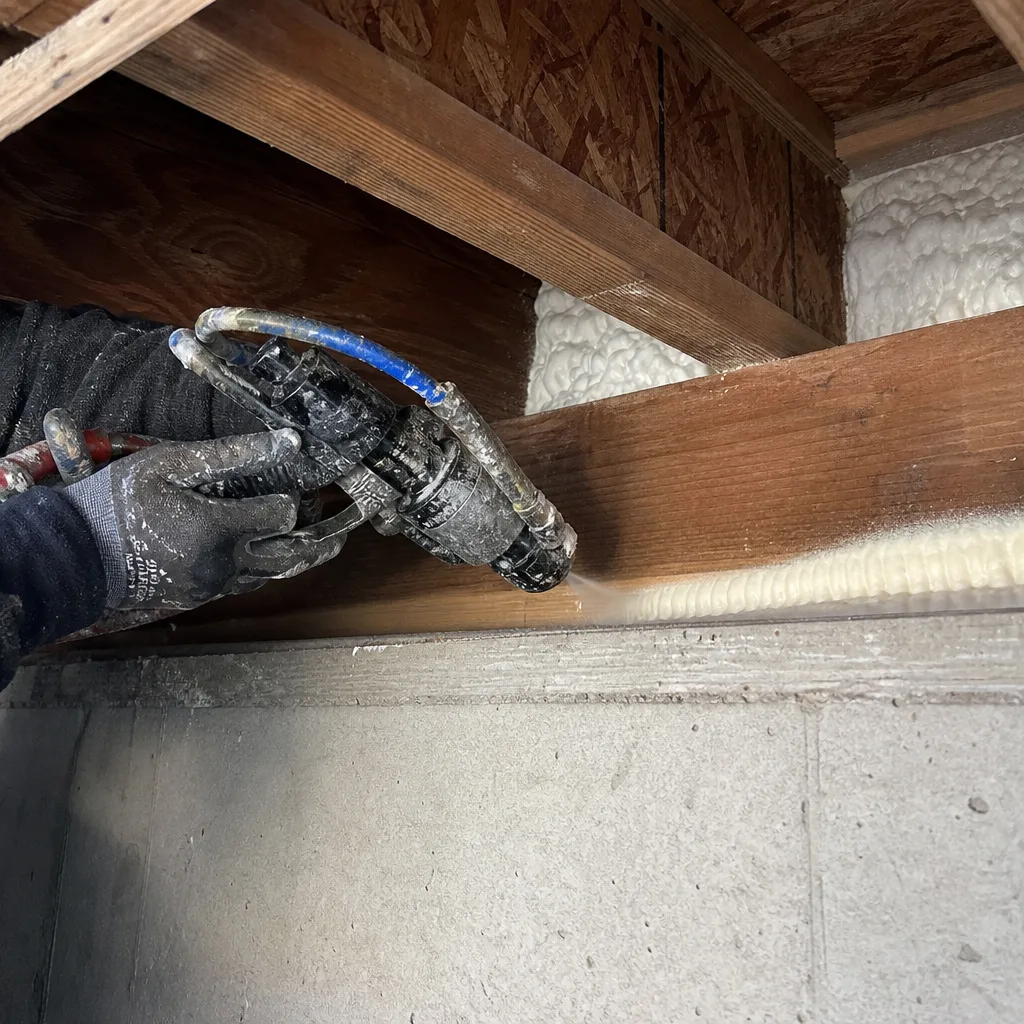
Rim Joist Spray Foam in Mayflower Village targets the single most overlooked air leak in the neighborhood’s older homes: the band board where floor framing meets the foundation. On a 1940s single-story bungalow off Mayflower Avenue, our crew found bare joists and open rim cavities in the shallow crawl space, with attic air finding its way out through every unsealed penetration. We sealed the rim joists with two-pound closed-cell foam and the homeowner stopped feeling the draft through the sliders in one trip. Expect rim joist spray foam to run $350 – $900 for a typical Mayflower Village crawl space, depending on linear footage and access height.
Why closed-cell owns the rim joist
Closed-cell foam is the standard for rim joist work because it air-seals and acts as a vapor retarder in one pass. In Mayflower Village’s dry, windy autumns, that matters: the rim joist is where dusty foothill air finds its way in, and where conditioned air leaks out. We carry Demilec and Icynene for this application specifically because both brands have closed-cell formulations that stand up to heat cycling without shrinking away from the framing.
One-trip detailing for older homes
The rim joist rarely gets quoted correctly on older Mayflower Village homes because the assembly is difficult to access and often buried under abandoned mechanical lines or old newspaper insulation. We scope it separately from wall foam. That’s not an upsell. It’s the difference between fixing the actual air leak and foaming a cavity that wasn’t the problem. When Noel Arredondo’s crews finish a Mayflower Village crawl space, the homeowner gets a thermal boundary that actually works.
Trusted Brands We Service in Mayflower Village
We carry Rockwool because some Mayflower Village homeowners prioritize fire resistance and sound dampening alongside thermal performance, and mineral wool earns its place when stucco additions need a non-combustible layer at the wall-to-roof transition. We stock Johns Manville and Knauf open-cell and closed-cell spray foam products because both brands have reliable, field-tested formulations for retrofit work in the 91006 ZIP code. And we carry CertainTeed because their fiberglass and foam lines are warrantied heavily and homeowners recognize the name. The point is simple: we’re not brand-loyal, we’re application-loyal. Fontana Insulation brings the full toolbox and lets the house tell us what it needs.
Common Spray Foam Insulation Problems We See in Mayflower Village Homes
- Original newspaper-and-sawdust fill behind plaster walls. Foaming over it without checking first can trap moisture and hide wiring problems behind the foam. We always inspect what’s already in the cavity before we quote wall foam on a 1920s – 1950s Mayflower Village bungalow.
- The 1980s – 2000s stucco addition treated as one assembly with the original plaster base. The rim-joist and knee-wall detailing that actually stops attic air never gets scoped, and the homeowner pays for wall foam that doesn’t fix the real leak.
- Aluminum slider windows and unsealed recessed cans pulling attic air into living rooms. On a 1940s bungalow off Mayflower Avenue, we confirmed the recessed cans were IC-rated and boxed before sealing the rim joists and knee walls. One trip, no return visit, and the attic bleed through the sliders stopped.
- Sealing a dry, windy foothill attic too tight without balancing venting. That leaves an ember-scrutiny problem for wildfire insurance instead of the air-sealing fix the homeowner actually wanted. Air-sealing and venting have to be designed together in Mayflower Village’s climate.
Pricing for Spray Foam Insulation in Mayflower Village, CA
A typical spray foam insulation project in Mayflower Village runs $2,200 – $6,800, with rim joist work on the lower end and full wall cavity retrofits on the higher end. Open-cell interior walls land at $2.50 – $4.50 per square foot. Closed-cell rim joist and moisture-prone assemblies run $3.50 – $6.50 per square foot. The two biggest cost drivers in the 91006 ZIP code are cavity access and whether the original newspaper-and-sawdust fill has to be removed before we foam. We quote rim joist and wall foam separately on older Mayflower Village homes because they’re two different scopes. Call (866) 271-1602 for a free estimate and we’ll walk the house with you, not just give you a number over the phone.
We Also Serve Cities Near Mayflower Village
Our crews regularly run spray foam projects in Arcadia, Monrovia, Sierra Madre, and North El Monte. If you’re in a neighboring city and dealing with the same two-part housing stock or foothill heat, the same material-agnostic approach applies. We cover the full San Gabriel Valley from our Fontana base.
Serving Mayflower Village, CA — Our Local Coverage Area
We’re based in the Mayflower Village area and know this community well. Use the map below to see our service coverage — if you’re nearby, we can almost certainly help.
FAQs About Spray Foam Insulation in Mayflower Village
Yes, they change what actually stops the air leak. Aluminum sliders on a 1940s Mayflower Village bungalow leak attic air into living rooms, and unsealed recessed cans are usually the path. We confirm the cans are IC-rated and boxed before foaming the knee walls and rim joists, because foaming around a non-IC-rated can is a fire hazard. Foam fixes the thermal boundary, but the window and can detailing determines whether the homeowner actually feels the difference. Call (866) 271-1602 and we’ll scope it in person.
We schedule Mayflower Village estimates on a rolling basis and can usually get a crew to the 91006 ZIP code within a few business days, sometimes sooner depending on the calendar. Rim joist and knee-wall scopes are often faster to quote because they’re contained. The estimate is free, and we’ll walk the house with you rather than quoting from a satellite photo.
Yes. We work the full 91006 ZIP code, from the original bungalow blocks off Mayflower Avenue and Duarte Road to the stucco additions closer to the Monrovia and Arcadia lines. Mayflower Village isn’t large, but its housing stock changes block by block, and we’re familiar with where the newspaper-and-sawdust cavities end and the 1980s stucco begins.
Pricing in Mayflower Village runs roughly in line with Arcadia, Monrovia, Sierra Madre, and North El Monte, usually $2.50 – $6.50 per square foot depending on open-cell versus closed-cell. What changes the number here is the age of the original cavity and whether the 1980s – 2000s addition has to be scoped separately. We don’t quote a single blanket number on these homes because the two assemblies rarely cost the same to foam.
Our spray foam work carries manufacturer-backed warranties through Icynene and Demilec, and we stand behind the installation itself with a workmanship guarantee. The manufacturer covers the foam’s performance when it’s installed to spec, and we document every Mayflower Village job so the warranty has teeth. Call (866) 271-1602 for specifics on your project.
Written by Noel Arredondo, Owner at Fontana Insulation, serving Mayflower Village and the San Gabriel Valley with material-agnostic insulation expertise.