
Fast, Reliable Spray Foam Insulation Across Lakeland Village
Spray foam insulation in Lakeland Village is a different job than it is ten miles up the hill. The lake air holds moisture, summer afternoons push past 100°F, and attics over older cabins and mid-century homes routinely hit 150°F or more. That combination means closed-cell foam is often the right call here, not just an upgrade. Fontana Insulation installs Icynene and Demilec open- and closed-cell spray foam, and we know which side of Lakeland Village needs which product. If your west-facing roof is cooking the rooms below it, call (866) 271-1602 and we’ll come out to look at what’s actually happening up there.
Why Fontana Insulation Is Lakeland Village’s Preferred Spray Foam Insulation Company
We carry eight insulation brands across fiberglass, mineral wool, spray foam, and cellulose, so the conversation starts with your home’s specific problem, not with whatever product we happen to have in the warehouse. In Lakeland Village, that problem is usually heat gain through an unvented or poorly vented attic, complicated by humidity off Lake Elsinore. Noel Arredondo leads our team, and he’s the kind of contractor who will tell you when spray foam is the wrong material for a job. That’s the advantage of being material-agnostic: we’d rather sell you the right fix than talk you into foam because it’s on the truck.
Our crew has worked throughout ZIP 92530, from the lake side to the slope homes above Grand Avenue, and we know what’s waiting in those attics: cooked fiberglass, compressed batts, gaps around recessed lights, and roof decks that radiate heat well into the evening. Lakeland Village homeowners call us because the upstairs stays hot at midnight, or the AC bill doubled in June, or there’s condensation in the attic that didn’t used to be there. We diagnose the thermal boundary first, then recommend the foam type and thickness that addresses it.
Spray Foam Insulation Contractors in Lakeland Village
Spray Foam Insulation Contractors working in Lakeland Village have to account for the lake’s humidity, and that changes the material recommendation. Open-cell foam is a great air sealer and costs less per board foot, but in a humid attic it can absorb moisture and lose R-value if it’s not detailed correctly on a west-facing roof deck. Closed-cell foam, like the Icynene and Demilec products we install, acts as its own vapor retarder and adds structural rigidity. For most Lakeland Village attics, closed-cell is the default. A typical closed-cell attic encapsulation in Lakeland Village runs $4,500 to $9,800 depending on square footage and roof pitch. Rim joist jobs in smaller lake cabins land closer to $1,800 to $3,600.
Closed-Cell for the Lake Humidity
Closed-cell spray foam at 2 inches gives you about R-13 to R-14 and a built-in vapor barrier. That matters here. When attic air is damp from Lake Elsinore, open-cell foam without a separate vapor retarder can wick that moisture and lose performance. We see this on the lake side of town: homeowners who got open-cell sprayed a few years ago and now have damp insulation against the roof deck. Closed-cell eliminates that failure mode.
Rim Joist and Crawlspace Sealing
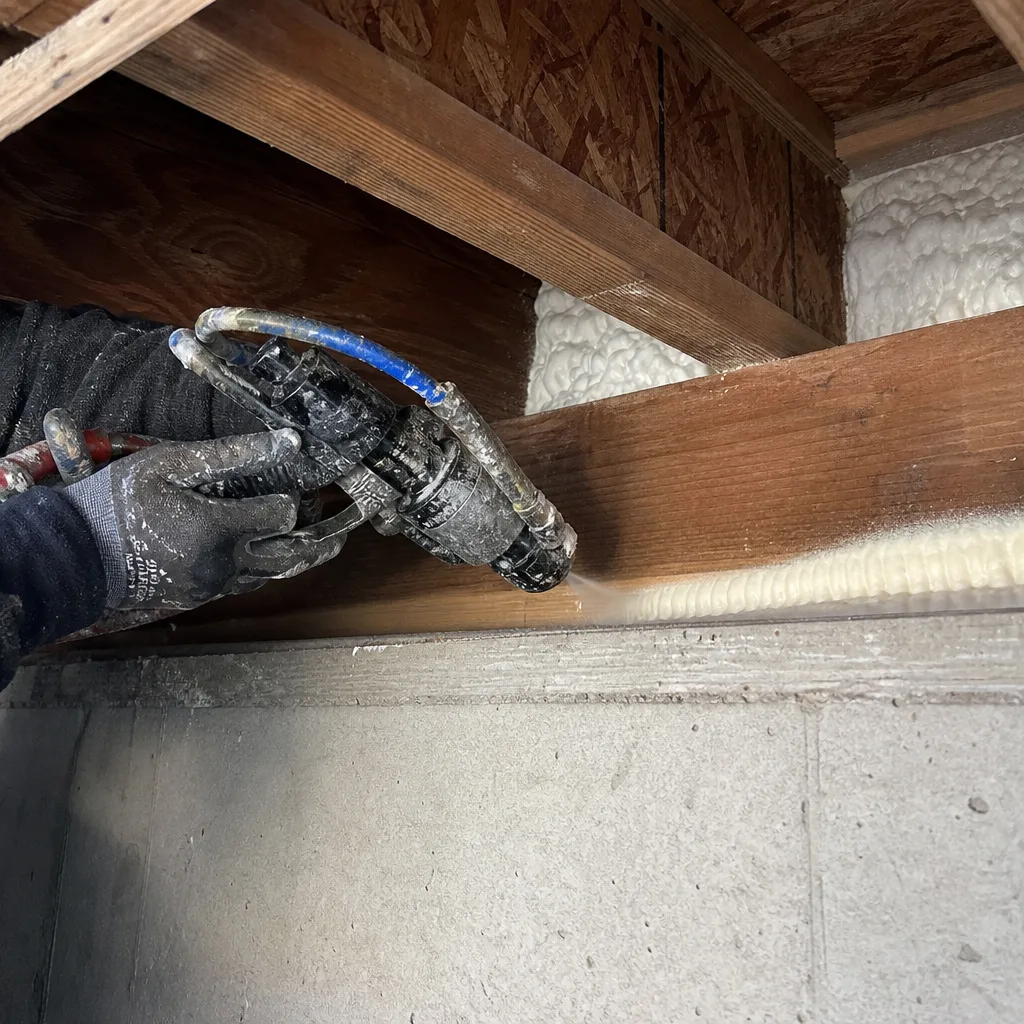
Older Lakeland Village homes often have uninsulated rim joists, and that’s a direct path for hot, humid outside air to get pulled into the conditioned space. We spray closed-cell foam on rim joists to stop air movement and add R-value in a tight space where batt insulation never fits well. It’s a one-day job on most homes, and it makes a measurable difference in how hard the AC has to run.
Spray Foam Attic Insulation in Lakeland Village
Spray Foam Attic Insulation in Lakeland Village almost always targets the roof deck rather than the attic floor, and there’s a specific reason why. When you insulate the floor of a ventilated attic, the attic itself still reaches 150°F on a July afternoon. That heat radiates down through the ceiling all evening. Foam on the underside of the roof deck brings the attic inside the home’s thermal boundary, so the attic temperature stays within a few degrees of the living space. A roof deck spray in a typical Lakeland Village ranch runs $5,200 to $11,000. Garage ceiling and roof deck projects fall between $2,400 and $6,500.
Unvented Attic Conversions
When foam goes on the roof deck, the attic becomes an unvented assembly. In Lakeland Village, that means two things have to happen: the foam has to be thick enough to hit a code-compliant R-value, and you need an ignition barrier if the space will be used for storage or accessed regularly. We walk every homeowner through what Riverside County code requires, and we don’t skip that step just to keep the bid low.
West-Facing Roof Decks
The homes that get hammered hardest in Lakeland Village are the ones with west-facing slopes. Afternoon sun pounds those shingles and roof decks. We recently sprayed closed-cell Icynene on the underside of a west-facing roof deck in a 1950s cabin near the lake, where the original fiberglass had compressed to less than R-8 and the attic had hit 160°F. After sealing the unvented assembly and adding an ignition barrier, the living space below dropped nearly 10°F during a 104°F afternoon, and the homeowner stopped running a second window unit in the front room.
Trusted Brands We Service in Lakeland Village
We don’t push one foam manufacturer. We install Icynene and Demilec spray foam because both have years of independent performance testing behind them, and we stock the ancillary materials those systems require for Lakeland Village jobs. Beyond foam, we carry Rockwool mineral wool for fire-resistance and sound-dampening applications, CertainTeed and Johns Manville fiberglass for budget-conscious vented attics, and Knauf for spec-driven remodel work. If your Lakeland Village attic needs foam but your walls need something else, we’re not going to sell you foam everywhere. Learn more about our full Spray Foam Insulation lineup and how we match material to application.
Common Spray Foam Insulation Problems We See in Lakeland Village Homes
- Open-cell foam absorbing lake humidity: On west-facing roof decks over unvented attics, open-cell foam applied without a vapor retarder can soak up moisture from lake air and lose R-value. We’ve pulled out damp, sagging open-cell foam from more than one Lake Elsinore shore home.
- Foam sprayed over compressed fiberglass: Mid-century homes in Lakeland Village often have original batts that have collapsed under decades of heat cycling. Spraying foam over them traps that dead fiberglass and the heat inside it. The old material has to come out first.
- Unvented attics without ignition barriers: Converting a vented attic to unvented means foam is exposed inside the space. Lakeland Village homes with older knob-and-tube or cloth wiring need an ignition barrier over the foam for fire safety, and some installers skip that step. We don’t.
- Skylights and recessed lights breaking the air seal: Homes near the lake often have skylights added in the 1990s, and the gaps around them leak air constantly. Foam has to be detailed around every penetration, not just sprayed over the general roof deck area and called good.
Pricing for Spray Foam Insulation in Lakeland Village, CA
As a local spray foam contractor serving Lakeland Village, here’s what we see in the current market. Closed-cell roof deck encapsulation on a 1,200 square foot attic typically runs $5,200 to $9,800. Open-cell attic spray, where the humidity profile allows it, runs $3,200 to $6,400. Rim joist sealing runs $1,800 to $3,600 for most homes. Garage ceiling spray runs $2,400 to $4,700. Larger lakefront homes with complex roof lines and multiple skylights land on the higher end. Foam thickness requirements, access difficulty, and the condition of the existing insulation all move the number. We give written, itemized quotes before any work starts, and the estimate is free. Call (866) 271-1602 to schedule an attic assessment in Lakeland Village.
We Also Serve Cities Near Lakeland Village
Our Lakeland Village customers often refer us to friends and family in nearby communities. We work regularly in Sedco Hills, Canyon Lake, Meadowbrook, and Wildomar, where the climate profile is similar but the housing stock shifts from lake cabins to newer tract homes. If you’re in one of those cities and dealing with a hot attic or high cooling bills, the same material-agnostic approach applies.
Serving Lakeland Village, CA — Our Local Coverage Area
We’re based in the Lakeland Village area and know this community well. Use the map below to see our service coverage — if you’re nearby, we can almost certainly help.
FAQs About Spray Foam Insulation in Lakeland Village
Yes, when the right foam is used for the assembly. Closed-cell spray foam acts as its own vapor retarder and is the safer choice for the humid side of Lakeland Village. Open-cell foam can work in vented attics, but on an unvented roof deck near the lake it needs a separate vapor retarder. We assess the attic before recommending anything. Call (866) 271-1602 and Noel will walk you through what your roof deck actually needs.
In most cases, yes. A typical 1,200 to 1,800 square foot attic takes one full day on site. Prep work, like removing compressed fiberglass or sealing wiring penetrations, sometimes adds a second morning, but the foam application itself is a single visit. We tell you upfront what your attic needs before we schedule the crew.
For a hot, humid climate like Lakeland Village’s, we aim for R-38 to R-49 on attic floors in vented assemblies, and R-20 to R-30 for closed-cell foam on roof decks in unvented assemblies. Those targets align with California’s Title 24 energy code for this climate zone. The exact number depends on your roof pitch, framing depth, and whether you’re converting the attic to conditioned space.
Spray foam isn’t the right product for sealing door gaps on an oversized workshop door; that’s a weatherstripping and threshold job. What foam does well is air-seal the walls and roofline of the workshop so the door isn’t the only thermal boundary. If you’re losing heat through the walls or roof of a detached shop, closed-cell foam handles that. If the doors themselves need a seal, we’ll tell you that directly and point you to the right fix.
Closed-cell foam on the underside of a west-facing roof deck stops radiant heat before it enters the attic space. We’ve measured attic temperatures above 160°F on the west side of Lakeland Village before foam was installed. After a closed-cell encapsulation, those same attics stay within 10 degrees of the living space. That’s what ended the second window unit situation in the cabin near the lake.
If your Lakeland Village home is fighting the Elsinore Valley heat and you want a straight answer about spray foam, call (866) 271-1602. We’ll assess the attic, give you a written quote, and recommend the material that solves your problem, not the one that’s easiest for us to sell.
Written by Noel Arredondo, Owner at Fontana Insulation, serving Lakeland Village and the Inland Empire.