
Fast, Reliable Spray Foam Insulation Across Hollywood
Spray foam insulation in Hollywood typically runs $2.50 – $7.50 per square foot installed, with attic jobs landing between $2,800 and $6,500 and wall retrofits between $3,200 and $8,000 depending on foam type and cavity access. Fontana Insulation serves all of Hollywood and the 90028 ZIP, from the courtyard apartments south of Franklin to the bungalow courts off Santa Monica Boulevard, and we’re usually on-site within 1 – 2 business days. Call (866) 271-1602 for a free estimate.
We know this neighborhood’s buildings aren’t like the rest of LA. That’s the point. Our Spray Foam Insulation team works in 1920s courtyard apartments, mid-century stucco walk-ups, and the newer infill near the Boulevard, so we understand what foam can and can’t do in each one.
Why Fontana Insulation Is Hollywood’s Preferred Spray Foam Insulation Company
Most Hollywood insulation jobs come down to one thing: matching foam to a building that was never designed for it. We carry open-cell and closed-cell spray foam from Icynene and Demilec, two brands tested for the exact conditions Hollywood throws at them. Close to the Hollywood Bowl and the 101, homeowners ask for acoustic performance first and thermal second. We spec foam to do both.
Our lead installer, Noel Arredondo, has walked hundreds of Hollywood attic hatches and wall cavities. He knows what hides behind 1920s lathe and plaster, what knob-and-tube wiring looks like from above, and when a party wall needs dense-pack cellulose instead of a spray. That’s the kind of judgment you don’t get from a contractor who only stocks one product line.
Because we carry eight brands across four material categories, we don’t have to convince you that foam is the only answer. Sometimes it is the answer, sometimes Rockwool or blown-in fiberglass does the job better. Hollywood customers get the honest call either way. No brand loyalty, just the best fit for your attic, walls, or crawlspace.
And we show up. Hollywood parking is tight, permits are particular, and older buildings have surprises. We’ve worked around film crews on residential streets, HOAs with strict hours, and buildings where the only attic access is a 14-inch scuttle. That local familiarity means fewer delays and cleaner installs.
Spray Foam Attic Insulation in Hollywood
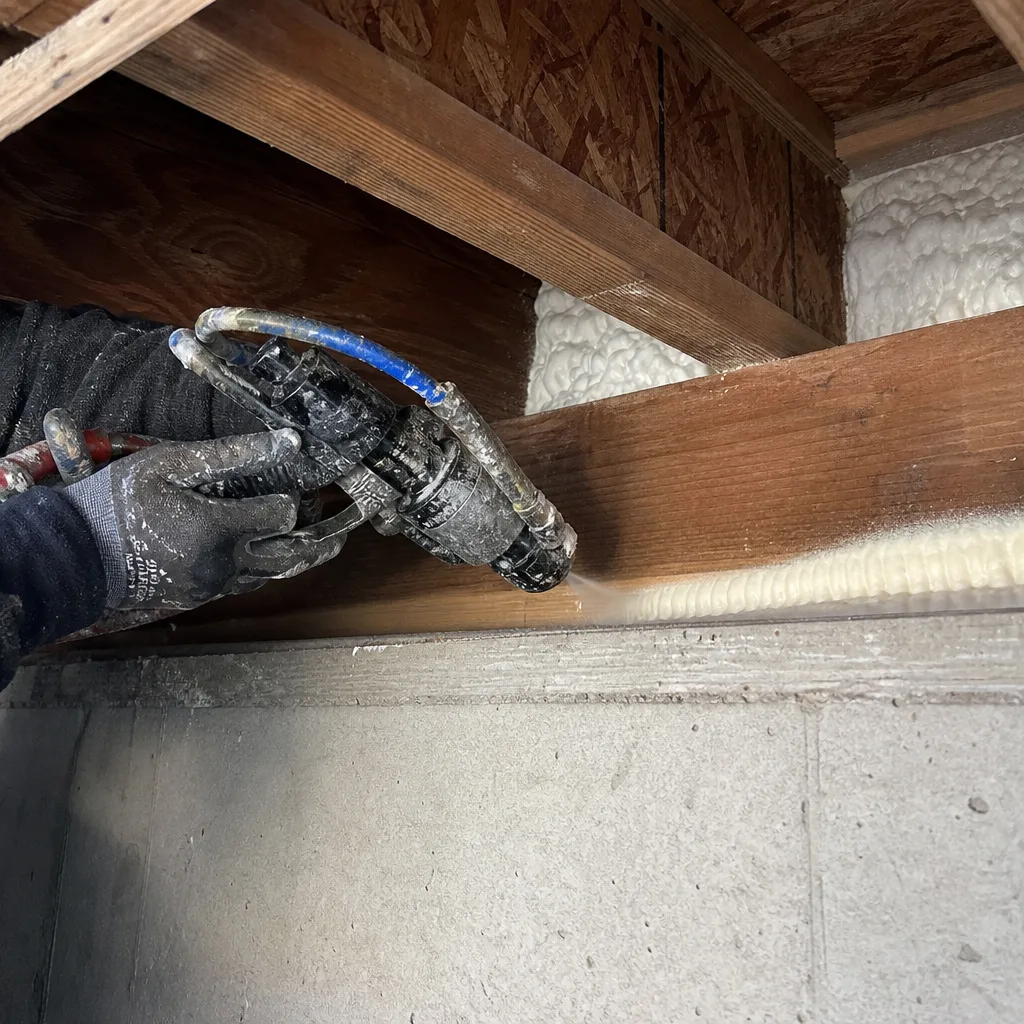
Spray Foam Attic Insulation in Hollywood is most often an open-cell application at the roofline, turning a vented attic into a semi-conditioned buffer against the long cooling season. The flat stucco and low-pitch roofs common in the flats absorb direct sun for hours; an unsealed attic under that roof can hit 130°F by 2:00 p.m. in August. Foam at the roofline keeps that heat out of the living space and puts the thermal boundary where it belongs.
What a Hollywood homeowner gets for this: we remove old batts or leave them where they don’t interfere, seal any penetrations from old wiring or plumbing, and apply foam to the roof deck. For a typical 900 – 1,400 square-foot attic, expect $2,800 – $6,500. Closed-cell adds R-value per inch and doubles as a moisture barrier, which matters when Santa Ana winds push dust and dry air through every gap, but open-cell usually wins for budget and sound control.
Shared-Attic Flanking in Courtyard Buildings
In Hollywood’s courtyard apartments, the attic is where noise travels between units with nothing to stop it. Foam alone doesn’t kill that sound; the sealing work does. We foam and seal shared attic penetrations at the same time, which is what actually stops the transfer. That’s the difference between a quote that covers R-value only and one that solves the problem you called about.
Roof Deck Retrofit, Not Just the Floor
Some homeowners ask for attic floor insulation only, but that’s already common in Hollywood’s older homes, and it doesn’t fix heat gain through the ceiling plane. A roofline application works harder here, especially with the dark flat roofs and south-facing slopes around Beachwood Canyon and the hills. We’ll give you both prices so you can see the trade-off.
Spray Foam Wall Insulation in Hollywood
Spray Foam Wall Insulation in Hollywood usually means retrofitting wood-frame, stucco-clad walls from the 1920s through the 1960s, walls that were built with zero insulation or a thin rock wool batt that’s settled into nothing. Drill-and-fill with open-cell foam or dense-pack cellulose lets us insulate without opening the interior, which matters in occupied rentals and historic bungalows. Budget $3,200 – $8,000 for a typical courtyard unit or single-family bungalow, with the higher end representing closed-cell on uneven stud bays or hard-to-reach party walls.
Party Walls and Sound Transfer
This is the Hollywood-specific piece. When units share a wall, the problem isn’t heat; it’s your neighbor’s television at 11:00 p.m. Foam in a party wall cuts the high-frequency transfer and fills the small penetrations that carry sound between units. It’s specified for acoustic isolation as often as thermal performance around here, especially in the dense blocks near Sunset and Santa Monica.
Wiring and Fire Code in Older Walls
You cannot spray foam over live knob-and-tube wiring in a 1920s wall. It’s a fire hazard and a code violation. On a 1926 courtyard building near the Hollywood Boulevard infill, we found original uninsulated walls with knob-and-tube wiring and thin stucco that let street noise straight through. We removed the old wiring first, sealed every penetration, then applied Icynene spray foam to the shared party walls. The owner got a quieter unit and lower cooling bills without a gut renovation.
Trusted Brands We Service in Hollywood
We install Icynene and Demilec spray foam because those two brands earn their place through independent testing and long-term performance data, not marketing. We also stock Johns Manville and CertainTeed fiberglass for jobs where spray foam doesn’t make sense, and Rockwool for Hollywood clients who want fire resistance and sound dampening in the same layer. We service all of these brands in Hollywood, and because we’re not tied to any single manufacturer, the material choice is yours to make with our input, not ours to push.
Written by Noel Arredondo, Owner at Fontana Insulation, serving Hollywood and greater Los Angeles.
Common Spray Foam Insulation Problems We See in Hollywood Homes
- Foam over original knob-and-tube wiring. 1920s walls still carry live cloth wiring in too many Hollywood buildings. We trace and decommission it before spraying; no shortcuts.
- Blistered foam on thin stucco from one thick pass. Foam applied too heavily on uneven, sun-baked stucco lifts and fails. We spray in controlled lifts, especially on south and west elevations where Hollywood’s sun is brutal.
- Acoustic flanking through unsealed shared attics. Even a perfectly foamed party wall won’t stop noise if the shared attic above is open. We seal penetrations and the attic plane at the same time, which is the only way that fix holds.
- Foam coverage gaps behind built-ins and closets. Old Hollywood bungalows are full of oddly framed dead spaces. We drill extra access holes rather than leave large voids, because a cavity that’s only 70% filled performs like it’s 40% filled.
Pricing for Spray Foam Insulation in Hollywood, CA
Here are the ranges we quote in Hollywood, based on recent projects: open-cell attic at the roofline, $2,800 – $5,200; closed-cell attic, $4,000 – $6,500; drill-and-fill wall retrofit per unit, $3,200 – $8,000; rim joist sealing, $900 – $1,800. The size of the cavity, access difficulty, prep work like wiring decommissioning or stucco repair, and whether you choose open- or closed-cell all move the number. We give a written line-item estimate before any work starts. Call (866) 271-1602 for a firm number on your building; estimates are free and there’s no obligation.
We Also Serve Cities Near Hollywood
If you’re just outside the 90028 ZIP, we work throughout the surrounding area: Universal City, West Hollywood, Koreatown, and Echo Park. Many of those neighborhoods share Hollywood’s older housing stock, so the same retrofit thinking applies. See our Spray Foam Insulation in Hollywood coverage details or call us directly to confirm your address.
Serving Hollywood, CA — Our Local Coverage Area
We’re based in the Hollywood area and know this community well. Use the map below to see our service coverage — if you’re nearby, we can almost certainly help.
FAQs About Spray Foam Insulation in Hollywood
Yes, spray foam reduces noise transfer through shared party walls and ceilings, especially open-cell foam’s air-sealing properties. In Hollywood’s 1920s courtyard buildings, we see significant sound flanking through unsealed attics and penetrations; sealing those gaps and adding foam at the party wall cuts high-frequency noise like voices and TV sound. Low-frequency thumps need more than foam, so call (866) 271-1602 and we’ll tell you what’s realistic for your building.
Spray foam is safe only after any knob-and-tube or degraded original wiring has been inspected and decommissioned or replaced. Foam applied directly over live legacy wiring is a fire hazard and a code violation, full stop. On the 1926 courtyard project near Hollywood Boulevard, we removed the old wiring before spraying the party walls. If your walls still have original electrical, budget for rewiring or dense-pack options and ask us for an honest sequence.
Spray foam does not make a building fireproof, but closed-cell foam can slow air movement that carries embers into wall and attic cavities when Santa Ana winds hit. For Hollywood homeowners near the hills or the 101 corridor where wind and dry brush overlap, we often spec closed-cell foam plus air sealing at the vent openings. Rockwool is the stronger fire-resistance play and we stock it too; call (866) 271-1602 for the trade-off conversation.
It performs well against heat gain, which is Hollywood’s real thermal challenge. Mediterranean climate patterns mean long cooling seasons, direct sun on stucco and flat roofs, and dry Santa Ana events that pull conditioned air out of buildings. Foam’s air-sealing ability addresses both, and on rooftops in the flats it turns the attic into a conditioned buffer instead of an oven. R-value targets depend on the specific roof and wall assembly, so we assess before quoting.
Yes, in most cases, because drill-and-fill and roofline applications work from inside cavities and attics rather than through finished surfaces. We don’t remove original lath-and-plaster or exterior stucco to install foam; we access stud bays through small holes we patch afterward. For architecturally protected buildings, we coordinate with what the local review board requires. Call (866) 271-1602 and we’ll walk you through what a historic-appropriate install looks like.
Written by Noel Arredondo, Owner at Fontana Insulation, serving Hollywood since our founding in Fontana, CA. Estimates are free and no two Hollywood buildings get the same quote.