
Fast, Reliable Spray Foam Insulation Across Highgrove
Spray foam insulation in Highgrove usually runs between $3.50 and $6.85 per board foot for open-cell and $1,200 to $4,600 for a typical rim joist or attic project, and most homes built before Title 24 need ventilation work done alongside the foam. We’re Fontana Insulation, and we work throughout the 92313 zip code. Highgrove’s older housing stock and 100°F+ summers mean the standard big-box insulation fix rarely holds up here. Call (866) 271-1602 for a free estimate, and we’ll look at what’s actually happening in your attic, rim joists, or crawl space before recommending a single material.
Why Fontana Insulation Is Highgrove’s Preferred Spray Foam Insulation Company
Highgrove doesn’t have a lot of insulation contractors based inside its borders. Most homeowners end up calling crews from Grand Terrace, Colton, or farther out, and those crews don’t always know what a 1950s Highgrove home looks like inside its walls. We’ve spent enough time on Highgrove Avenue, Center Street, and the older blocks near the 215 to recognize the signs of compressed fiberglass, rodent damage, and poorly framed additions. That local familiarity changes what we recommend.
We carry Spray Foam Insulation products from Icynene and Demilec, and we’re authorized installers for both. But we don’t push foam where it doesn’t fit. When we quote a home off Barton Road, we’re comparing open-cell against closed-cell against what’s already in the attic. Noel Arredondo built the company around that material-agnostic approach, and it matters in Highgrove because no two homes here are framed quite the same. Our reviews from Highgrove customers consistently mention the same thing: we explained the trade-offs and then did the work without subcontracting it out.
We respond to Highgrove calls quickly because we’re based just up the road in Fontana. If you call about a drafty rim joist or a crawl space that’s sweating through the summer, we can usually get eyes on it fast and quote it the same visit.
Rim Joist Spray Foam in Highgrove
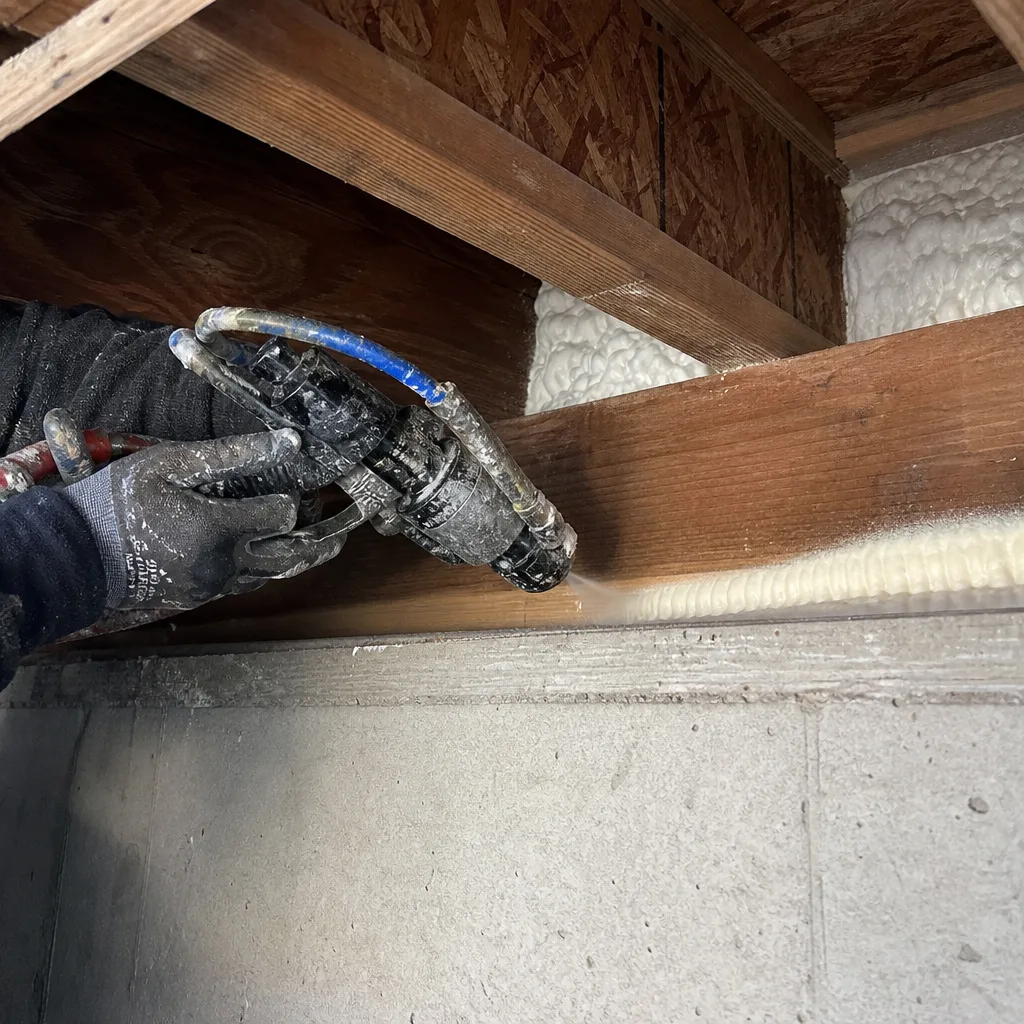
Rim joist spray foam in Highgrove costs between $1,200 and $3,200 on a typical mid-century home, depending on how many lineal feet of perimeter joist bay we’re sealing and whether we’re using open-cell or closed-cell foam. The rim joist is where your floor framing meets the foundation wall, and in Highgrove’s pre-1980s homes it’s almost always uninsulated or stuffed with fiberglass that’s fallen away. That gap lets 100°F+ outside air pour into the crawl space and up through your floors. We spray a continuous band of foam across each joist bay, which seals the air leaks and stops the stack effect that makes older Highgrove homes feel hot and stale even with the AC running.
One thing we see often in Highgrove: rim joists that were never insulated because the home predates energy codes entirely. No Title 24 requirement, no insulation, nothing. Those homes benefit immediately from foam because the air infiltration is so dramatic.
Closed-Cell Foam on Rim Joists
For rim joists in Highgrove we typically recommend closed-cell spray foam. It adds structural rigidity plus an air and vapor barrier in a single pass. In crawl spaces where foundation vents pull in damp winter air, closed-cell keeps moisture out of the framing itself, which matters on 70-year-old lumber.
Dealing With Foundation Vents
Spraying rim joists on a mid-century Highgrove home without addressing existing foundation vents can create condensation against the foam. We check vent placement and sizing first. Sometimes vents need to be reduced or sealed; sometimes they’re fine as-is. It’s something a generic foam crew will skip.
Crawl Space Spray Foam Insulation in Highgrove
Crawl space spray foam insulation in Highgrove typically runs $2,800 to $6,500 for a full encapsulation plus rim joist treatment on an average 1,200-square-foot home, though smaller jobs start around $1,500. Most Highgrove homes have vented crawl spaces that were never designed for the humidity swings we get here. Hot summer air hits the cooler ground under the house, condensation forms, and that moisture wicks into floor joists and subflooring. Spray foam on the crawl space walls and rim joists seals that route.
If your home has an unpermitted addition, we need to look at how that space ties into the original crawl. Often the addition has no crawl access at all, or the framing leaves gaps that short-circuit the thermal boundary. We fill and seal those before anything else.
Moisture in Mid-Century Crawl Spaces
Highgrove’s crawl spaces sit below homes that were framed tight to the ground in the 1950s and 60s. Many have original fiberglass batts hanging from floor joists that have absorbed decades of damp air. We remove that compromised material before foaming. Spraying over it traps the moisture in place and accelerates rot.
Unpermitted Additions and Cavity Gaps
Additions built without permits in Highgrove often have inconsistent wall cavities, which means open-cell foam may over-expand and push drywall, or closed-cell may leave voids where framing isn’t square. We check with a borescope and adjust our spray pattern per cavity. That’s not a detail you get from a crew that’s never worked in Highgrove before.
Trusted Brands We Service in Highgrove
We’re authorized installers for Icynene and Demilec spray foam, and we also stock Johns Manville, Knauf, CertainTeed, and Rockwool for homes where foam isn’t the right call. Why does that matter in Highgrove? Because a 1950s attic with existing ventilation issues might do better with Rockwool batts and air sealing than with closed-cell foam that traps moisture. We carry competing brands so the recommendation comes from your home’s condition, not our warehouse. We stock materials locally and can usually start Highgrove jobs within days of the estimate. Noel Arredondo’s position on this is simple: no brand loyalty, just the best fit for your attic, walls, and crawl space.
Common Spray Foam Insulation Problems We See in Highgrove Homes
- Foam sprayed over compressed fiberglass in unvented attics. If the old fiberglass has been matted down by rodent nests or roof leaks, the foam can’t form a continuous air barrier. You get voids and thermal bridging, and the attic still cooks in summer.
- Rim joist foam without vent remediation. Pre-1980s Highgrove homes often have foundation vents that were fine when the house was built. Seal the rim joists without looking at the vents, and you can create condensation against the new foam, which rots the band board.
- Inconsistent cavities in unpermitted additions. We see additions off Center Street and around Barton Road where stud spacing isn’t standard. Foam over-expands in narrow bays or leaves gaps in wide ones. Those gaps only show up as hot spots when the AC bill arrives in July.
- Rodent-contaminated attics that look fine from the hatch. Highgrove has older homes with more pest entry points than newer builds. Insulation can look intact from the access point but be destroyed in the far corners. Spray foam over that just seals the problem in.
Pricing for Spray Foam Insulation in Highgrove, CA
Open-cell spray foam in Highgrove runs $3.50 to $5.20 per board foot installed. Closed-cell runs $5.50 to $6.85 per board foot. A full attic deck for a 1,200-square-foot home lands between $4,500 and $8,200, while rim joist work falls in the $1,200 to $3,200 range. Crawl space jobs vary the most because every mid-century crawl has its own moisture history. What changes your number: the condition of existing insulation, whether we’re removing rodent-damaged material, vent remediation, and the framing irregularities in additions. We don’t charge for the estimate, and we’ll walk you through the line items before any work starts. Call (866) 271-1602 to schedule a Highgrove site visit.
We Also Serve Cities Near Highgrove
Beyond Highgrove, our crews work regularly in Grand Terrace, Colton, Loma Linda, and Rubidoux. Each of those communities has its own mix of mid-century homes and newer builds, but the same principle applies: the material has to match the house. If you’re in any of those areas, call (866) 271-1602 and we’ll send someone who knows the local housing stock.
Serving Highgrove, CA — Our Local Coverage Area
We’re based in the Highgrove area and know this community well. Use the map below to see our service coverage — if you’re nearby, we can almost certainly help.
FAQs About Spray Foam Insulation in Highgrove
Spray foam can absolutely fix old insulation problems in a 1950s Highgrove home, but only if the existing compromised material is removed first and the attic or crawl space ventilation is addressed in the same job. A 1950s attic off Highgrove Avenue with unvented framing will trap moisture behind new foam unless we add baffles, a ridge vent, or both. Call (866) 271-1602 and we’ll evaluate your specific attic before quoting anything.
Closed-cell spray foam outperforms fiberglass in Highgrove’s summer heat because it stops air movement, not just conduction. Fiberglass lets 100°F+ attic air move through gaps around the insulation, while properly installed foam creates a continuous air and thermal barrier. That’s the difference between an attic that’s 140°F and one that stays closer to 115°F. The trade-off is cost and the need for proper ventilation design.
The best approach is to inspect the addition’s framing and its connection to the original crawl space before spraying any foam. Unpermitted additions in Highgrove often have cavity widths that don’t match the main house, and we need to know that before choosing open-cell or closed-cell. We foam the original crawl space first, then work through the addition’s gaps until the thermal boundary is continuous.
No, spray foam should never be applied over old, compressed insulation that’s been flattened by rodents, roof leaks, or decades of settlement. The old material has to come out so the foam can bond directly to the air barrier surface and reach full thickness. Applying foam over compromised fiberglass creates voids and traps moisture. We’ll remove it as part of the job and show you what we pulled out.
Spray foam insulation itself typically doesn’t require a permit in Highgrove, but if your home has unpermitted additions, any significant retrofit may trigger a closer look at the framing and ceiling connections. We can work with you to navigate that process, and in most cases the insulation work can proceed while any addition paperwork gets sorted. The bigger practical issue is the framing itself, which we’ll evaluate before quoting. Call (866) 271-1602 for a straight answer on your specific situation.
Written by Noel Arredondo, Owner at Fontana Insulation, serving Highgrove and the surrounding Inland Empire communities with material-agnostic insulation expertise.