
Fast, Reliable Spray Foam Insulation Across Walnut
Spray foam insulation in Walnut typically runs $2.50 to $6.50 per board foot installed, with whole-attic jobs in the 91788, 91789, and 91795 zip codes landing between $4,800 and $14,000 depending on roof-line configuration. But the real issue in Walnut isn’t just price, it’s sequence. Homes here, especially those 1980s to 2000s tract builds near the 60 Freeway foothills, develop heat-driven pressure imbalances that pull insulation away from eaves. Foam alone won’t fix that. Our crews serve Walnut weekly, and we see the same failure mode repeated across Grand Avenue, Snow Creek, and the hillside-adjacent tracts off Lemon Avenue. Call (866) 271-1602 and we’ll walk your roofline before anyone touches a spray gun.
Why Fontana Insulation Is Walnut’s Preferred Spray Foam Insulation Company
Walnut homeowners call us because we carry both Icynene and Demilec spray foam systems, which means we can recommend open-cell or closed-cell based on what your specific attic actually needs, not what we happen to stock that week. Noel Arredondo built Fontana Insulation around a material-agnostic approach: eight brands across fiberglass, mineral wool, spray foam, and cellulose. For Walnut’s cathedralized ceilings and unvented roof lines, that matters more than in flat-ceiling cities. We’ve worked in enough 1988 stucco-and-tile homes off Grand Avenue to know where the hot spots hide.
Walnut customers often tell us other contractors quoted a simple batt upgrade and missed the air-sealing entirely. That’s the difference between a specialist and a company that installs one product. Our Spray Foam Insulation team handles open-cell, closed-cell, rim joist, garage ceiling, and roof deck applications without subcontracting. When you call, you get a straight read on whether foam is even the right material for your situation, or whether blown-in or batts paired with air-sealing would serve you better. No brand loyalty. Just the best fit for your roofline.
Rim Joist Spray Foam in Walnut
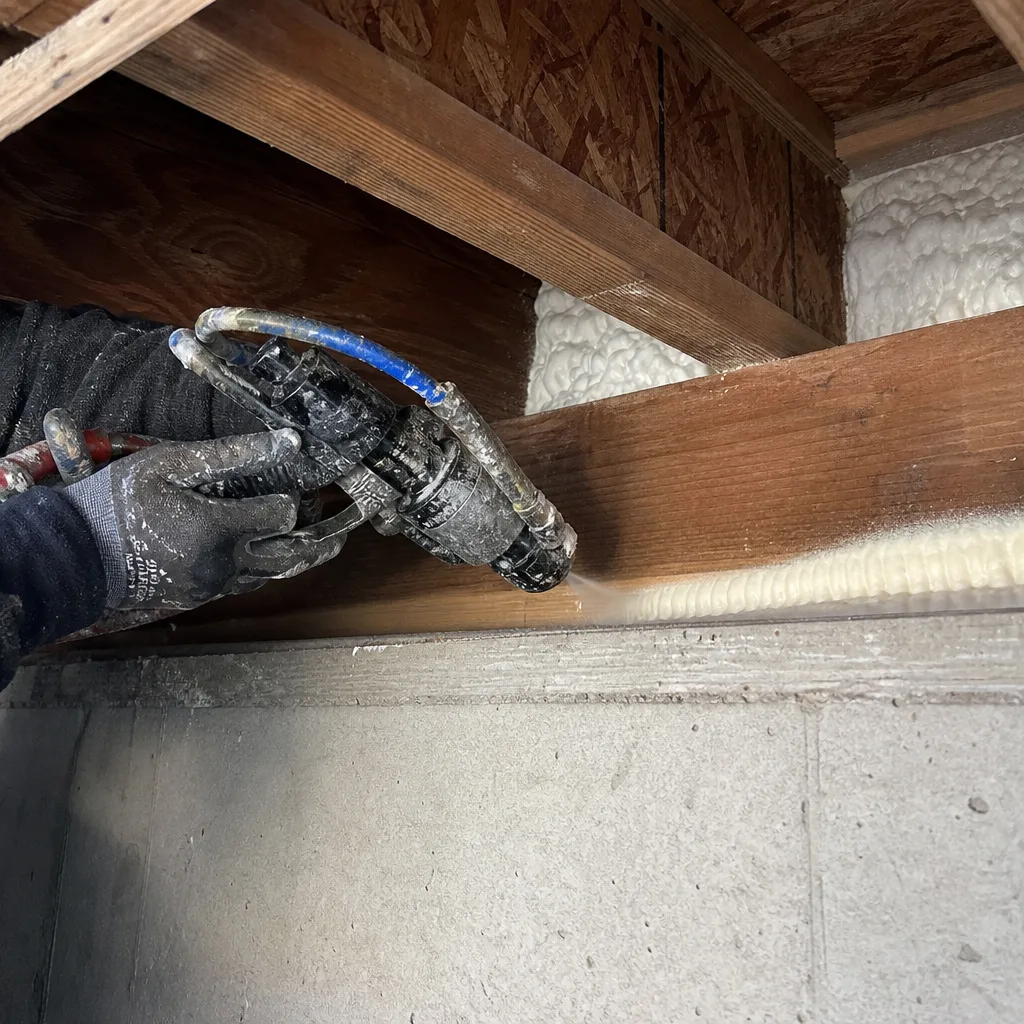
Rim Joist Spray Foam in Walnut targets the band joist where your first-floor walls meet the foundation, and in 1980s ranch-style homes with attached garages this junction is routinely uninsulated or stuffed with degraded fiberglass. Walnut’s mild winters mean rim joist air leakage shows up as cold tile floors in January and inflated summer cooling bills when hot garage air migrates into conditioned space. A typical rim joist spray foam job in Walnut runs $900 to $2,200, depending on linear footage and access.
Where the Leak Actually Starts
The rim joist sits behind the sill plate, and in Walnut’s stucco-on-frame construction it’s often hidden behind drywall or blocked by ductwork. We spray closed-cell foam directly onto the band board, which stops air movement and adds R-value in one pass. This is the highest-ROI air-sealing move for attached-garage homes where the garage shares a wall with the living room.
Garage Ceiling Applications
For Walnut homes where a bonus room sits above the garage, the ceiling cavity becomes a thermal shortcut. Spraying the garage ceiling with closed-cell foam isolates that unconditioned slab and prevents the “oven effect” that pushes heat into the room above by 3 p.m. This runs $1,800 to $4,500 depending on square footage and whether the existing drywall stays in place.
Crawl Space Spray Foam Insulation in Walnut
Crawl Space Spray Foam Insulation in Walnut addresses the vented crawl spaces common under 1970s ranch homes and early 1980s tract builds, where stucco exteriors and concrete tile roofs do nothing to stop humidity from the dirt floor. Walnut’s dry climate isn’t the humidity threat; it’s the temperature differential. Ventilated crawl spaces under air-conditioned homes pull hot summer air through floor framing, and in winter the cold floor drives heat loss. Typical closed-cell crawl space work in Walnut runs $2,800 to $6,500 for walls and band areas.
Vented vs. Sealed Approach
We recommend sealing the crawl space with closed-cell foam on the walls and band joist, then conditioning the space as part of the home’s thermal envelope. This stops the stack effect that pulls Walnut’s 95°F summer air through floorboards. Foam alone won’t manage moisture on the dirt floor, so we sequence vapor barriers and drainage checks before spraying.
When Open-Cell Makes Sense
Open-cell foam can work in a Walnut crawl space if the homeowner wants noise dampening and doesn’t need the vapor-closed properties of closed-cell. But for hillside-adjacent homes with exposed north walls, closed-cell’s rigidity also helps brace older cripple walls. Call (866) 271-1602 and we’ll tell you which material fits your floor system.
Trusted Brands We Service in Walnut
We stock and install Icynene and Demilec spray foam in Walnut because those two brands have the most performance-tested formulations for unvented roof applications. For clients who want mineral wool for fire resistance in attached garages, we carry Rockwool, which most Walnut contractors don’t stock. Our fiberglass line includes CertainTeed and Knauf when batts are the right call for flat-ceiling ranch homes. Because we’re brand-neutral, we’re not pushing one foam over another. We’re selecting the material that matches your roofline, your budget, and your cooling-load target.
Common Spray Foam Insulation Problems We See in Walnut Homes
- Wind-washed batts near the north eave. Homes along the 60 Freeway foothills catch afternoon upslope winds that blow existing fiberglass back from the eave, leaving a 2-foot strip of bare drywall. Spray foam stops this only if the top plate is air-sealed first; otherwise the pressure imbalance keeps working against the assembly.
- Cathedralized ceilings that won’t hold setpoint. 1980s and 1990s Walnut tract homes often have open-frame cathedral ceilings with no ventilation channel. Foam sprayed directly to the underside of the roof deck is the right fix, but it must be applied continuously over engineered trusses or the thermal bridging short-circuits the R-value.
- Moisture trapped behind stucco and tile. Walnut’s concrete tile roofs and stucco walls can trap moisture when closed-cell foam is applied to an unvented assembly without a drying plan. We evaluate sheathing condition and roof-line ventilation before recommending closed-cell.
- Blown-back batts masking air leakage at the top plate. In hillside-adjacent tracts, heat-driven pressure pulls insulation away while air leaks through the top plate. Many Walnut homeowners have re-insulated twice and still feel hot spots because the air-sealing step was skipped.
Pricing for Spray Foam Insulation in Walnut, CA
Walnut spray foam pricing tracks roof-line complexity more than square footage. Open-cell attic floors run $2.50 to $3.75 per board foot, while closed-cell roof deck applications run $4.00 to $6.50 per board foot. Rim joist work lands between $900 and $2,200, crawl space encapsulation between $2,800 and $6,500, and a full unvented roof assembly on a 2,000 square foot home starts around $9,500. The material choice between open-cell and closed-cell depends on whether you need vapor-closed performance and structural bracing, not on what’s cheapest to spray. Call (866) 271-1602 for a free estimate. We quote by roofline, not by generic square-foot multipliers.
We Also Serve Cities Near Walnut
Our Walnut crews also cover South San Jose Hills, Rowland Heights, West Covina, and Pomona, where the same 1980s tract-home rooflines and hillside pressure imbalances repeat. If you’re in a neighboring city with a hot attic or a drafty added-on room, call (866) 271-1602 and we’ll route the nearest crew to you.
Serving Walnut, CA — Our Local Coverage Area
We’re based in the Walnut area and know this community well. Use the map below to see our service coverage — if you’re nearby, we can almost certainly help.
FAQs About Spray Foam Insulation in Walnut
Spray foam alone fails in Walnut’s hillside homes because heat-driven pressure imbalances pull air through unsealed top plates, which batts and loose-fill can’t stop and which foam applied after the fact only partially addresses. The air-sealing step must come first. Call (866) 271-1602 and we’ll check your top plates before recommending a foam application.
Yes, closed-cell spray foam applied to the underside of the roof deck brings those attic temperatures down dramatically, often from 140°F to within 10 degrees of indoor conditions. The key is continuous application over the engineered trusses. In Walnut tract homes we’ve sprayed, the upstairs rooms finally held setpoint by mid-afternoon. (866) 271-1602 for a roofline assessment.
Yes, rim joist spray foam on an attached-garage ranch in Walnut stops garage air from migrating into conditioned space, which is the biggest comfort complaint in those floor plans. It typically pays for itself within a few cooling seasons. Call (866) 271-1602 for a rim joist quote.
Seal the crawl space walls and band joist with closed-cell foam, then cover the dirt floor with a vapor barrier. Stucco and tile don’t manage humidity at the ground line, so the vapor barrier matters as much as the foam. (866) 271-1602 and we’ll walk your crawl space.
In a vented Walnut attic with flat ceilings, yes, we remove old batts and air-seal the ceiling plane before blowing or spraying. For an unvented cathedralized roof, we spray directly to the roof deck and the old floor batts become irrelevant. Call (866) 271-1602 for a specific read on your attic.
Our crews serve Walnut weekly, so in most cases we can schedule an assessment within a few business days and start work within one to two weeks. For a hot attic right now, call (866) 271-1602 and we’ll tell you the earliest window.
Yes, we stand behind our Walnut spray foam installations with the manufacturer’s warranty on Icynene or Demilec material, plus our workmanship guarantee. The warranty coverage depends on the material chosen and the roof-line configuration. Call (866) 271-1602 for details on your specific project.
Written by Noel Arredondo, Owner at Fontana Insulation, serving Walnut since our first hillside attic air-sealing job.