
Fast, Reliable Spray Foam Insulation Across Upland
Spray foam insulation in Upland does two jobs most other materials can’t: it air-seals and it handles the 150°F attic heat that cooks mid-century tract homes every summer. We install open-cell and closed-cell foam from Icynene and Demilec, and we’ve worked in enough Upland attics to know exactly where the heat gets in. If you’re in 91784, 91785, or 91786 and your upstairs rooms bake by early afternoon, call (866) 271-1602 for a free site assessment.
Our Spray Foam Insulation team runs jobs across Upland weekly, from Foothill Boulevard up into the San Gabriel foothills. We know this city’s housing stock, its wind patterns, and its attics. That matters more here than in most places because Upland isn’t one climate. It’s two. More on that below.
Why Fontana Insulation Is Upland’s Preferred Spray Foam Insulation Company
Upland homeowners call us because we stock eight insulation brands and we’re not married to any of them. If your attic needs closed-cell foam for structural strength and moisture control, we’ll tell you. If open-cell is the smarter buy for your walls, we’ll say that instead. Noel Arredondo built this company on the idea that a contractor shouldn’t push one product line because it’s what’s in the warehouse. We carry Icynene and Demilec for spray foam specifically because both brands have decades of field testing in extreme heat applications. That’s what Upland throws at us.
We also know the local failure patterns. In the older tracts off Foothill and Baseline, we regularly find attics where blown-in fiberglass has settled into uneven pockets after years of thermal cycling. A homeowner sees 150°F in the attic and thinks more insulation is the answer. Often the answer is spray foam applied to the right surfaces, not more material on the floor. That kind of recommendation only comes from walking a lot of Upland attics. And our crews have walked hundreds of them.
Crawl Space Spray Foam Insulation in Upland
Crawl Space Spray Foam Insulation in Upland solves a very specific problem for the 91786 valley floor and parts of 91784: hot, dry air pushing into the crawl space through rim joists and vent openings, then up into the living areas. The Foothill and Baseline tracts have older vented crawl spaces that leak conditioned air all summer, and because Upland’s winters are mild, the cooling season is where you lose money. Closed-cell foam on rim joists and foundation walls seals that thermal boundary. That’s not just an incremental improvement in Upland; it’s often the difference between a home that holds 78°F and one that cycles the AC all afternoon.
What you’ll typically pay depends on the size of the crawl and whether we’re wrapping the full perimeter or just the rim joists. A rim joist sealing job on a 1,200 to 1,800 square foot Upland ranch runs $1,800 to $3,200. Full crawl space encapsulation with closed-cell foam on the walls and a vapor barrier on the dirt floor runs $6,000 to $12,000 here. Homes in 91784 with sloping lots and taller stem walls will fall on the higher end because there’s more square footage to spray.
Rim Joist Sealing
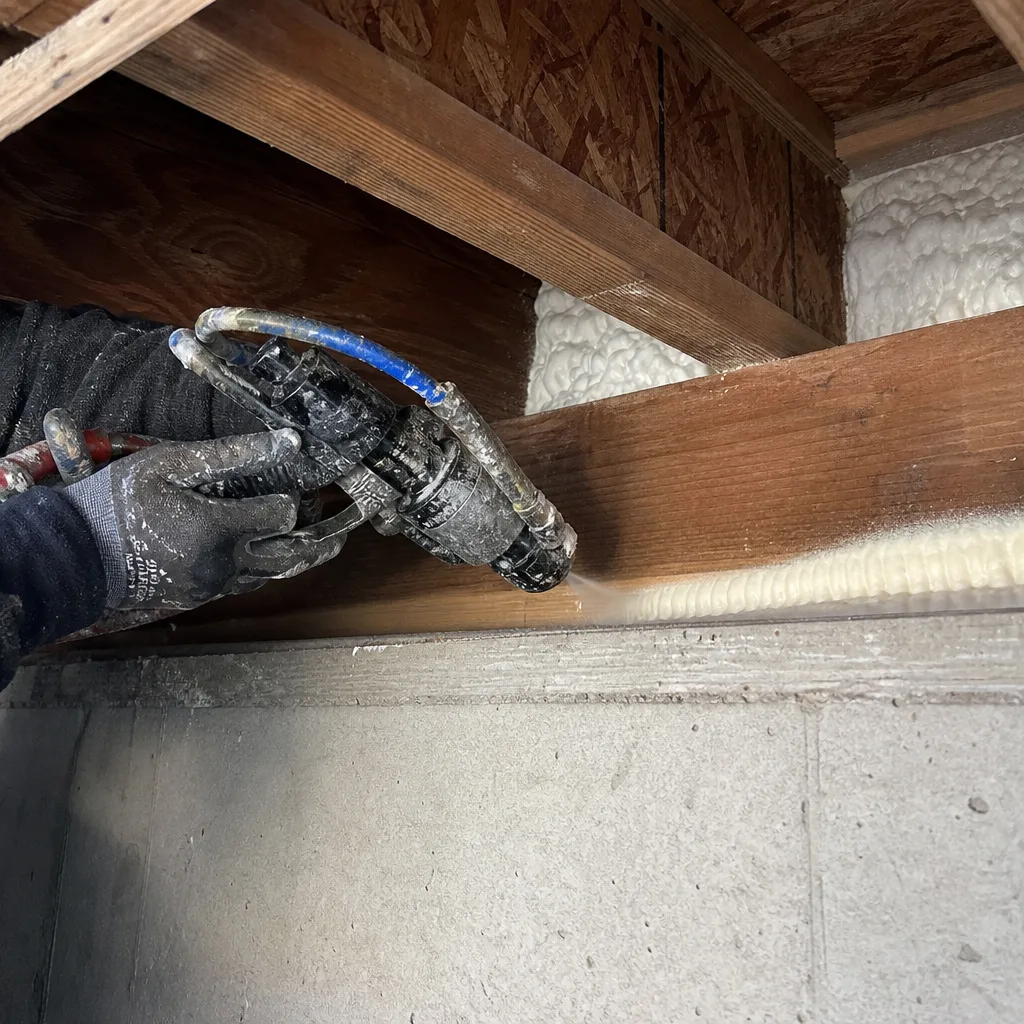
The rim joist is where the floor framing meets the foundation, and in Upland’s older tract homes it’s usually a bare piece of lumber with fiberglass stuffed between the joists. Wind-driven heat from the Cajon Pass pushes straight through that assembly. We spray closed-cell foam directly on the rim joist and the top of the foundation wall, which creates a continuous air and vapor barrier. It’s a one-day job for most single-story Upland homes.
Vented Crawl Space Conversion
Some Upland homeowners in the 91784 foothills have crawl spaces with open vents on two or three sides. In summer, 110°F air pours through those vents and heats the floor framing from below. We can close the vents and insulate the crawl walls with closed-cell foam, turning a hot, dusty crawl into a semi-conditioned space that stops fighting your AC. The trade-off is you lose the passive venting, so in older homes we always check for moisture issues first. Upland is dry, but winter condensation can occur near the footings.
Garage Spray Foam Insulation in Upland
Garage Spray Foam Insulation in Upland covers two scenarios we see constantly: attached garages that heat up the rooms above them, and detached workshops that homeowners use year-round for projects. On the attached side, Upland’s mid-century ranches often have bedrooms or bonus rooms sitting directly over the garage, and the garage ceiling is either uninsulated or has a single layer of thin batts. When the garage ceiling hits 140°F in summer, the room above it steals that heat through the floor. An open-cell foam layer on the garage ceiling drops that transfer dramatically.
For an attached garage ceiling in Upland, you’re looking at $1,600 to $2,800 for a typical two-car footprint. A detached workshop or oversized three-car garage runs $3,000 to $5,500 depending on whether we’re doing walls, ceiling, or both. We use open-cell on garage ceilings where moisture isn’t a concern and it’s the most cost-effective air seal. On exterior-facing walls of detached structures, we often spec closed-cell because it adds structural rigidity and blocks wind-driven heat from the Cajon Pass.
Garage Ceiling Air Sealing
The number one gap in Upland’s attached garages is the ceiling. Drywall seams, can lights, and attic access hatches all let hot air pour into the garage from the attic above. Spray foam seals those penetrations as it insulates. The result is a garage that stays 20 to 30 degrees cooler in summer, which matters for anyone using the space as a gym, workshop, or storage for temperature-sensitive items.
Detached Workshop Walls
Upland has plenty of detached garages and workshops, especially in the 91784 foothills where lots are larger. These structures often have exposed stud walls with no insulation at all. Applying closed-cell foam to the walls and the underside of the roof deck turns a metal or wood-framed shell into a usable workspace even on 110°F afternoons. It also dampens sound, which matters if you’re running saws or compressors and the neighbors are close by.
Trusted Brands We Service in Upland
We install Icynene and Demilec spray foam because those two brands have the longest performance track records in high-heat climates, which is exactly what Upland serves up from May through October. We also carry Rockwool mineral wool for Upland homeowners who want a fire-resistant, sound-dampening alternative in interior walls or between floors. When a customer asks for fiberglass instead, we stock Owens Corning and CertainTeed too. We keep materials staged for Upland jobs, and because we order by the project rather than the truckload, a Upland homeowner isn’t paying freight charges for foam that sits in our yard. You call with an address in 91784, 91785, or 91786, we know exactly what we need before the crew rolls out.
Common Spray Foam Insulation Problems We See in Upland Homes
- The ‘Upland bake’ under the ridge: In the older tracts off Foothill and Baseline, blown-in fiberglass settles unevenly under the ridge beam after years of 150°F+ attic cycling. Homeowners don’t notice it until rooms directly under the ridge start roasting. Spray foam on the roof deck is often the only fix that re-seals those voids without tearing out the entire attic floor.
- Unsealed can lights leaking attic air: Single-story Upland ranches from the 1950s and 1960s usually have recessed can lights in the living room and hallway. Those cans are direct holes into the attic. We see them leak 150°F attic air into conditioned rooms every week. Foam-sealing around them, or replacing them with IC-rated fixtures, is part of almost every Upland spray foam job we do.
- Open-cell foam trapping winter condensation: In the 91784 foothills, some homeowners have low-slope roof decks where open-cell foam was applied to the underside without a vapor barrier plan. When winter condensation forms on the sheathing, the foam holds that moisture against the wood. We fix this by checking the ventilation first and using closed-cell where the risk exists.
- Foam applied over settled fiberglass: Some contractors will spray foam directly over old blown-in fiberglass in Upland attics. That traps heat under the foam and hides the settled pockets underneath, so the attic still bakes unevenly. We remove the old material first, inspect for air leaks and moisture, then apply foam to the right surfaces. Skipping the removal step is how you get a 150°F attic with a new foam lid on it.
Pricing for Spray Foam Insulation in Upland, CA
The pricing spread below reflects what Upland homeowners actually pay for spray foam work in this market, not a national average. These are installed prices per square foot of foam applied:
- Open-cell spray foam (attic roof deck or ceiling): $0.90 to $1.60 per board foot
- Closed-cell spray foam (rim joists, crawl space walls, roof decks): $1.60 to $2.60 per board foot
- Garage ceiling (two-car, open-cell): $1,600 to $2,800 total
- Crawl space rim joist sealing (1,200 to 1,800 sq ft home): $1,800 to $3,200 total
- Full crawl space encapsulation with closed-cell: $6,000 to $12,000 depending on square footage and access
What moves the price in Upland: attic accessibility in the older Foothill tracts where access hatches are small, whether we’re working around existing mechanical systems, and whether the roof deck is low-slope, which is common in the 91784 foothills and requires different equipment angles. We give you a written quote before any work starts, and we don’t pad it with line items you didn’t ask for. Call (866) 271-1602 for a free estimate, and we’ll send someone out to walk the property with you.
We Also Serve Cities Near Upland
Our crews run spray foam jobs in Upland every week, and we regularly work in San Antonio Heights, Claremont, Montclair, and Rancho Cucamonga. The heat-gain patterns change a few miles in any direction, but the fixes carry over. If you’re just over the city line, call us and we’ll tell you straight whether foam makes sense for your house. Same phone: (866) 271-1602.
Serving Upland, CA — Our Local Coverage Area
We’re based in the Upland area and know this community well. Use the map below to see our service coverage — if you’re nearby, we can almost certainly help.
FAQs About Spray Foam Insulation in Upland
Yes, but only if the settled fiberglass is removed first. Spraying foam over settled blown-in material traps heat underneath it and hides the very voids that are causing your uneven attic temperatures. We remove the old insulation, inspect for air leaks, then apply foam to the roof deck or attic floor. In Upland’s Foothill and Baseline tracts, this is the single most common correction we make. Call (866) 271-1602 and we’ll assess what’s actually in your attic before recommending anything.
Spray foam handles it by creating an air seal, not just an R-value. The foam stops the superheated attic air from moving through gaps, can lights, and top plates into your living space. Closed-cell foam also acts as a radiant barrier in the sense that it has a high resistance to heat transfer through the material itself. Upland’s problem isn’t just high temperatures; it’s the Santa Ana wind-driven heat from the Cajon Pass pushing through every penetration. Foam seals those penetrations. That’s why it outperforms fiberglass in Upland’s climate. Call us if you want a site-specific recommendation.
Yes. We run our Upland jobs as complete single-day or two-day projects depending on scope, and we stage materials before the crew arrives. A detached workshop with walls and a roof deck usually takes one full day. An attached garage ceiling with air sealing is a half-day job. If you’re in the 91784 foothills with a larger lot and a bigger structure, we’ll schedule the crew accordingly but we don’t leave a job halfway and come back weeks later. Call (866) 271-1602 and we’ll tell you exactly what a one-trip schedule looks like for your property.
Open-cell foam is lighter, less expensive, and acts primarily as an air seal. Closed-cell foam is denser, costs more, and adds a vapor barrier plus structural rigidity. For Upland crawl spaces specifically, closed-cell is usually the right call on rim joists and foundation walls because it blocks ground moisture and wind-driven heat. Open-cell in a crawl space can absorb moisture in the winter months. If you’re on the valley floor in 91786 and the crawl is dry year-round, open-cell can work. We’ll tell you which one your crawl actually needs after looking at it.
Yes, because the heat load is different. Homes in 91784 sit against the San Gabriel foothills with more exposure to afternoon solar gain and wind coming through the Cajon Pass. Homes in 91786 are on the valley floor where the heat is steadier and less wind-driven. That shifts material choices, especially on roof decks and rim joists. We also account for the older low-slope roofs common in the foothills, where ventilation and condensation planning matter more. When you call (866) 271-1602, tell us your ZIP and we’ll send a crew that already knows the difference.
Written by Noel Arredondo, Owner at Fontana Insulation, serving Upland and the surrounding Inland Empire.