
Fast, Reliable Spray Foam Insulation Across Tujunga
Spray foam insulation in Tujunga typically runs $2.50 – $6.50 per square foot installed, with closed-cell foam at the higher end. Most Tujunga homes we quote fall between $4,000 and $14,000 for a full attic or roof deck application, depending on square footage and access. If you’re fighting a hot second floor or an attic that hits 140°F in August, foam is the first material we talk about. Call Fontana Insulation at (866) 271-1602 for a Tujunga-specific quote.
We know the streets that climb off Foothill Boulevard, the canyon lots off Day Street, and the older ranch homes scattered through ZIP codes 91042 and 91043. Tujunga’s heat is different from Burbank’s or even Sunland’s. The hills hold the sun longer, and the dry air means attic temperatures climb fast and stay there. We have spent years working in those attics, so we know what works and what doesn’t when the roof deck is radiating heat all afternoon.
Why Fontana Insulation Is Tujunga’s Preferred Spray Foam Insulation Company
Fontana Insulation carries eight insulation brands across fiberglass, mineral wool, spray foam, and cellulose, which means we are not pushing one product because it’s what we stock. We recommend open-cell or closed-cell foam when the home’s structure and Tujunga’s climate call for it, and we say so plainly when a different material makes more sense. Our team is led by Noel Arredondo, who has built the company around material-matched recommendations rather than brand loyalty.
Tujunga homeowners repeatedly tell us the same thing about other insulation contractors: they got a quote for whatever product the crew had on the truck. That’s not how we operate. We are authorized installers for Icynene and Demilec, two of the most performance-tested spray foam brands in North America, because Tujunga’s heat demands foam that holds its shape and R-value over decades.
When you call, you get a straight answer about whether your attic needs closed-cell foam on the roof deck, open-cell in the walls, or a hybrid approach. No subcontracting, no pressure. Just an Spray Foam Insulation specialist who can explain the trade-offs and get the work scheduled.
Closed Cell Spray Foam Insulation in Tujunga
Closed Cell Spray Foam Insulation is the highest-performing option we install in Tujunga, and for good reason: it adds structural rigidity, blocks moisture, and delivers an R-value of roughly R-6.5 to R-7 per inch, which matters when attic space is tight and every inch counts. In Tujunga’s older homes, where rafter bays are often shallow, closed-cell gives you the most thermal resistance in the least space. Expect closed-cell foam to run $4.50 – $6.50 per square foot installed for typical Tujunga roof deck or rim joist applications.
Roof Deck Applications for Hillside Homes
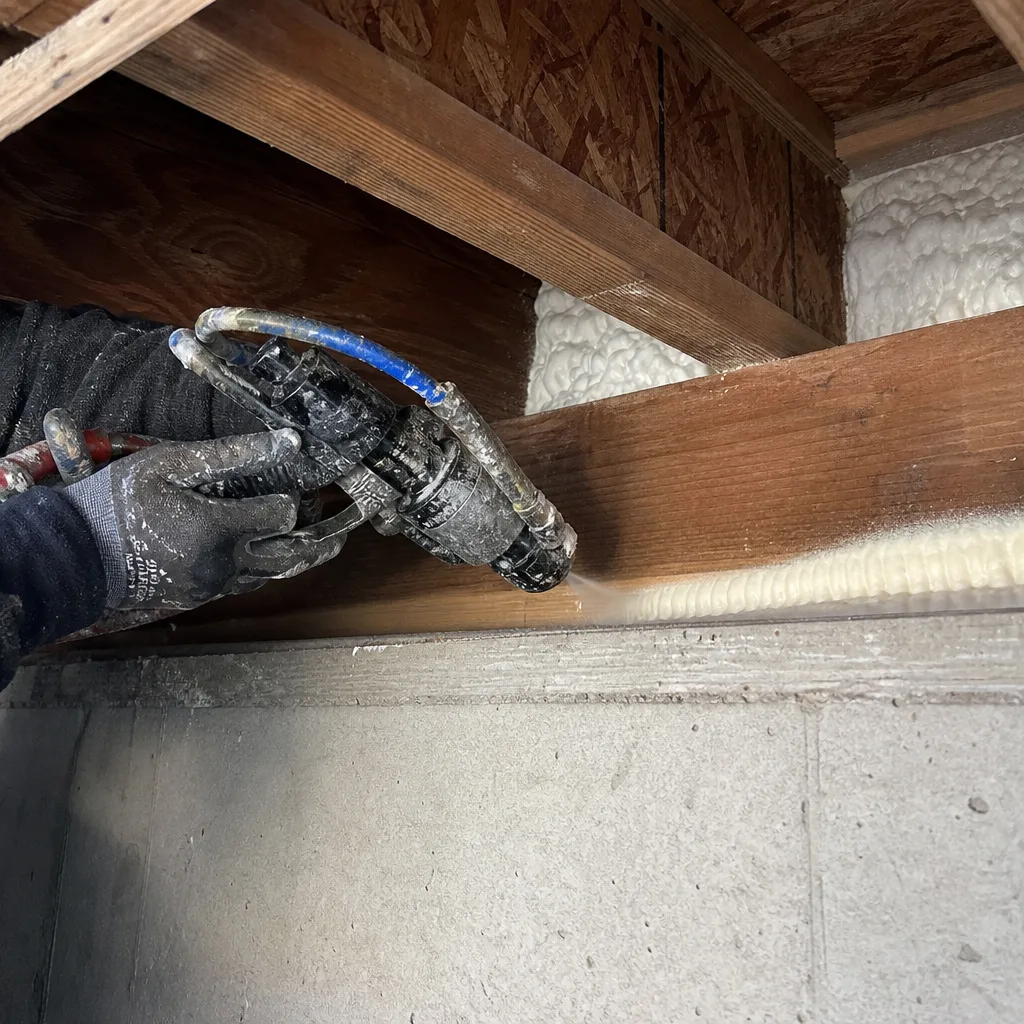
Many Tujunga hillside homes have attic spaces too shallow for conventional blown-in insulation. We apply closed-cell foam directly to the underside of the roof deck, which converts the attic into a conditioned space and stops radiant heat before it enters the living area. This is especially effective in the canyon homes above Foothill Blvd where roof framing is exposed and irregular.
When Closed-Cell Beats Open-Cell in Tujunga
Closed-cell foam is the right call when moisture is a concern, when you need extra structural strength, or when attic depth limits how much open-cell you can fit. For Tujunga homes with pier-and-beam foundations or older framing, the added rigidity of closed-cell can be a genuine benefit beyond the thermal performance.
Open Cell Spray Foam in Tujunga
Open Cell Spray Foam is the workhorse for Tujunga homes where air-sealing is the priority and the budget is tighter. It expands up to 100 times its liquid volume, sealing every gap, crack, and electrical penetration that lets conditioned air escape. Open-cell foam runs $2.50 – $4.50 per square foot installed, making it a solid value for full attic or wall cavity applications in the 91042 and 91043 ZIP codes.
Attic Ceilings and Wall Cavities
For Tujunga’s mid-century single-family homes with standard attic heights, open-cell foam applied to the attic floor or ceiling joists creates an effective thermal boundary at roughly R-3.5 to R-3.7 per inch. It’s particularly effective at stopping the drafts and air leaks that make Santa Ana wind days feel worse inside than they should.
Noise Reduction for Canyon Properties
Open-cell foam also dampens sound, which matters in Tujunga’s canyon neighborhoods where wind and wildlife traffic are constant. Homeowners who install open-cell in interior walls and ceilings often notice quieter rooms as a secondary benefit to the lower cooling loads.
Trusted Brands We Service in Tujunga
We’re authorized installers for Icynene and Demilec, two spray foam brands with long performance histories in hot, dry climates. We carry them because Tujunga’s temperature swings demand foam that won’t shrink, crack, or lose R-value after a decade of 40° winter nights and 105° summer days. For Tujunga homeowners who want a material comparison, we also stock Rockwool mineral wool and CertainTeed fiberglass, so you’re not forced into a foam recommendation when another product would serve your walls better. If you’re in Tujunga and want to see samples or compare R-values, call (866) 271-1602 and we’ll bring the spec sheets.
Common Spray Foam Insulation Problems We See in Tujunga Homes
After years of working in Tujunga attics, we see the same issues repeat across neighborhoods. Here’s what we find most often:
- Settled and compressed legacy insulation. Original rock-wool or fiberglass batts in 1950s and 1960s ranches have often compressed to less than two inches, leaving bare spots over living spaces. That thin layer is doing almost nothing against the afternoon sun.
- Poor adhesion from dusty or dirty framing. Spray foam applied over old, dusty rafters can delaminate, especially when Tujunga’s extreme heat cycles cause expansion and contraction. We clean and prep every substrate before application.
- Blocked ventilation paths from previous foam jobs. If foam is applied without baffles at the eaves, attic heat builds up and moisture condenses on the underside of the roof deck during cold winter nights. We see this in homes across the Sunland-Tujunga area.
- Shallow rafter bays that make standard insulation impossible. Hillside homes above Foothill Blvd often have rafters too shallow for traditional batt depth, which is exactly where closed-cell spray foam earns its higher price per inch.
Pricing for Spray Foam Insulation in Tujunga, CA
For a typical Tujunga attic, open-cell spray foam runs $2.50 – $4.50 per square foot, while closed-cell runs $4.50 – $6.50 per square foot installed. A 1,200-square-foot attic floor in open-cell foam typically lands between $4,500 and $5,400. Closed-cell roof deck applications for hillside homes often run $8,000 – $14,000 depending on access and roof geometry. What moves the price: attic height, rafter depth, how much old insulation needs removal, and whether we need to add baffles for ventilation. Every estimate is free, and we walk you through the material options before you decide. Call (866) 271-1602 for exact numbers on your Tujunga home.
We Also Serve Cities Near Tujunga
Fontana Insulation handles spray foam projects throughout the foothill communities. From Tujunga we regularly work in Sunland, La Crescenta-Montrose, Shadow Hills, and Burbank. If you’re just over the line in Sunland or up the hill in Shadow Hills, the same crew and the same pricing applies. Give us a call and we’ll let you know the next available appointment for your area.
Serving Tujunga, CA — Our Local Coverage Area
We’re based in the Tujunga area and know this community well. Use the map below to see our service coverage — if you’re nearby, we can almost certainly help.
FAQs About Spray Foam Insulation in Tujunga
Spray foam is a stronger choice for Tujunga hillside homes because it air-seals and insulates in one pass, which traditional fiberglass or cellulose cannot do in shallow, irregular rafter bays. The radiant heat that builds in Tujunga attics above 140°F gets stopped at the roof deck with closed-cell foam, rather than being absorbed and conducted into living spaces. For canyon homes with limited attic access, foam also conforms to odd framing shapes that batts leave gap-filled. Call (866) 271-1602 to talk about whether your specific roofline is a good foam candidate.
Yes, spray foam is one of the only insulation materials that works in Tujunga’s shallow, hard-to-access attics. Because foam is applied as a liquid and expands in place, our technicians can reach rafter bays and gable ends that would be impossible to insulate with batts or rolls. Closed-cell foam is particularly effective here because it delivers high R-value per inch, fitting into the 2×4 and 2×6 rafter bays common in the 1920s – 1970s homes throughout 91042 and 91043. If you have an attic we can barely stand up in, foam is likely your best option.
Spray foam stops heat at the point of entry: the roof deck. When closed-cell foam is applied to the underside of the roof sheathing, the sun’s radiant energy never enters the attic space, so attic temperatures stay much closer to the home’s interior temperature. This is the only strategy that works when attic ventilation alone can’t keep up with Tujunga’s summer sun. Homeowners with foam-sealed roof decks consistently report attic temperatures 30 – 40°F lower than before, even during August heat waves.
It depends on what’s up there and what we’re foaming. If we’re applying foam to the roof deck, existing floor insulation can often stay in place, since the thermal boundary moves to the roofline. If we’re foaming the attic floor, we remove settled rock-wool or compressed batts first, because spray foam needs direct contact with the substrate to adhere properly. On a recent hillside property off Day Street in Tujunga, we cleared original rock-wool that had settled to under two inches, then applied closed-cell foam directly to the roof deck and gables with new baffles at the eaves. The homeowner reported a noticeably cooler second floor within days.
Spray foam does change the ventilation equation, which is why we install baffles at the eaves whenever needed to keep airflow moving from soffit to ridge. A foam-sealed attic without proper ventilation can trap heat and cause moisture to condense on the underside of the roof deck during Tujunga’s cold winter nights. The fix is part of a proper foam installation, not an afterthought. We include ventilation assessment in every Tujunga quote, so you never end up with a sealed attic that can’t breathe. Call (866) 271-1602 for a free attic assessment and foam estimate.
Written by Noel Arredondo, Owner at Fontana Insulation, serving Tujunga and the surrounding foothill communities.