
Fast, Reliable Spray Foam Insulation Across Temple City
Spray foam insulation in Temple City runs about $2.50 to $6.50 per board foot installed, depending on whether you go open-cell or closed-cell and how much prep the attic needs. Most ranch homes here fall between $3,800 and $9,200 for a full attic air-seal and roof deck application. Call (866) 271-1602 for a free estimate, and we’ll walk your specific roof before quoting anything. We’re in Temple City regularly, and we know these attics well enough to tell you honestly whether foam is the right move or if blown-in would do the job for less.
Why Fontana Insulation Is Temple City’s Preferred Spray Foam Insulation Company
Temple City isn’t a new-construction market. It’s a retrofit market, and that changes how insulation work gets done. Most homes here were built between the 1920s and 1950s, which means we’re working around settled rock wool, old wiring, and attics that were never designed for modern insulation levels. Our crew has spent enough afternoons in Temple City attics to know which homes have shallow hip-roof cavities and which have accessible gable space. That matters when the difference between a clean job and a mess is knowing what you’re walking into before you cut the hatch open.
Noel Arredondo runs our spray foam division and has been in attics across the San Gabriel Valley long enough to recognize a 1940s rock wool job before he’s three steps up the ladder. We carry Icynene and Demilec spray foam products, both performance-tested brands, and we’re authorized installers for both. Temple City homeowners get the same crews every time, not a rotating set of subcontractors.
Spray Foam Insulation Contractors in Temple City
Spray foam insulation contractors in Temple City do a different job than they would in a newer city like Arcadia or Chino Hills. Here, the work starts with removal. Most of these attics still have their original rock wool or vermiculite compacted down to two or three inches, and a contractor who sprays foam directly over that is creating a moisture trap that’ll delaminate within a few seasons. The right sequence is: remove the old material, air-seal the top plates and all penetrations, address any wiring concerns, and then apply foam to the roof deck.
Removal and air-sealing come first
You can’t spray foam over settled rock wool and call it a thermal barrier. The old material has to come out, and the framing needs an air-sealing pass before any foam goes down. In Temple City’s 1920s-1950s stock, that often means finding gaps around plaster keys, old can lights, and vent stacks that have been leaking attic air into the house for decades.
Closed-cell vs. open-cell in Temple City attics
For unvented roof deck applications, which is what most Temple City ranches need, we typically recommend closed-cell foam. It gives you R-6.5 to R-7 per inch, acts as a vapor barrier, and stiffens the roof structure. Open-cell is cheaper per board foot but doesn’t provide the same moisture resistance, and in a low-pitch attic with limited spray clearance, closed-cell gets you to code minimums faster.
Spray Foam Attic Insulation in Temple City
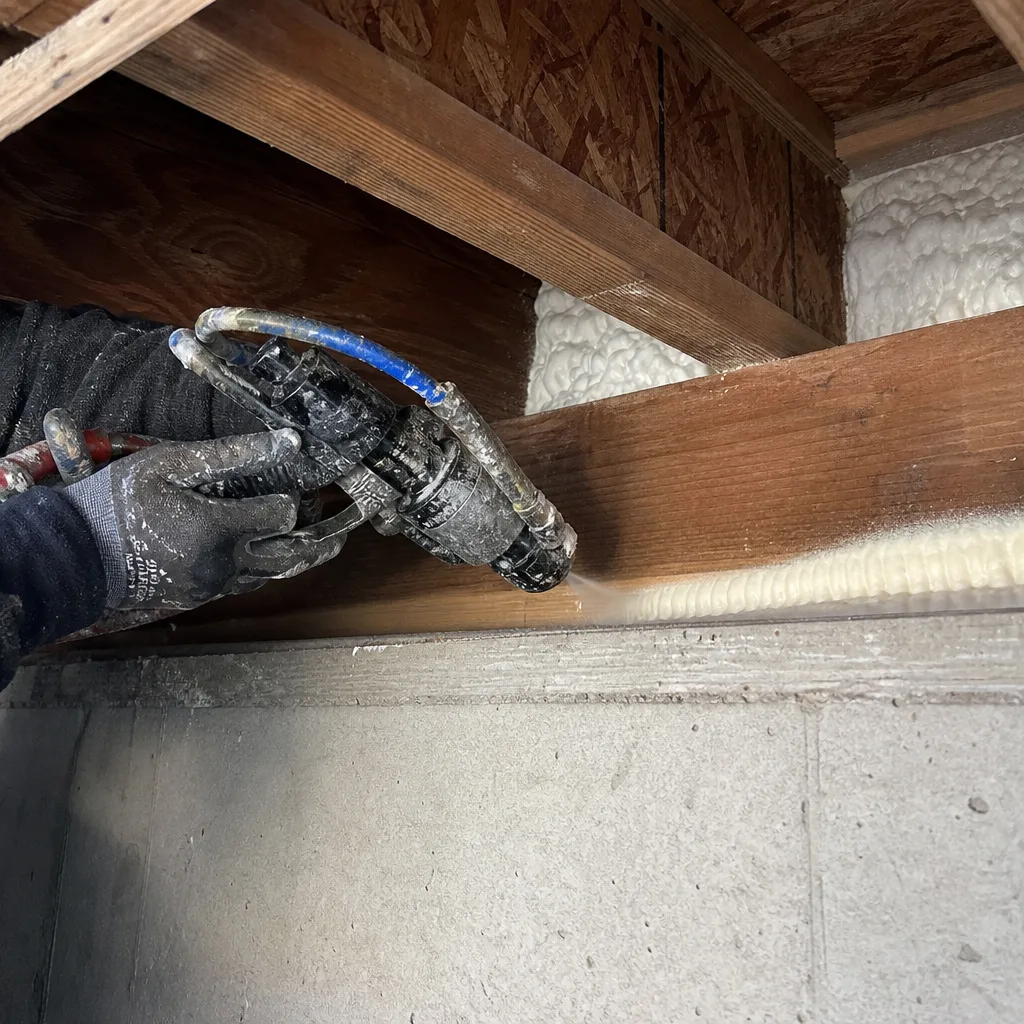
Spray foam attic insulation in Temple City usually means converting a vented attic to an unvented, conditioned space by spraying the roof deck rather than the attic floor. That changes the thermal boundary from the ceiling to the roofline, which matters a lot in a city where summer attic temperatures routinely hit 140°F and ducts running through that space are bleeding cooled air into a furnace. Most Temple City homes have their HVAC ducts in the attic, and moving the insulation plane to the roofline keeps those ducts inside the conditioned envelope.
Why roof deck application makes sense here
Low-pitch hip roofs leave very little attic floor area to work with. Spraying the floor with fiberglass or cellulose doesn’t address the radiant heat coming off the roof deck itself, and in Temple City’s 90-100°F summer afternoons, radiant heat is the dominant load. Foam on the roofline cuts that radiant transfer at the source.
What the prep looks like
Prep is the part that separates a Temple City foam job from a generic one. We check for knob-and-tube wiring before spraying anything. If it’s present and active, we coordinate an electrician to address it first, because burying live knob-and-tube under closed-cell foam is a genuine fire hazard. Then we air-seal every top plate, chase, and penetration. Only after that does the foam go down.
Trusted Brands We Service in Temple City
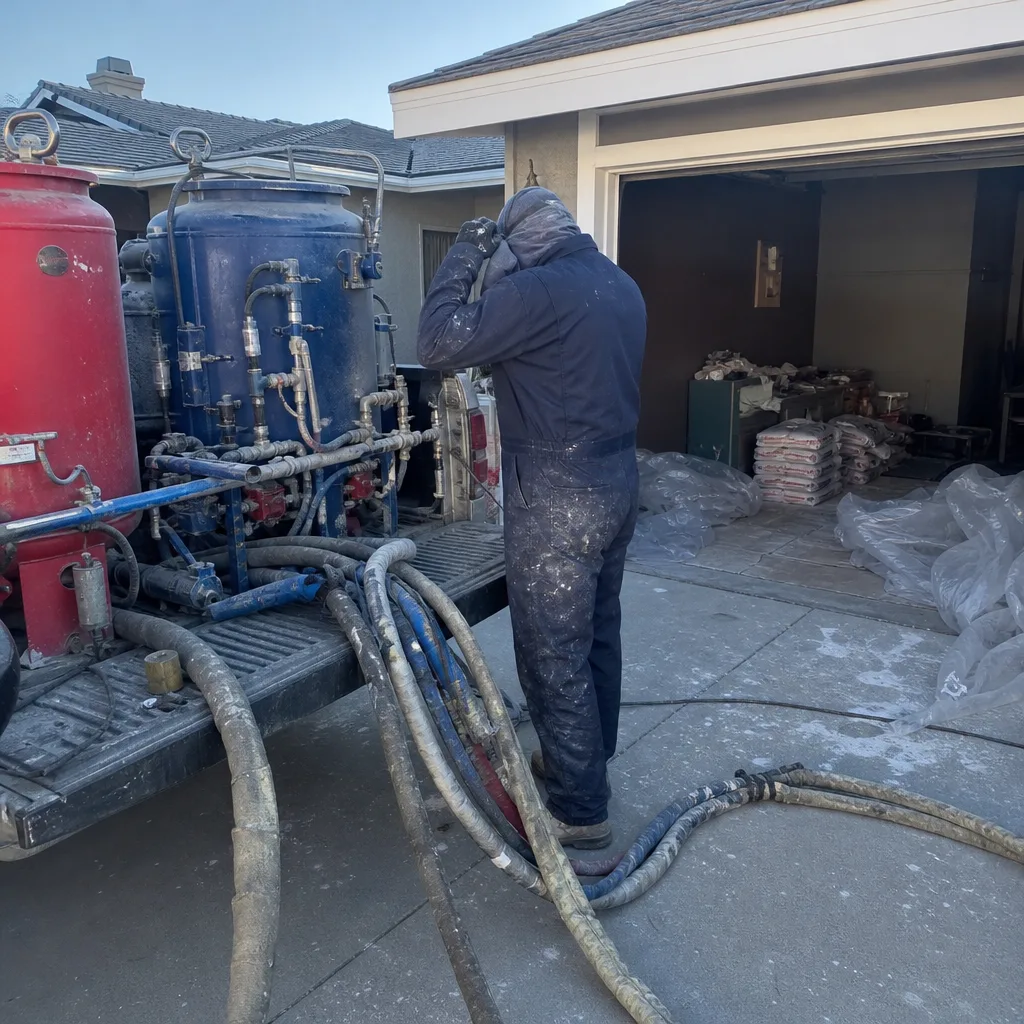
We stock and install Icynene and Demilec spray foam products, two of the most performance-tested foam brands in North America. For Temple City homes where foam isn’t the right fit, we also carry Johns Manville and Knauf fiberglass, plus Rockwool mineral wool for homeowners who want fire resistance and sound dampening alongside thermal performance. That’s the difference with Spray Foam Insulation from Fontana: we’re not anchored to one product line. Noel Arredondo and the crew will tell you if mineral wool or blown-in fiberglass is the better call for your specific attic, even if it means a smaller invoice for us.
Common Spray Foam Insulation Problems We See in Temple City Homes
- Foam sprayed over old compacted rock wool: This is the most common failure we’re called to fix. The foam can’t bond to settled rock wool, moisture gets trapped between the layers, and the foam peels away from the framing. Full removal has to come first.
- Uncovered knob-and-tube wiring under foam: Temple City’s 1920s-1940s homes often still have active knob-and-tube circuits in the attic. Spraying foam directly over live knob-and-tube insulates the wiring and prevents heat from dissipating, which can lead to insulation breakdown and fire.
- Incomplete coverage in shallow hip-roof triangles: The low-pitch hip roofs on Temple City ranches leave narrow wedges at the eaves where spray guns can’t reach. Some contractors skip those areas entirely. We use different nozzle tips and sometimes spray from the exterior soffit side to get full coverage, because those edge gaps create thermal bridges that negate most of the foam’s benefit.
- Ductwork buried in hot attics: Many Temple City homes run their HVAC ducts through unconditioned attics. If the attic isn’t brought inside the thermal envelope with roof deck foam, those ducts lose a significant fraction of their cooling to the 140°F attic air every summer afternoon.
Pricing for Spray Foam Insulation in Temple City, CA
Open-cell spray foam in Temple City typically runs $2.50 to $4.00 per board foot installed. Closed-cell runs $4.50 to $6.50 per board foot. For a typical 1,200-square-foot ranch with a low-pitch hip roof, a full attic removal, air-seal, and closed-cell roof deck application lands between $6,500 and $9,200. A smaller job, like a rim joist or garage ceiling, runs $1,800 to $3,400. The biggest variables in Temple City are removal cost (old rock wool and vermiculite take time to extract and dispose of properly) and whether knob-and-tube remediation is needed before we can spray. Call (866) 271-1602 for an exact quote. Estimates are free, and we’ll walk your attic before we put any numbers on paper.
We Also Serve Cities Near Temple City
Beyond Temple City, our crews handle spray foam and insulation work in North El Monte, Rosemead, San Gabriel, and Arcadia. The housing stock shifts a bit across those borders, from the postwar tracts of Rosemead to the mid-century ranches of Arcadia, but the prep work and material choices stay specific to each home.
Serving Temple City, CA — Our Local Coverage Area
We’re based in the Temple City area and know this community well. Use the map below to see our service coverage — if you’re nearby, we can almost certainly help.
FAQs About Spray Foam Insulation in Temple City
Yes, but only if the knob-and-tube is addressed before any foam goes down. We will not spray foam over active knob-and-tube wiring, period. If your attic still has live knob-and-tube circuits, we’ll coordinate with a licensed electrician to rewire or abandon those circuits before we touch the foam. Once the wiring is safe, spray foam works extremely well in low-pitch hip roofs because it air-seals the roofline and brings the attic inside the thermal envelope. Call (866) 271-1602 and we’ll inspect your attic before quoting anything.
For most Temple City ranches, spray foam on the roof deck outperforms blown-in fiberglass or cellulose on the attic floor, especially in summer. Blown-in on the floor leaves the attic itself at 140°F, which means your ducts are running through an oven. Foam on the roofline moves the thermal boundary to the roof, keeps the attic cooler, and puts your ducts inside the conditioned space. The trade-off is cost: spray foam runs roughly two to three times the installed price of blown-in per square foot. We install both, and we’ll tell you honestly which one fits your attic and your budget.
For a roof deck application in Temple City’s climate, we typically target R-20 to R-30 at the roofline. Closed-cell foam at 3 to 4 inches gets you there, and because closed-cell carries an R-value of about R-6.5 to R-7 per inch, it hits code minimums without eating up too much clearance in a shallow attic. Your exact target depends on your roof’s pitch, available rafter depth, and whether you’re using the attic as conditioned storage or just keeping it inside the envelope. We’ll assess your specific roof before recommending a number.
Yes, and this is one of the best reasons to go with foam in Temple City’s low-pitch hip roofs. Those narrow eave triangles are nearly impossible to insulate well with batts or blown-in material because the space is too shallow to work in. Spray foam expands into the cavity and seals it completely, eliminating both the thermal bridge at the roof edge and the dust and fiber migration you get from loose-fill products. We’ve seen these triangles left completely uninsulated on many Temple City homes because other contractors didn’t have the equipment to reach them.
In most cases, re-insulating an existing attic in Temple City does not require a permit, but it depends on the scope. If the job involves removing old material, addressing knob-and-tube wiring, or changing the attic from a vented to an unvented assembly, the city may want a permit pulled for the electrical or structural changes. We handle permitting when it’s needed and can tell you upfront whether your specific job triggers one. Call (866) 271-1602 and we’ll check your address against current Temple City requirements.
Ready to get your Temple City attic sealed properly? Call Fontana Insulation at (866) 271-1602 for a free, no-pressure estimate. We’ll walk your attic, show you exactly what’s up there, and give you a straight answer on whether spray foam is the right material for your home.
Written by Noel Arredondo, Owner at Fontana Insulation, serving Temple City and the San Gabriel Valley.