
Fast, Reliable Spray Foam Insulation Across Redondo Beach
Spray foam insulation in Redondo Beach typically runs $3.50 – $7.50 per square foot installed, depending on whether you need open-cell or closed-cell foam. Most jobs in the 90277 and 90278 zip codes take one to two days once we start spraying. If you’re dealing with a drafty 1950s ranch near the beach or a newer two-story near the Riviera, call us at (866) 271-1602 for a straight answer and a free estimate.
We know Redondo Beach homes the way only a local contractor can. The salt air off King Harbor, the morning fog that rolls up Prospect Avenue, the way older attics in 90278 trap dampness differently than beachside 90277 builds. That’s the local knowledge that tells us which foam belongs in your attic and which doesn’t. And it’s why our Spray Foam Insulation team treats every Redondo Beach job as its own project, not another stop on a route.
You’ll find us in the South Bay regularly, from Hermosa Beach up through Manhattan Beach and Marina del Rey. But Redondo has its own rhythm, its own housing stock, and its own set of insulation failures. We know them cold.
Why Fontana Insulation Is Redondo Beach’s Preferred Spray Foam Insulation Company
We didn’t build our name in Redondo Beach by pushing one brand of foam. We built it by carrying eight nationally recognized insulation brands and letting the house tell us what it needs. That matters here because Redondo Beach homes split into two distinct types: the beach-adjacent 90277 stock that fights salt and fog every day, and the inland 90278 tracts that deal more with aging batt insulation and unsealed attics. One foam doesn’t fit both.
Noel Arredondo leads our spray foam work, and he’s the reason our clients get a straight answer about open-cell versus closed-cell instead of a sales pitch. We stock Icynene and Demilec spray foams, both performance-tested North American brands, because Redondo Beach’s coastal environment demands material we can stand behind. When we recommend closed-cell foam for a King Harbor-area attic, it’s because that application needs a moisture barrier, not because it’s the most expensive option on our truck.
We also carry Rockwool mineral wool, CertainTeed fiberglass, and Knauf products for jobs where spray foam isn’t the right call. That’s the real difference: we’ll tell you when foam doesn’t make sense. Most insulation contractors in the South Bay can’t say that without losing a sale. We can, because we carry the alternatives.
Closed Cell Spray Foam Insulation in Redondo Beach
Closed Cell Spray Foam Insulation is the workhorse for Redondo Beach’s beachside 90277 homes, where moisture and salt air are constant. It cures into a rigid, water-impermeable layer that insulates around R-6.5 to R-7 per inch and also acts as a vapor barrier. In a coastal environment where fog condenses on attic framing, that dual function is often the deciding factor. A typical closed-cell job in Redondo Beach runs $4.50 – $7.50 per square foot installed.
The salt-air corrosion issue is real here. In attics near King Harbor and the Esplanade, we regularly find radiant barrier fasteners rusted through years before the insulation itself fails. Closed-cell foam seals those penetrations and encapsulates the framing, which slows further corrosion dramatically. It’s the material we recommend when a homeowner wants to address both insulation and moisture in one pass.
Salt-Air Sealing for Attic Decks
When we spray the attic deck with closed-cell foam in a 90277 home, we’re creating a thermal boundary at the roofline that also blocks the damp marine air from condensing on the underside of the sheathing. This is the single most effective fix for attics that stay humid year-round and smell musty. The job usually takes one day for a standard single-story ranch, and we leave the attic cleaner than we found it.
Rim Joist and Crawlspace Applications
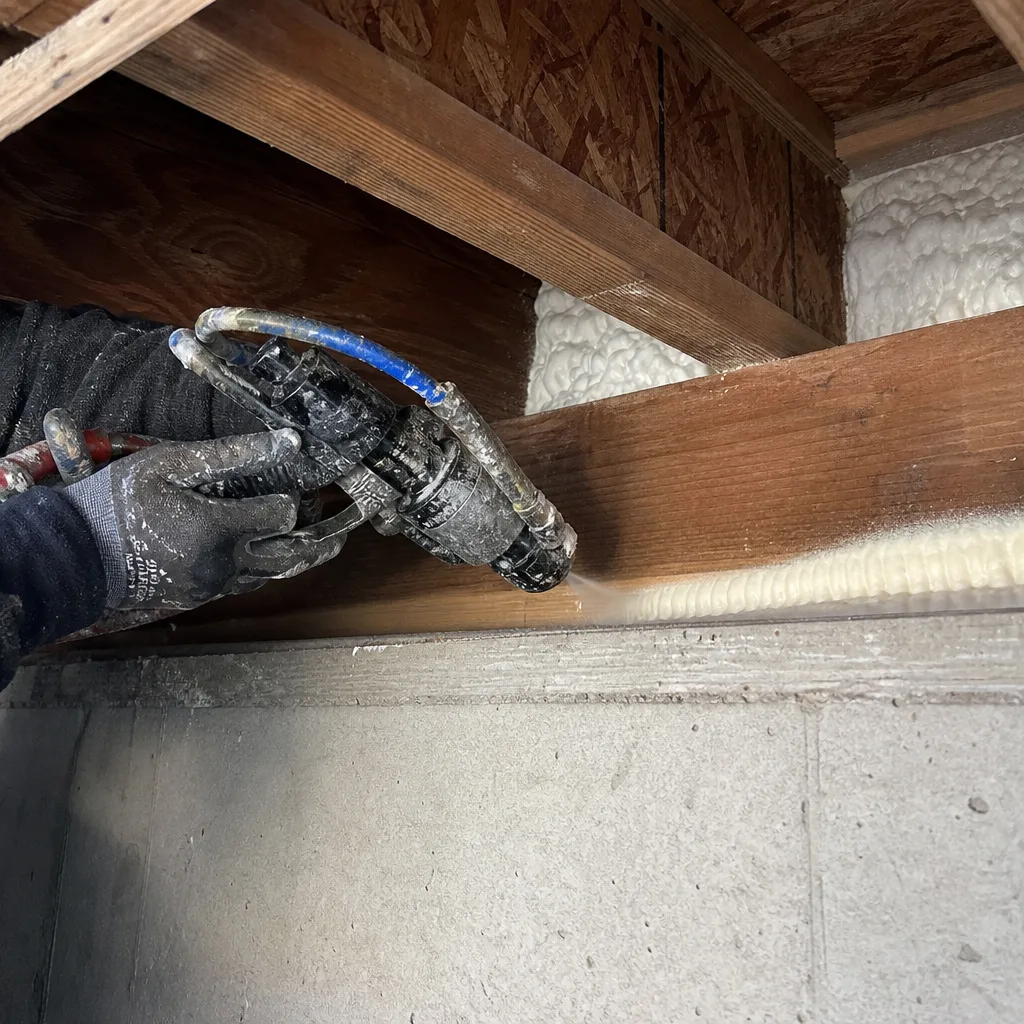
Beach-adjacent crawlspaces in Redondo Beach pull in damp air through rim joist gaps, and that moisture feeds mold and draws pests. Closed-cell foam on rim joists seals those gaps and adds structural rigidity. In 90278 homes built on raised foundations over sandy soil, we see rim joists that have never been sealed since the 1950s. The foam fixes that permanently.
Open Cell Spray Foam in Redondo Beach
Open Cell Spray Foam serves a different role in Redondo Beach homes. It’s softer, less expensive, and expands aggressively to fill odd cavities, which makes it a strong fit for interior walls and vaulted ceilings where air-sealing matters more than vapor-blocking. A typical open-cell job in Redondo Beach runs $3.50 – $5.50 per square foot installed. It insulates at roughly R-3.5 to R-3.8 per inch, so it’s often applied thicker in attics.
Open-cell is not a vapor barrier, and that’s a critical distinction for Redondo Beach’s coastal homes. In a damp attic, a thick layer of open-cell foam without proper ventilation can absorb moisture from fog-laden air. We don’t call it the wrong material, but we’re careful about where we specify it. In the drier inland 90278 neighborhoods, open-cell often makes solid sense and keeps costs down for a full attic seal.
Wall Cavities and Sound Control
For interior walls in Redondo Beach condos and two-story remodels, open-cell foam does two jobs at once: it blocks airflow and cuts noise transfer between rooms. That dual benefit matters in the beachside 90277 condo buildings where units share walls and the ocean breeze isn’t the only thing you hear. We spray it into open stud bays during remodel, before drywall goes up.
Attic Ceilings Where Ventilation Exists
In a Redondo Beach home with properly baffled soffit vents and a ridge vent doing its job, open-cell foam on the attic floor can be an effective and cost-conscious air-seal. It fills the gaps that let conditioned air escape, which is a common issue in 1960s-era ranches along Aviation Boulevard and throughout 90278. The material cost is lower than closed-cell, and the install is typically faster.
Trusted Brands We Service in Redondo Beach
We carry Icynene and Demilec spray foams because both companies have years of independent performance testing behind them, and both hold up under coastal humidity conditions common in Redondo Beach. When a job calls for mineral wool instead of foam, we turn to Rockwool for its fire resistance and sound dampening, which matters in densely built South Bay neighborhoods. For fiberglass batts in unconditioned spaces, we stock CertainTeed and Knauf. If a homeowner is focused on recycled-content materials, our GreenFiber cellulose is on the truck. We keep local stock available for Redondo Beach jobs, which means less waiting and faster turnaround when a remodeler calls mid-project. Need a specific brand for a spec sheet? Ask. We probably have it.
Common Spray Foam Insulation Problems We See in Redondo Beach Homes
- Salt-air corrosion on attic fasteners and radiant barrier hardware. In the beachside 90277 blocks, the marine layer carries salt into open attic spaces and settles on exposed metal. We find fastener heads rusted through and radiant barrier staples disintegrating. Closed-cell foam encapsulation is our standard fix, paired with stainless replacement hardware.
- Matted, compressed batt insulation in older attics. Years of damp marine air settle into fiberglass batts and flatten them, dropping their effective R-value well below what was installed. This is common in 1950s ranches throughout Redondo Beach. We remove the failed batt and replace it with spray foam that won’t compress or hold moisture.
- Drafty rim joists and unsealed penetrations in 90278 ranch homes. The onshore breeze pushes damp air through every gap around plumbing stacks, wiring penetrations, and rim joists. That airflow carries moisture into wall cavities and attics, feeding condensation and sometimes mold. Spray foam seals those gaps permanently.
- Open-cell foam misapplied in high-humidity attics. We’ve corrected other contractors’ work in Redondo Beach where open-cell foam was sprayed directly against the roof deck without a vapor strategy, and the foam absorbed enough fog moisture to stay damp. That’s a recipe for mold and sheathing rot. The material choice has to match the microclimate.
Pricing for Spray Foam Insulation in Redondo Beach, CA
Closed-cell spray foam in Redondo Beach typically costs $4.50 – $7.50 per square foot installed. Open-cell runs $3.50 – $5.50 per square foot. A small rim joist project in a 90278 ranch might come in around $1,800 – $3,000 total, while a full attic deck seal in a beachside 90277 home can range from $6,000 to $14,000 depending on square footage and how much old insulation has to come out first.
What moves the number: the amount of demo and disposal of failed batt or matted insulation, the accessibility of the attic or crawlspace, and whether we’re also sealing rim joists or a roof deck in the same visit. Our estimates are free, and we quote a firm number before we start, not an hourly guess. Call (866) 271-1602 and we’ll walk the property, take measurements, and tell you exactly what it costs.
We Also Serve Cities Near Redondo Beach
If you’re in Hermosa Beach, Palos Verdes Estates, Manhattan Beach, or Marina del Rey, we’re already working in your neighborhood too. The coastal conditions that shape insulation decisions in Redondo Beach don’t stop at the city line, and neither do we. Call the same number and we’ll schedule your estimate just as fast.
Serving Redondo Beach, CA — Our Local Coverage Area
We’re based in the Redondo Beach area and know this community well. Use the map below to see our service coverage — if you’re nearby, we can almost certainly help.
FAQs About Spray Foam Insulation in Redondo Beach
The salt-laden marine layer off King Harbor and the beachfront carries airborne salt into open attic spaces where it settles on metal fasteners, radiant barrier staples, and hardware. Closed-cell spray foam resists moisture intrusion and encapsulates framing, which slows corrosion on what’s already in place and protects what we install next. In our work throughout 90277, we pair closed-cell foam with stainless fasteners for that exact reason. Call (866) 271-1602 to have your attic assessed.
Fog and coastal humidity condense in attics and soak into fiberglass batts, matting them down and reducing their effective R-value. The dampness also traps moisture against framing, which accelerates rot and fastener corrosion. In beachside homes, we often find insulation that looks thick but underperforms because it’s been wet and compressed for years. Spray foam, particularly closed-cell, doesn’t absorb that moisture and holds its insulating value.
Yes. Inland 90278 ranches and tracts deal less with salt spray and more with decades-old batt insulation, unsealed top plates, and drafty rim joists. The prep work focuses on air-sealing penetrations and removing degraded material rather than corrosion mitigation. The foam choice also shifts: open-cell often works well in 90278 attics with functioning ventilation, while beachside 90277 attics usually call for closed-cell.
Indirectly, yes. Spray foam seals the attic and rim joist air paths that let salt-laden damp air move through the structure and settle on metal components throughout the home, including garage-door springs, hinges, and tracks. When the thermal envelope is sealed, humidity swings in the garage flatten out, and that reduces the condensation that drives corrosion. It won’t undo existing rust, but it slows the next round. In a 1950s ranch near King Harbor, we removed failing batt insulation, applied closed-cell foam at the attic deck and rim joists, and replaced the corroded fasteners with stainless hardware. The garage now holds more stable air, which is what the hardware needed all along.
Closed-cell spray foam is the better fit for most Redondo Beach applications because it acts as both insulation and vapor barrier. It keeps marine moisture from condensing inside wall and attic cavities. Open-cell foam has a place in interior walls, sound control, and dry inland attics, but it should be specified carefully near the coast. We carry Icynene and Demilec in both open- and closed-cell formulations, so the recommendation comes from your home’s conditions, not from what’s easiest for us to stock. For a free on-site assessment and a firm quote, call (866) 271-1602.
Written by Noel Arredondo, Owner at Fontana Insulation, serving Redondo Beach and the South Bay since day one.