
Spray Foam Insulation in Pasadena, CA: What Homeowners Need to Know
Spray foam insulation in Pasadena typically costs $2.50 – $6.50 per board foot for closed-cell and $1.30 – $2.80 for open-cell, with a standard 1,200 sq ft attic running $3,800 – $9,200 depending on foam type and prep work. Most Pasadena jobs take one to two days once wiring and ventilation concerns are addressed. But here’s what rarely shows up in a generic quote: in this city, the foam itself is sometimes the second thing we do.
Pasadena’s housing stock runs older than almost anywhere else in the San Gabriel Valley. We’re talking 1920s Craftsman bungalows in Bungalow Heaven, Spanish Colonial Revival homes near the Arroyo Seco, and mid-century ranches up in the 91104 and 91105 neighborhoods. Many of these homes still have original knob-and-tube wiring, lath-and-plaster walls, and attics that have never seen insulation. Before any closed-cell foam goes in, a responsible crew has to evaluate what’s hiding in those cavities. That’s the reality of Spray Foam Insulation work in Pasadena, and it’s why you want someone who’s opened a lot of these attics.
Call (866) 271-1602 for a free estimate. We’ll walk your attic, check the wiring situation, and tell you honestly whether foam is the right material for your home.
Key Takeaways for Pasadena Homeowners
- Closed-cell spray foam in Pasadena runs roughly $2.50 – $6.50 per board foot; open-cell runs $1.30 – $2.80.
- Knob-and-tube wiring in pre-1940 homes must be evaluated and often bypassed before foam installation.
- Historic districts like Bungalow Heaven restrict exterior alterations but interior insulation work is generally fine.
- Garage spray foam is one of the most common requests we see in Pasadena, driven by detached garages and ADU conversions.
Fast, Reliable Spray Foam Insulation Across Pasadena
Pasadena homeowners call us when the attic hits 130 degrees in August, when the garage feels like an oven by 10 a.m., or when winter drafts whistle through lath-and-plaster walls on cold January nights. We know these homes. Not because we’ve read about them, but because our crews have crawled through hundreds of attics from the 91182 ZIP code near Caltech down through Bungalow Heaven and across to the San Marino border.
The spray foam work we do in Pasadena is rarely a simple “spray and go” job. Older homes demand sequencing. Wiring first. Ventilation planning second. Foam application third. If a contractor quotes you spray foam over the phone without asking about the age of your house or the wiring in your attic, that’s a red flag. We ask those questions before we ever load the truck. Call (866) 271-1602 and you’ll get a straight answer about whether your house is a good candidate.
Why Fontana Insulation Is Pasadena’s Preferred Spray Foam Insulation Company
We’re material-agnostic. That’s the first thing Pasadena homeowners should know about us. We stock and install eight insulation brands across four categories: fiberglass, mineral wool, spray foam, and cellulose. That means when we recommend foam, it’s because foam is genuinely the best fit for your attic or garage, not because foam is the only product we sell. Noel Arredondo built the company on that principle, and it shows in how the crews talk to customers about their options.
We’re also authorized installers for Icynene and Demilec, two of the most performance-tested spray foam brands in North America. Both are open-cell and closed-cell formulations that have been through years of real-world testing in climates like Pasadena’s. Carrying two foam brands lets us match the product to the application rather than forcing one product into every job. We also carry Rockwool mineral wool, which matters in Pasadena because some homeowners in fire-prone foothill areas ask specifically about mineral wool’s fire resistance. Pasadena has real concern about wildfire-adjacent conditions, and we can have that conversation with actual product knowledge, not a sales script.
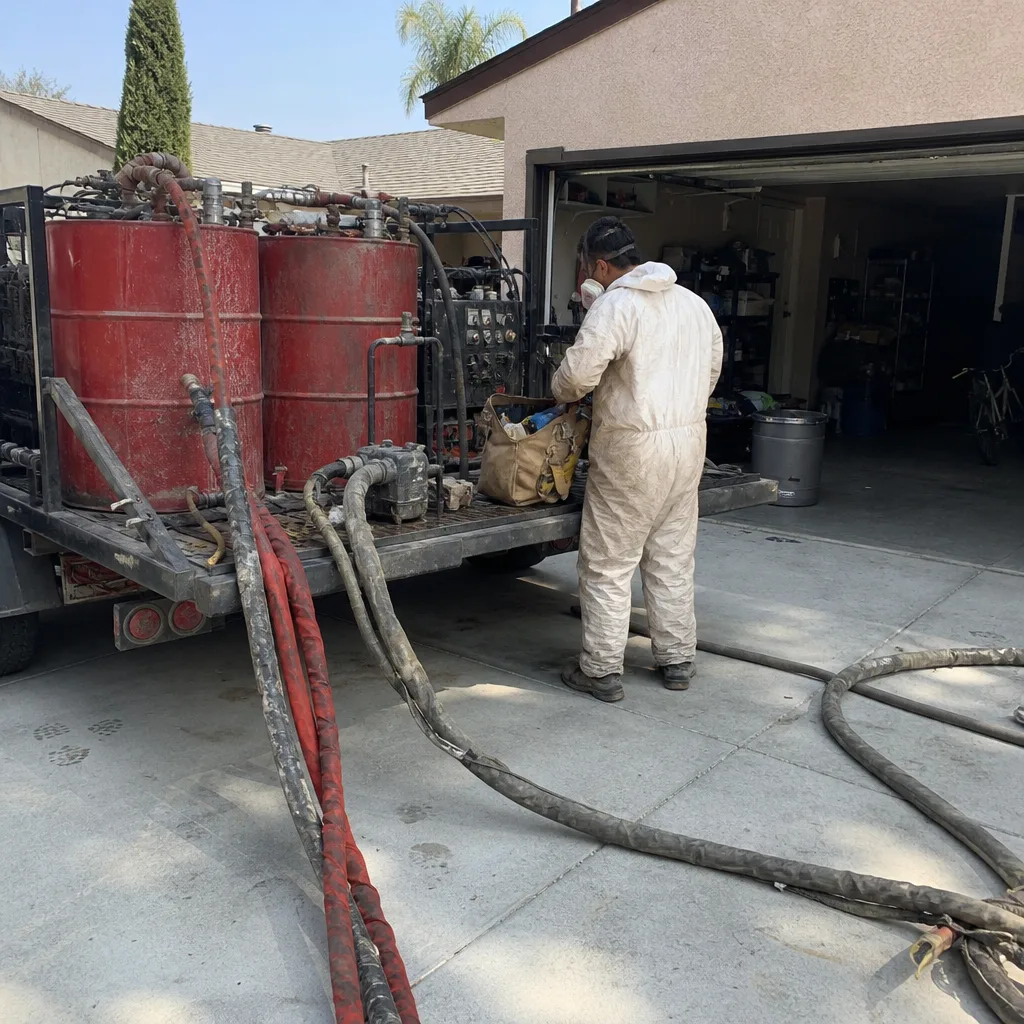
Every Pasadena job is handled in-house. We don’t subcontract the spray application, the prep work, or the cleanup. The same crew that maps your attic is the crew that sprays it. For a city with this many older homes, that continuity matters.
Garage Spray Foam Insulation in Pasadena
Garage Spray Foam Insulation is one of the most frequent requests we field from Pasadena homeowners, especially in neighborhoods like Bungalow Heaven and northeast Pasadena where detached garages are common and increasingly being converted to workshops, home offices, or ADUs. The garage roof deck or garage ceiling gets sprayed to stop heat radiating down into the space. In Pasadena’s summer, an uninsulated garage can sit at 110 – 120 degrees by noon, and that heat loads the adjacent living space too.
For a typical Pasadena detached garage, garage ceiling spray foam runs $2,200 – $4,800 depending on square footage, foam type, and whether the existing roof deck has any access issues. If the garage has a flat roof, access often has to go through the ceiling cavity, which adds labor. If the garage is being converted to living space, we recommend closed-cell at the roof deck for the air seal plus structural rigidity.
Garage Conversions and ADU Projects
Pasadena’s ADU ordinance has pushed a wave of garage conversions across the city, and spray foam is often the right answer for those spaces because it delivers both insulation and air sealing in one pass. The garage becomes a conditioned room, and the foam creates the thermal boundary at the roofline rather than at a dropped ceiling.
Detached Garage Heat Load
Detached garages in Pasadena with west-facing exposure absorb a tremendous amount of afternoon heat. Spraying the ceiling plane with closed-cell foam stops that heat from building a radiant load that bleeds into the rest of the structure. Homeowners with attached garages report the most immediate comfort difference because the garage sits against living space.
Closed Cell Spray Foam Insulation in Pasadena
Closed Cell Spray Foam Insulation is what we recommend for most Pasadena attic roofline applications and any area where moisture management is a concern. Closed-cell is dense, structural, and acts as a vapor barrier at roughly 2 inches of thickness. In Pasadena’s climate profile, with hot dry summers that push heat into attics and cool winters that create condensation risk in wall cavities, closed-cell delivers the air-seal performance that open-cell can’t match at the same thickness.
Closed-cell spray foam in Pasadena runs $2.50 – $6.50 per board foot installed. A standard attic roofline in a 1920s bungalow might take 1,500 – 2,500 board feet, landing between $3,800 and $9,500 depending on the roof geometry and the prep work required. Homes in Bungalow Heaven with knob-and-tube wiring will have additional electrical labor before foam goes in.
Air Sealing the Pasadena Attic
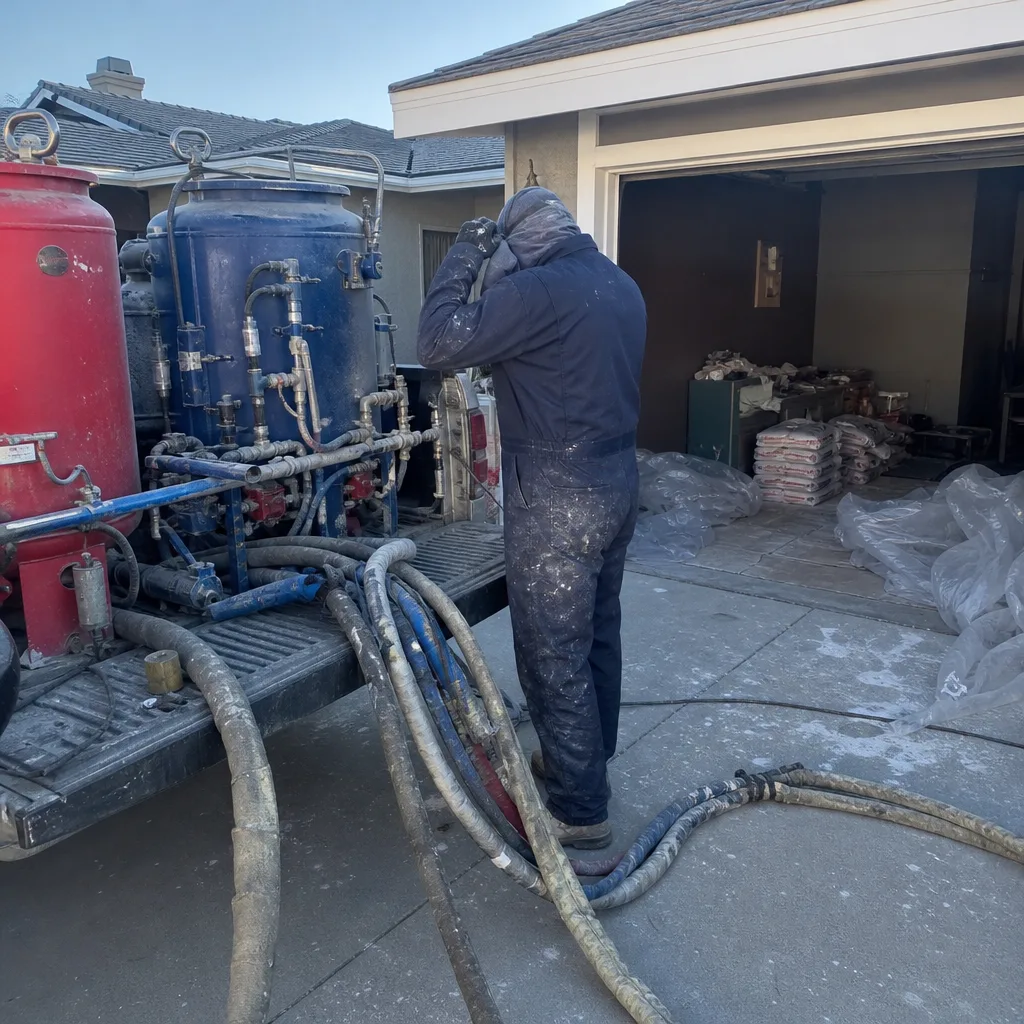
Pasadena sits in a climate zone where summer cooling loads dominate. Closed-cell foam at the roofline creates an unvented attic, moving the thermal boundary to the roof deck, which keeps the attic space itself within a few degrees of the living space. That’s a material difference from blown fiberglass on the attic floor, which still leaves the attic hot and the ductwork baking in it.
Moisture and Vapor Performance
In Pasadena’s mild winter, warm indoor air can push into uninsulated wall cavities and condense against the cold outer sheathing. Closed-cell’s vapor barrier properties address that directly. For Spanish Colonial Revival homes with original lath-and-plaster walls, however, the vapor plan needs to be considered carefully. Foam against the wrong surface can trap moisture and blister plaster. We evaluate wall cavities before spraying, not after.
Trusted Brands We Service in Pasadena
Pasadena homeowners get access to our full brand lineup, and we’re authorized installers for Icynene and Demilec spray foam. We carry Icynene because it’s one of the most extensively tested open-cell and closed-cell foam families in North America, with a track record in retrofit work like the kind Pasadena demands. Demilec’s closed-cell products perform exceptionally in hot-climate roof deck applications, which is exactly what a Pasadena attic needs. We also stock Johns Manville and CertainTeed fiberglass, Knauf, and Rockwool mineral wool, which matters for homeowners in the foothills who specifically request mineral wool’s fire-resistant properties. The point is this: no brand loyalty, just the best fit for your attic, walls, or crawlspace.
Common Spray Foam Insulation Problems We See in Pasadena Homes
- Foam over live knob-and-tube wiring: In pre-1940 Craftsman and Spanish Colonial homes, we regularly find original knob-and-tube circuits running through attic floors and wall cavities. Spraying closed-cell foam directly over live K&T is a mistake. The foam fully encapsulates the old conductors, holds heat against them, and makes future access nearly impossible. Wiring must be bypassed or decommissioned first.
- Trapped moisture against lath-and-plaster walls: Spanish Colonial Revival homes in Pasadena still have original lime plaster over wood lath. Foam shot tight against those cavities without a ventilation plan can trap winter condensation and cause the plaster to blister or crumble. This is a real failure mode we’ve seen in northwest Pasadena and the streets around the Huntington.
- Choked eave vents in 1920s bungalows: Many older Pasadena bungalows rely on original eave and soffit vents for attic cooling during Santa Ana heat events. Foam sprayed into the eaves without installing baffles or leaving vent channels can starve the attic of airflow, driving roof deck temperatures up instead of down.
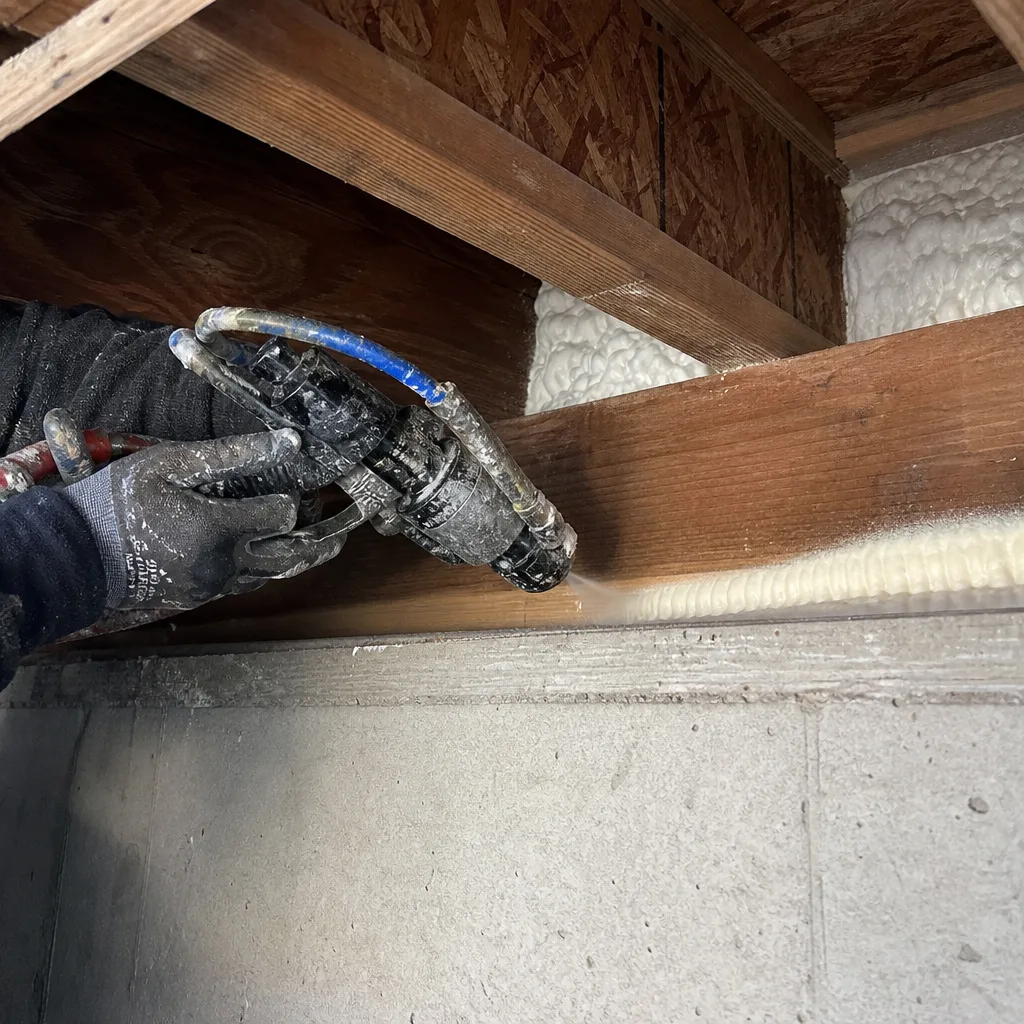
- Dust and air intrusion through band joists: Pasadena’s Santa Ana winds push fine dust through the smallest openings in the thermal envelope. Homes near the Arroyo and chaparral edges complain about dust accumulation in attics and crawlspaces. Spray foam band joist sealing at the rim joist solves this, but only if the foam is applied to a clean surface with proper prep.
Pricing for Spray Foam Insulation in Pasadena, CA
Here’s what Pasadena homeowners should expect, in real numbers. Open-cell spray foam runs $1.30 – $2.80 per board foot installed. Closed-cell runs $2.50 – $6.50 per board foot. A 1,200-square-foot attic roofline at 2 inches of closed-cell foam typically lands between $4,500 and $8,800. Garage ceilings run smaller: $2,200 – $4,800 for a standard two-car Pasadena garage. Rim joist spray foam for a crawlspace is usually $1,200 – $2,400 for a typical foundation perimeter.
What moves the price in Pasadena specifically: knob-and-tube wiring mitigation, access issues in tight 1920s attics, roof geometry with lots of hip edges, and whether the existing insulation needs removal first. We give free on-site estimates so the price you’re quoted reflects your actual attic, not a generic square-foot table. Call (866) 271-1602 to schedule one.
We Also Serve Cities Near Pasadena
Our crews work across the San Gabriel Valley and the foothills. If you’re in South Pasadena, San Marino, Altadena, or East Pasadena, you’re in our normal service radius and we can usually schedule within the same week. Pasadena is where we spend most of our time, but the surrounding communities call on us for the same retrofit work and the same brand selection.
Serving Pasadena, CA — Our Local Coverage Area
We’re based in the Pasadena area and know this community well. Use the map below to see our service coverage — if you’re nearby, we can almost certainly help.
FAQs About Spray Foam Insulation in Pasadena
No, not until the knob-and-tube wiring is addressed. Live knob-and-tube circuits cannot be buried under spray foam because the foam encapsulates the conductors, traps heat, and eliminates any future access to the wiring. In Pasadena, we map the attic circuits first, then bypass or decommission the active K&T runs before any foam application. This adds cost but it’s non-negotiable for safety and code compliance. Call (866) 271-1602 and we’ll walk your attic to assess the wiring situation.
It can, if applied incorrectly. Closed-cell foam shot directly against the backside of lath-and-plaster without a ventilation or vapor plan can trap moisture and cause the original plaster to blister, crack, or detach from the lath. In Pasadena’s older Spanish Colonial and Craftsman homes, we evaluate the wall cavity construction and existing vapor profile before recommending any foam in walls. Sometimes the right answer is dense-pack cellulose, not foam. We’ll tell you which is safer for your house.
Because Pasadena has thousands of detached and attached garages, many of them built in the 1920s through 1950s, and the city’s ADU ordinance has made garage conversions one of the most common residential projects in town. An uninsulated garage acts as a heat sink all summer, and foam at the ceiling or roof deck dramatically cuts that load. Home offices, gyms, and workshops are the typical drivers. A standard Pasadena garage ceiling runs $2,200 – $4,800 to spray.
In designated historic districts like Bungalow Heaven, the city’s Historic Preservation Commission reviews exterior alterations, including anything visible from the street. Interior insulation work in attics, walls, and crawlspaces generally moves forward without commission review because it doesn’t change the building’s exterior appearance. If your project involves roof changes, eave modifications, or exterior wall penetrations for venting, that’s where review can come into play. We plan the work to avoid triggering exterior review wherever possible.
For most Pasadena ranch houses, closed-cell is the better attic choice. Ranch homes from the 1950s and 1960s typically have low-slope or shallow-pitch roofs with limited attic space, and closed-cell delivers much more R-value per inch (about R-6.5 vs. R-3.7 for open-cell). In Pasadena’s hot summer conditions, that matters. Open-cell makes more sense in walls where you want some vapor permeability or where budget is the deciding factor. We’ll show you both options and the cost difference on-site.
Why the Pasadena Insulation Market Demands a Specialist
Pasadena’s insulation work is dominated by the need to protect and preserve its large stock of pre-1940 Craftsman and Spanish Colonial homes, where original balloon-frame walls, knob-and-tube wiring, and uninsulated attics create both a huge energy-saving opportunity and a high risk of moisture damage if modern insulation is installed without proper ventilation and air-sealing. A standard insulation crew that sprays foam like it’s a new-construction tract house in Rancho Cucamonga is going to make expensive mistakes here.
In Bungalow Heaven, we opened a 1923 attic to find original knob-and-tube wiring running through an uninsulated ceiling cavity and bare lath. Before any Icynene went down, we mapped and bypassed the live circuits and air-sealed the top plates. We then applied closed-cell foam to the band joists and attic roofline, which sealed the Santa Ana wind-driven dust intrusion the homeowner had been complaining about while leaving the wall cavities breathable. That’s the kind of sequencing Pasadena work demands.
Noel Arredondo has built Fontana Insulation around the understanding that the right material depends on the house, not on the inventory. In Pasadena, that means sometimes the answer is foam, sometimes it’s Rockwool, sometimes it’s dense-pack cellulose in the walls and foam at the roofline. We’ll give you the honest recommendation for your specific house. Call (866) 271-1602 for a free estimate and we’ll walk through your attic together.
Written by Noel Arredondo, Owner at Fontana Insulation, serving Pasadena and the San Gabriel Valley.