
Fast, Reliable Spray Foam Insulation Across North Hills
Spray foam insulation in North Hills typically costs $2,800 to $7,500 for a full attic air-seal and spray job, with smaller rim joist or garage ceiling projects running $900 to $2,400. Most North Hills homes need it because the original 1950s and 60s batt insulation has failed under decades of Valley heat, leaving attics that bake and cooling bills that climb every summer. Our crews know the ranch tracts around Sepulveda, the stucco-walled additions off Woodley, and the converted attics near Balboa Boulevard. We show up with Icynene and Demilec foam ready, not a generic kit. Call (866) 271-1602 and we’ll give you a straight answer about your house, not a sales pitch.
Why Fontana Insulation Is North Hills’s Preferred Spray Foam Insulation Company
North Hills keeps us busy with a very specific kind of job: fixing thermal envelopes in 1950s-60s tract homes that were never truly insulated in the first place. Most of those houses got a thin layer of fiberglass batt in the attic when they were built, and that batt has been cooking in 100°F+ attic heat for sixty years. It settles. It compresses. It stops doing anything useful. Our crew has crawled through enough low-clearance attics between Parthenia and Nordhoff to know exactly what that looks like: an inch and a half of gray fluff, gaps at the top plates, and recessed light cans leaking conditioned air straight into the roof cavity.
What sets our approach apart isn’t some marketing line. It’s that we install eight nationally recognized insulation brands across four material categories, so the recommendation you get is based on your house’s framing, your budget, and your comfort goal – not what we’ve got sitting in the warehouse. For North Hills attics specifically, we most often reach for open-cell Icynene or Demilec because those foams air-seal as they insulate. That matters here more than in most places. We serve North Hills from our base in Fontana and our lead installer, Noel Arredondo, personally walks every job before we quote it.
You’ll find our work in finished attics off Hayvenhurst, in the addition-heavy blocks around Sepulveda Basin, and in the 91343 and 91393 ZIP codes where the original builds dominate. Homeowners in North Hills keep calling us back because we explain the trade-offs between open-cell, closed-cell, and blown-in options honestly. We’ll tell you when spray foam is overkill and when it’s the only material that makes sense.
Open Cell Spray Foam in North Hills
Open cell spray foam is the most common insulation retrofit we install in North Hills attics, and it’s chosen first for air-sealing and condensation control on the cool side of those thin, low-clearance 1950s-60s ranch roofs. In this part of the Valley, the attic is a furnace in summer and a condensation trap on winter nights when temperatures swing 30 degrees between afternoon and dawn. Open cell expands into the odd framing gaps, top plate seams, and can-light wells that fiberglass batts simply cannot reach. It’s also the right call under a low-pitch roof deck where closed-cell’s rigidity can create drainage and sheathing issues if the roof ever needs repair. A typical open cell job in a North Hills ranch attic, air-sealing included, runs $3,200 to $6,800 depending on square footage and how many knee walls and bypasses we’re working around.
Air-Sealing First, R-Value Second
In North Hills, open cell earns its keep by stopping air movement before we even talk about R-value. The original attics here were built with framing so thin and irregular that conditioned air escapes through a dozen small paths before it ever touches the insulation. We seal top plates, wire penetrations, and recessed can housings first, then apply the foam to the roof deck or floor line.
Condensation Control in Valley Nights
The wide diurnal temperature swings in the San Fernando Valley put moisture exactly where you don’t want it: in the fiberglass, on the backs of drywall, and along the cool side of the sheathing. Open cell’s air-impermeable structure stops that vapor transport. For attics with existing moisture staining or a musty smell, this is usually the material that fixes the root cause, especially around knee walls in converted attic spaces.
Spray Foam Insulation Contractors in North Hills
Spray foam insulation contractors serving North Hills need to understand the weird framing, thin attics, and stucco wall cavities that define this housing stock, not just how to run a hose. Most crews from outside the Valley look at a 1950s ranch with a 2-foot attic clearance and pass on the job. Our team has worked in enough of these houses to know where the bypasses live: around the chimney chase, behind the bathtub soffit, at the transition between the original build and a later addition. We quote these jobs accurately because Noel Arredondo and our installers have seen the inside of hundreds of similar envelopes. Typical spray foam work in North Hills ranges from $2,800 for a rim joist and can-light sealing package to $7,500 or more for a full attic and wall cavity retrofit on an addition-heavy house.
Retrofitting Attic Conversions
North Hills has a lot of attic conversions and room additions, many done decades ago with no insulation plan at all. Those irregular envelopes have odd kneewalls, sloped ceilings, and shallow rafter bays. Spray foam is the only material that conforms to that geometry, and our crew has the experience to hit every surface in one pass without leaving cold spots.
Working Inside Stucco Wall Cavities
The stucco-clad exterior walls on most North Hills ranches hide uninsulated 2×4 frame cavities. In summer those walls radiate heat into the house from late afternoon until well after dark. When we can access the wall bays from the inside or through the attic, closed-cell foam is often the right choice there because its higher R-value per inch and vapor-closed structure prevent hot Valley air and moisture from migrating into the framing. Open-cell alone in those bays would breathe too much for this climate and could allow condensation on the back side of the stucco.
Rim Joist Sealing for Crawlspace Homes
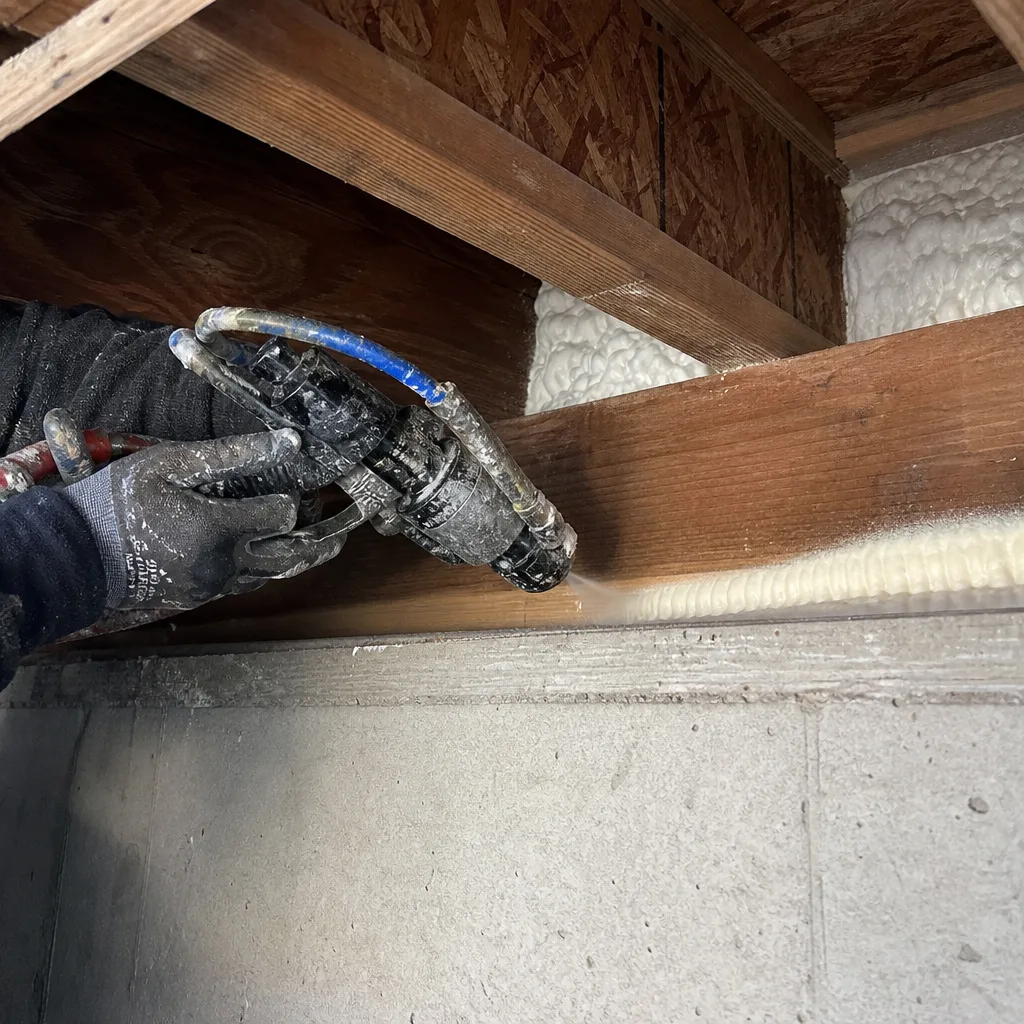
Some North Hills homes, particularly those built on slightly raised foundations near the Sepulveda Flood Control Basin, have crawlspaces with unsealed rim joists. We apply a closed-cell band at the rim to stop the stack effect that pulls hot attic air into the house every summer while pushing cool air out at the base. This is a smaller job, typically $900 to $1,800, and it makes a measurable difference in how hard the AC works in August.
Trusted Brands We Service in North Hills
For North Hills homes, we carry Icynene and Demilec spray foam because both brands have a proven track record in Southern California retrofit work. Icynene’s open-cell foam has the right expansion profile for tight, irregular rafter bays. Demilec’s closed-cell foam delivers the high compressive strength needed when sealing rim joists and the underside of roof decks. We also stock CertainTeed fiberglass and Rockwool mineral wool for the parts of a job where foam isn’t the best answer, like a fire-rated separation wall or a sound-dampening floor assembly. Because we carry the full material range, we’re not trying to force-feed you a product that doesn’t match your house. North Hills customers get a recommendation based on the envelope, not the inventory.
Common Spray Foam Insulation Problems We See in North Hills Homes
- Compressed original batts in low-clearance attics: Decades of extreme Valley attic heat settle 1950s-60s fiberglass down to an inch or less, leaving convective gaps at top plates. Spray foam must air-seal those paths first, not just cover the batts with more material.
- Uninsulated stucco wall bays pulled hot air into the house: The original stucco cladding on many North Hills ranches hides empty 2×4 cavities that radiate heat late into the evening. Closed-cell foam in those bays is often required to stop a condensation risk that open-cell alone can’t handle.
- Attic conversions and additions with irregular envelopes: Decades of haphazard room additions created framing bypasses and sloped ceilings that a one-pass fiberglass job simply misses. Spray foam’s expansion conforms to that odd geometry and seals in one application.
- Knee wall leaks behind finished attic spaces: Converted attics in North Hills almost always have uninsulated kneewalls behind the drywall, creating rooms that bake by mid-afternoon. Open-cell foam applied to the underside of the roof deck and the kneewall cavities fixes the air-sealing problem and the R-value problem at once.
Pricing for Spray Foam Insulation in North Hills, CA
Open cell spray foam in a standard North Hills attic runs $1.80 to $2.60 per board foot installed, with a typical single-story ranch attic landing around $3,500 to $6,000 including air-sealing. Closed cell runs $2.80 to $4.00 per board foot, and most North Hills wall cavity or rim joist projects land between $900 and $2,400. A full house envelope retrofit that includes attic, rim joists, and accessible wall bays can exceed $9,000 on larger or addition-heavy properties. What moves the price is the condition of the existing attic, how much air-sealing is needed before foam goes in, and how many hard-to-reach cavities we’re working in. Call (866) 271-1602 and we’ll come measure your attic and give you a written quote, free.
We Also Serve Cities Near North Hills
Beyond North Hills, our crews regularly handle Spray Foam Insulation projects in Northridge, Van Nuys, Valley Glen, and San Fernando. The housing stock in those neighborhoods shares the same 1950s-60s ranch profile, so our local experience carries directly over. If you’re near the North Hills border, give us a call and we’ll schedule a walkthrough.
Serving North Hills, CA — Our Local Coverage Area
We’re based in the North Hills area and know this community well. Use the map below to see our service coverage — if you’re nearby, we can almost certainly help.
FAQs About Spray Foam Insulation in North Hills
Blown-in insulation adds R-value but leaves the air leaks, and in North Hills the leaks are the bigger problem. A 1950s ranch attic with compressed batts and gaps at the top plates will still bleed hot air in summer no matter how much cellulose you pile on top. Spray foam air-seals those paths and insulates in one pass.
Yes, and it’s typically the right choice. Open cell foam expands into the tight rafter bays and seals without adding the structural rigidity of closed-cell, which can complicate roof repairs on those shallow 1950s-60s decks. We apply it directly to the underside of the sheathing while keeping the necessary ventilation paths clear. Call (866) 271-1602 for a specific assessment of your pitch and deck condition.
Yes, it’s the only material that reliably can. The odd kneewalls, sloped ceilings, and framing transitions left by decades-old attic conversions create bypasses that batts and blown material can’t follow. Spray foam expands to fill those irregular cavities and seals the air paths in the same application. We’ve done this exact work throughout 91343 and 91393.
In most cases, yes. The empty 2×4 wall bays behind original stucco are too shallow for meaningful open-cell performance and too prone to condensation when hot Valley air meets the cool interior surface. Closed-cell foam at 2 to 3 inches delivers the R-value and vapor control those cavities need. We’ll confirm with a wall inspection before recommending anything.
We install Icynene and Demilec spray foam, plus complementary materials including CertainTeed fiberglass and Rockwool mineral wool for fire-rated or sound-sensitive sections. Both foam brands are selected based on the specific cavity we’re filling, not a blanket preference. If your North Hills house needs a material we don’t think fits your roof deck or wall assembly, we’ll say so before quoting.
Written by Noel Arredondo, Owner at Fontana Insulation, serving North Hills with material-right insulation installations.