
Fast, Reliable Spray Foam Insulation Across Moreno Valley
Spray foam insulation in Moreno Valley runs roughly $1.50 to $4.50 per board foot installed, with most garage ceiling jobs landing between $1,800 and $4,200 and full attic applications typically ranging from $4,500 to $9,500 depending on square footage and foam type. We’re Noel Arredondo’s crew at Fontana Insulation, and we work in Moreno Valley weekly – we know the 1980s stucco tracts, the newer infill off Moreno Beach Drive, and exactly what these attics look like under the tile. Call (866) 271-1602 for a free estimate, and we’ll walk your roof before we quote anything.
Most Moreno Valley homes we see were built between 1985 and 2005, which means vented attics, builder-grade batts, and radiant-barrier foil that’s been baking under Inland Empire sun for decades. Spray foam isn’t always the right call for every one of these houses, but when it is – rim joists, garage ceilings, knee walls, roof decks – it’s the highest-performing air-sealing material we stock. And because we carry both Icynene and Demilec spray foam alongside fiberglass, mineral wool, and cellulose, we’re not going to sell you foam if blown-in fiberglass actually fits your house better.
Why Fontana Insulation Is Moreno Valley’s Preferred Spray Foam Insulation Company
We’re not a Moreno Valley contractor, and we won’t pretend to be. What we are is a Fontana-based insulation specialist that’s spent years working the Inland Empire’s inland heat belt, and Moreno Valley’s 100°F summer afternoons are part of that territory. Homeowners in 92553, 92551, and 92552 call us because our Spray Foam Insulation team actually removes the failed radiant barrier before foaming, which most contractors skip. That step matters more in Moreno Valley than almost anywhere else we work.
The housing stock here is specific. Two-story stucco boxes with concrete-tile roofs and attached garages, built fast in the 1980s and early 1990s when energy codes were looser. The original batts have settled. The foil under the tile is hanging in strips. When we quote a Moreno Valley job, we’re quoting the repair work plus the upgrade – not just spraying foam over a mess and calling it done.
Garage Spray Foam Insulation in Moreno Valley
Garage Spray Foam Insulation is the most common spray foam call we get from Moreno Valley homeowners, and for good reason – hundreds of tract homes here have attached garages with uninsulated ceilings that share wall and floor assemblies with conditioned bedrooms. When the garage ceiling hits 130°F in July, the room above it never cools down. We spray closed-cell foam directly to the garage ceiling and rim joist area, creating an air and thermal break that stops that heat transfer at the source.
A typical two-car garage ceiling in Moreno Valley runs $1,800 to $3,600 for closed-cell foam at 2 inches, which is what we recommend for the ceiling plane. You get roughly R-14 from that depth plus a full air seal, which matters more than R-value when your garage door leaks air every time the wind kicks up off the Badlands.
Rim Joist and Band Board Sealing
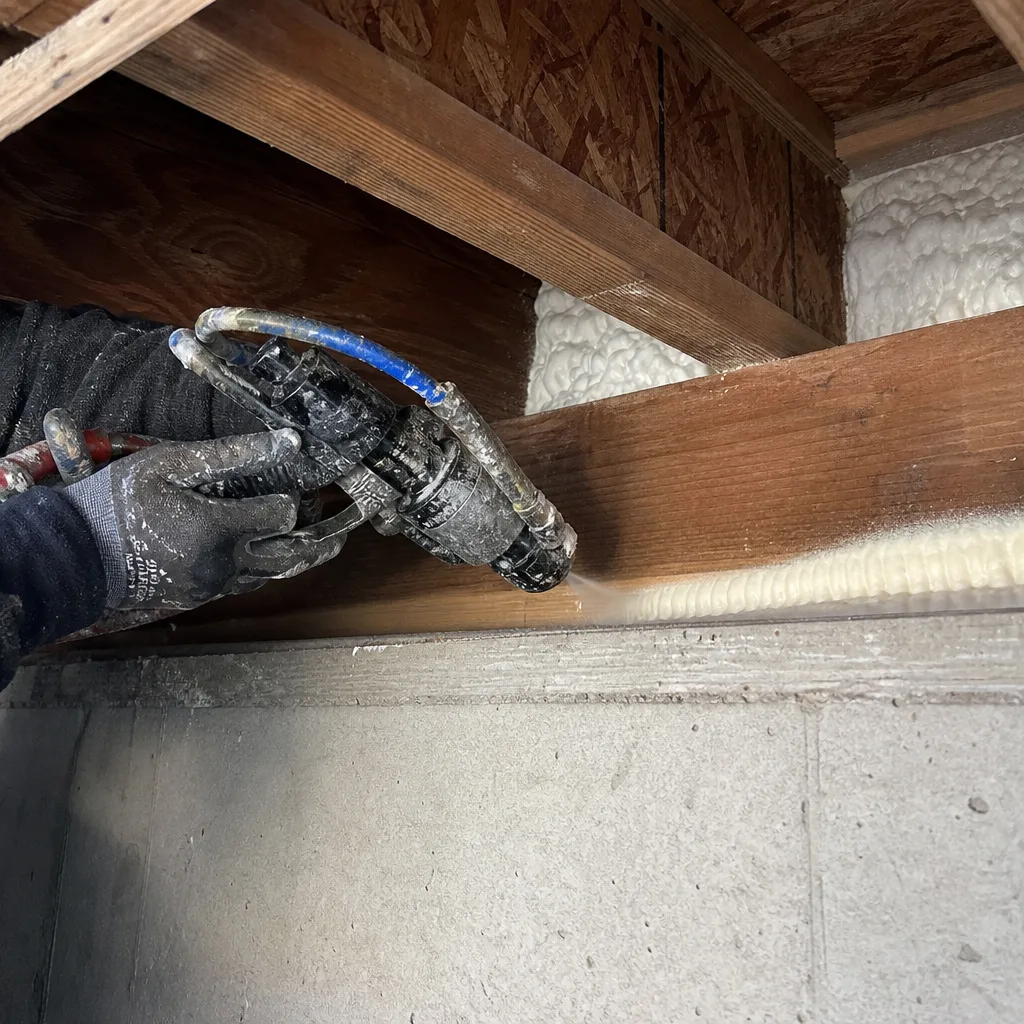
The rim joist – where your floor framing meets the foundation – is a gap factory in Moreno Valley homes. We spray closed-cell foam into each joist bay to stop unconditioned air from pulling through, which is also where dust and pest intrusion happens in older tracts.
Above-Garage Bedroom Comfort
That bedroom over the garage that’s always 8 degrees hotter than the rest of the house? That’s not an HVAC problem. We find it’s almost always a missing or failed thermal boundary at the garage ceiling. Foam fixes it in one afternoon.
Closed Cell Spray Foam Insulation in Moreno Valley
Closed Cell Spray Foam Insulation is our default recommendation for Moreno Valley roof decks, rim joists, and garage ceilings because it adds structural rigidity and its R-value per inch holds up better under repeated 140°F attic conditions than open-cell. At roughly R-6.5 to R-7 per inch, two inches of closed-cell gives you about R-14 plus a vapor barrier and air seal, which open-cell doesn’t deliver at that depth.
On 1980s Moreno Valley builds with 2×4 or 2×6 roof framing, we typically quote $2.25 to $3.75 per board foot for closed-cell applied to the roof deck. A standard 1,800 square foot attic roof deck at 2 inches runs $8,000 to $13,000, which is a real investment – which is why we’ll tell you honestly whether blowing fiberglass to R-38 or R-49 makes more sense for your specific house.
Roof Deck Applications
If your Moreno Valley home has ductwork running through a vented attic, closing the attic with spray foam on the roof deck moves the thermal boundary to the roofline. That keeps ducts inside conditioned space, which in a 140°F attic can be the single biggest efficiency move available.
Knee Walls and Bonus Rooms
Two-story Moreno Valley floor plans often have knee wall attics behind upstairs bedrooms. Closed-cell foam seals those cavities and stops the stack effect that pulls hot air up through wall framing from the garage and lower floors.
Trusted Brands We Service in Moreno Valley
Fontana Insulation carries both Icynene and Demilec spray foam because they’ve proven themselves in Southern California heat, but we also stock Knauf and CertainTeed fiberglass and Rockwool mineral wool for the parts of a Moreno Valley job where foam isn’t the right tool. We don’t have a brand quota. If your 92553 attic needs radiant-barrier removal plus blown fiberglass to R-38, that’s what we’ll recommend. If your 92555 newer build has duct leakage and a vented attic, closed-cell foam on the roof deck may be the fix. One crew, eight brands, no brand loyalty – just the best fit for your attic, walls, or garage.
Common Spray Foam Insulation Problems We See in Moreno Valley Homes
- Settled original batts under foil: In the 1980s west-end tracts around 92551 and 92553, the builder’s R-11 and R-19 fiberglass has settled to half depth and fallen off the joists. Spray foam applied over those gaps without remediation just hides the problem.
- Degraded radiant-barrier foil: Concrete-tile roofs amplify attic heat, and after 20 to 30 years the foil tears, sags, and traps heat against the batts. It has to come out before foam goes in, or you’re sealing the failure in place.
- Old open-cell foam losing R-value: Vented attics in Moreno Valley routinely hit 140°F plus. Open-cell foam installed years ago in those conditions can degrade and lose its loft. Closed-cell holds performance better under repeated heat cycling.
- Duct leakage through the attic: Flex ducts in 1980s tracts leak at the seams, and that leaks conditioned air into a 140°F attic. Foam air-sealing around supply boots and at the ceiling plane stops the bleed.
Pricing for Spray Foam Insulation in Moreno Valley, CA
Here’s what Moreno Valley homeowners can expect to pay, based on the jobs we’ve quoted in the 92551 through 92557 ZIPs. Garage ceiling spray foam runs $1,800 to $4,200 for a typical two-car garage. Rim joist sealing runs $900 to $1,800 for most single-family homes. Closed-cell roof deck application on a 1,500 to 2,000 square foot attic runs $7,000 to $13,000 at 2 inches. Open-cell is cheaper per board foot – $1.50 to $2.75 – but you’ll need more inches to hit the same R-value, and it doesn’t air-seal as tightly at thin depths. Square footage, access difficulty, existing insulation removal, and whether we’re doing radiant-barrier tearout all move the number. Call (866) 271-1602 and we’ll give you a written quote based on an actual attic walk, not a guess over the phone.
We Also Serve Cities Near Moreno Valley
Our crews run the 60 and 215 corridors regularly, so if you’re in March Air Force Base, Woodcrest, Colton, or Loma Linda, we can get to you quickly. We also serve the full Moreno Valley area – all four ZIP codes, from the west-end tracts to the newer builds east of the 215.
Serving Moreno Valley, CA — Our Local Coverage Area
We’re based in the Moreno Valley area and know this community well. Use the map below to see our service coverage — if you’re nearby, we can almost certainly help.
FAQs About Spray Foam Insulation in Moreno Valley
Because your original batts are probably doing almost nothing. In Moreno Valley’s 1980s west-end tracts, the R-11 and R-19 fiberglass has settled to half depth and pulled away from the joists, leaving uninsulated gaps that foam can bridge and seal in a way batts never will. That’s the technical answer. The practical answer is that your upstairs bedrooms are hot, and the foil under your tile roof is torn. Call (866) 271-1602 and we’ll tell you what you actually need after inspecting the attic.
No. You should not spray foam over failed radiant-barrier foil, and we won’t do it. The foil in 92551 and 92553 homes is typically torn, dusty, and hanging loose under concrete-tile roofs, and foaming over it traps the failure in place. We remove it, verify batt depth, and then apply foam to a clean substrate. That’s the step most contractors skip, and it’s the step that determines whether your new foam actually performs.
Repeated exposure to 140°F attic temperatures degrades open-cell foam faster than closed-cell. Closed-cell spray foam, like the Icynene and Demilec products we install, holds its R-value and structural integrity under sustained heat cycling much better, which is why we recommend it for Moreno Valley roof decks and garage ceilings. Open-cell has its place in wall cavities, but we won’t spec it for a vented attic that bakes all summer without telling you the trade-off.
For a standard two-story stucco home with an attached two-car garage, the typical scope is the garage ceiling at 2 inches of closed-cell foam plus the rim joist bays where the garage meets the house. That runs $1,800 to $4,200 depending on ceiling area and joist depth. If the room above the garage is a bedroom, we’ll also air-seal around any recessed light housings and the attic access hatch. Estimates are free – call (866) 271-1602.
That depends on what part of the attic you’re foaming. If you’re spraying the roof deck and making the attic conditioned space, you need enough foam depth to meet code for your climate zone – typically R-38 equivalent, which is about 6 inches of open-cell or 5 inches of closed-cell. If you’re only air-sealing the attic floor plane and leaving the attic vented, you still need the flat insulation brought up to R-38 or R-49, which we typically do with blown fiberglass over what’s left of the original batts. We’ll explain the difference on site, and we won’t sell you foam you don’t need. Call (866) 271-1602 for a free attic assessment.
In Moreno Valley’s 1980s west-end tracts, the real job is almost never just adding foam. It’s removing the failed radiant barrier, verifying batt depth, and then deciding where foam actually belongs. On a 1986 two-story stucco home near Lasselle Street in 92553, our crew found the original R-11 batts settled to half depth and falling off joists, with radiant-barrier foil shredded and dusty under the concrete-tile roof. We removed the failed foil, vacuumed the attic, and applied closed-cell spray foam to the garage ceiling and knee walls to seal duct leaks and stop thermal bridging, then upgraded the flat attic to R-38 with blown fiberglass over new Owens Corning batts. The homeowner reported a 22°F drop in upstairs bedroom temperature during a 105°F afternoon. That’s the kind of result we can only deliver when we do the full job, not just the visible part.
If you’re in Spray Foam Insulation in Moreno Valley planning territory – whether it’s a 1980s west-end tract home, a newer infill build near Moreno Beach Drive, or anything in between – call (866) 271-1602 for a free estimate. We’ll climb into your attic, tell you what’s actually going on up there, and recommend the right material for your home’s specific situation. No brand loyalty, no pressure, no shortcuts.
Written by Noel Arredondo, Owner at Fontana Insulation, serving Moreno Valley and the Inland Empire.