
Fast, Reliable Spray Foam Insulation Across March Air Force Base
Spray foam insulation in March Air Force Base typically costs between $2,800 and $7,500 for a standard attic application, with wall insulation projects ranging from $3,500 to $9,000 depending on square footage and foam type. Most homes in the March ARB area need closed-cell foam for the high desert heat, and we can usually schedule work within 5 to 7 business days once base access is confirmed. If you’re dealing with a hot attic or drafty walls in ZIP 92551, call Noel Arredondo’s team at Fontana Insulation at (866) 271-1602 for a site assessment and exact quote.
We know this area’s housing stock differently than most insulation contractors. The former military housing around March Air Force Base was built to Cold War specifications, not modern civilian codes. That changes how we prep, what we find behind the stucco, and which foam formulation actually performs here. Our crew has worked homes along N Street, C Street, and the residential blocks near the old base exchange, so we understand the access protocols and the construction quirks that come with this ZIP code.
Why Fontana Insulation Is March Air Force Base’s Preferred Spray Foam Insulation Contractor
Homeowners in March Air Force Base keep calling us for one reason: we carry eight insulation brands across four material categories, so we’re not married to a single product line. If open-cell Icynene makes sense for your walls, we’ll tell you. If closed-cell Demilec is the better call for your sun-baked roof deck, we’ll tell you that too. The recommendation follows the house, not our inventory. Noel Arredondo built the company around that principle, and it shows in the work.
The homes here aren’t like the tract developments in Moreno Valley or Perris. Properties in ZIP 92551 often have original 1940s and 1950s military-spec batt insulation that’s compressed, missing, or was never properly air-sealed. We’ve seen attics where base-era remodels buried original framing under added decking. You don’t find that in Good Hope. Our team maps the existing construction before spraying anything, which means fewer surprises and a tighter thermal boundary when we’re done.
We also carry Rockwool mineral wool for homeowners who want fire resistance and sound dampening alongside thermal performance – a real consideration in older wood-frame stucco homes where wall cavities are tight and summer heat radiates through exterior walls all afternoon. Most local contractors don’t stock it. We do. And we install everything in-house: attic insulation, spray foam, and blown-in. No subcontracting.
Spray Foam Attic Insulation in March Air Force Base
Spray Foam Attic Insulation in March Air Force Base requires a different prep sequence than what we do in neighboring Riverside. Original military housing from the 1940s through the 1970s often had attic ventilation and vapor retarder details that were altered during base-era modifications. Before applying foam, we map the attic’s original construction to verify where vapor retarders sit and whether added decking has hidden air leaks underneath. Skip that step and you’re spraying foam over problems instead of solving them.
A typical attic spray foam job in March Air Force Base runs $2,800 to $7,500. Closed-cell foam on the roof deck costs more per board foot but delivers higher R-value per inch and adds structural rigidity – important in older military housing where roof framing has seen decades of temperature swings. Open-cell costs less and works well for attic floors in homes that already have good roof insulation but need air-sealing at the top plates.
Roof Deck Applications for Desert Heat
Unvented attic assemblies make sense here. The inland Riverside County climate pushes attic temperatures past 140°F in July and August, and that heat radiates down through ceiling drywall all night. Applying Icynene or Demilec closed-cell foam to the underside of the roof deck moves the thermal boundary to the roofline. The attic becomes conditioned space, which reduces cooling load and keeps HVAC ducts from sitting in a 140-degree oven.
Air-Sealing Before Foam
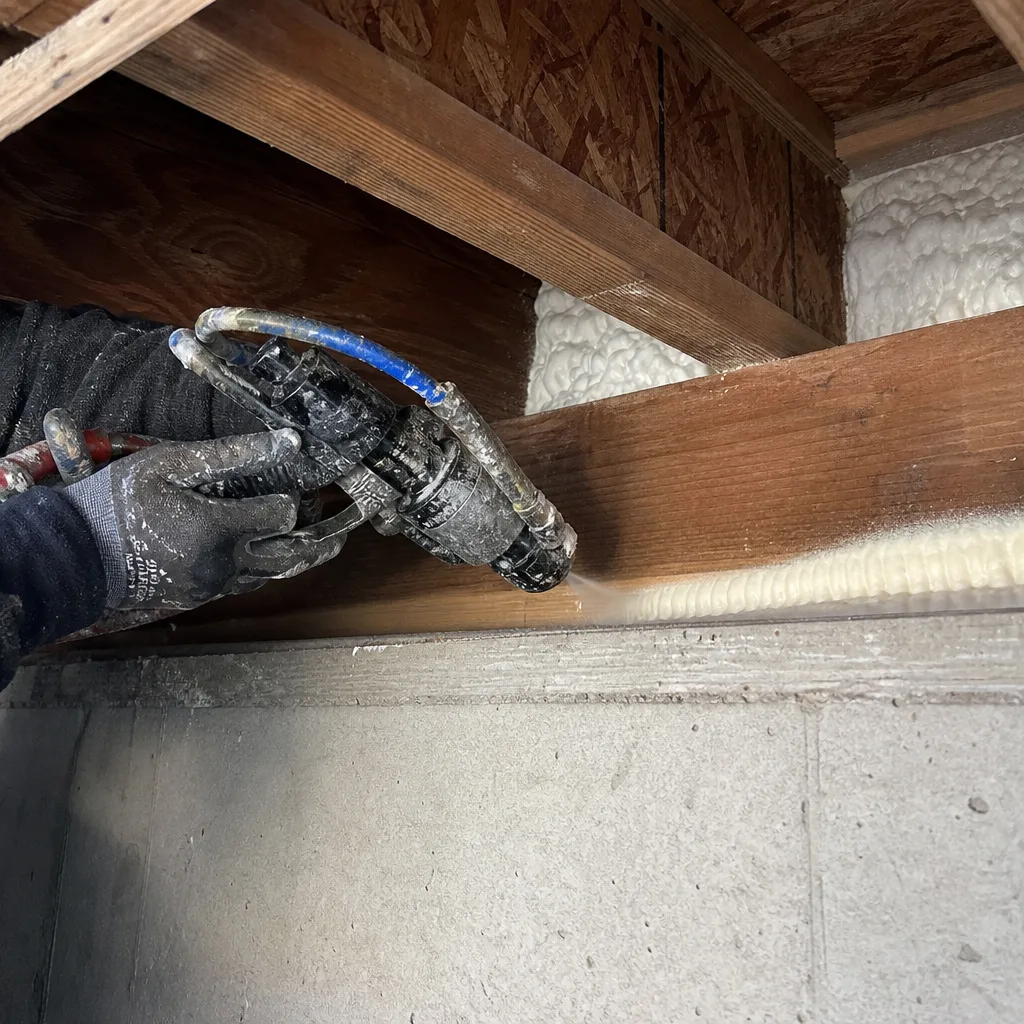
On a 1950s wood-frame stucco home near the former March ARB housing area, our tech found original military-spec batt insulation compressed to less than an inch under attic decking that had been added during a base-era remodel. We removed the degraded batts, air-sealed the top plates with spray foam, and applied Icynene to the attic roof deck, restoring R-value and stopping the radiant heat gain that had been pushing attic temperatures past 140°F. That’s the sequence that matters here: remove, seal, then foam.
Spray Foam Wall Insulation in March Air Force Base
Spray Foam Wall Insulation in March Air Force Base usually means working inside older wood-frame stucco cavities that were built with minimal or no insulation. Many of these homes went up between 1940 and 1975, when the military base was expanding and energy was cheap. The stucco exterior absorbs sun all day, and without proper wall insulation, that heat transfers straight into living spaces by late afternoon. We see this constantly in the housing around Arnold Heights and the residential streets near the base’s north gate.
Wall spray foam in this area typically runs $3,500 to $9,000 depending on wall count, cavity depth, and whether we’re doing open-cell or closed-cell. Closed-cell Demilec works best in 2×4 walls where you need maximum R-value in a shallow cavity. Open-cell Icynene is better for interior walls where sound control matters more than thermal performance. We walk you through both options with actual R-value numbers, not vague claims.
Moisture and Vapor Retarder Verification
The temperature swings here create a real adhesion risk. Triple-digit days followed by cool desert nights mean wall-to-roof junctions expand and contract significantly. If spray foam isn’t properly sealed at those junctions in older stucco homes, it can crack and lose adhesion over time. We verify the original vapor retarder placement before spraying – something rushed crews often skip. Trapping moisture in a wall cavity in this climate leads to mold and rot, and we won’t let that happen because a schedule got tight.
Base-Access Coordination
Properties in ZIP 92551 sometimes require base coordination that civilian contractors in Riverside never deal with. We handle the access paperwork and scheduling so the project doesn’t stall. It adds a layer of logistics, but it’s part of working in March Air Force Base, and we’ve done it enough times that it rarely delays a job beyond a day or two.
Trusted Brands We Service in March Air Force Base
We carry Icynene and Demilec spray foam because both brands have extensive performance testing behind them, and they cover the open-cell and closed-cell sides of the material spectrum. For homeowners in March Air Force Base who want an alternative to foam, we stock CertainTeed fiberglass and Knauf batts, plus Rockwool mineral wool for fire resistance and sound control. Our team keeps a working inventory of materials suited to the local housing stock, so we’re not waiting on a supplier truck from Riverside when your job is ready to start. You get the right material for your March Air Force Base home’s specific situation, not whatever happens to be on the shelf.
Common Spray Foam Insulation Problems We See in March Air Force Base Homes
- Compressed or missing original military-spec insulation. Many 1940s-1970s homes near the former base housing area have batt insulation that’s been compressed under added decking or pulled out during base-era remodels and never replaced. Spraying foam without removing and mapping this first hides air leaks permanently.
- Cracked foam at wall-to-roof junctions in older stucco homes. The large daily temperature swings in March Air Force Base cause expansion and contraction at these joints. If the foam wasn’t sealed properly during install, it can crack within a few seasons and lose its air-sealing value.
- Hidden air leaks from base-era modifications. Remodels done during the base’s active years often added walls, dropped ceilings, or electrical chases that created new pathways for air movement. Foam applied over these without mapping the original construction won’t stop the drafts.
- Moisture trapped by unverified vapor retarders. In a dry climate, people assume moisture isn’t an issue. But if the original vapor retarder placement is ignored and foam is sprayed on the wrong side of it, condensation forms inside the wall cavity during the cool desert nights. We verify placement before we spray.
Pricing for Spray Foam Insulation in March Air Force Base, CA
Attic spray foam in March Air Force Base runs $2,800 to $7,500 for a standard single-story home. Wall insulation jobs range from $3,500 to $9,000 depending on cavity depth and whether you choose open-cell or closed-cell. Closed-cell costs more per board foot – usually 40 to 60 percent more than open-cell – but you get roughly double the R-value per inch. A 2×4 wall cavity filled with closed-cell foam lands around R-21, while open-cell in the same cavity hits about R-13 to R-14. We also do rim joist spray foam (typically $1,200 to $2,800 for a full perimeter) and garage ceiling spray foam ($900 to $2,200 for most single and double garages). Every quote starts with a free site assessment so we can measure actual square footage and check the existing construction. Call Noel Arredondo’s team at (866) 271-1602 to schedule one.
We Also Serve Cities Near March Air Force Base
Beyond March Air Force Base, our Spray Foam Insulation crew handles jobs in Moreno Valley, Woodcrest, Perris, and Good Hope. The housing stock changes once you cross the city line – newer tracts, different construction methods – but the heat doesn’t. If you’re in one of those areas and want a contractor who understands Inland Empire insulation requirements, give us a call at (866) 271-1602.
Serving March Air Force Base, CA — Our Local Coverage Area
We’re based in the March Air Force Base area and know this community well. Use the map below to see our service coverage — if you’re nearby, we can almost certainly help.
FAQs About Spray Foam Insulation in March Air Force Base
Yes. March Air Force Base’s former military housing was built to Cold War-era specifications with attic ventilation and vapor retarder details that differ from Riverside’s modern tracts. We have to map the original construction and verify vapor retarder placement before spraying, which we don’t need to do in newer Riverside homes built to current codes. Call (866) 271-1602 and we’ll walk you through what your specific house needs.
We can coordinate base access for properties in ZIP 92551, including the residential areas near the former March ARB housing. It requires paperwork and scheduling with base officials, which we handle in-house. Most access approvals take a few days, and we factor that into the project timeline so the insulation work itself doesn’t get delayed. Call (866) 271-1602 and we’ll confirm the current access requirements for your address.
We use Icynene open-cell and Demilec closed-cell spray foam for attic applications in March ARB homes. Icynene works well for attic floors where air-sealing is the priority, while Demilec closed-cell is our go-to for roof deck applications where maximum R-value per inch matters. Both brands have extensive independent performance testing. Call (866) 271-1602 and we’ll explain which fits your attic.
The hot, dry Riverside County climate means spray foam here is primarily fighting radiant heat gain and cooling load, not moisture intrusion. But the daily temperature swings between triple-digit afternoons and cool desert nights put real expansion and contraction stress on foam at wall-to-roof junctions. That’s why we emphasize proper sealing at those joints, especially in older wood-frame stucco homes. Call (866) 271-1602 for an inspection and we’ll show you exactly where your home is losing its thermal boundary.
Expect a thorough attic and wall cavity assessment that includes checking for compressed original insulation, mapping any base-era modifications, verifying vapor retarder placement, and measuring actual square footage. The inspection takes about an hour, and you’ll get a written quote with specific R-value targets and a recommended foam type. Call (866) 271-1602 to schedule yours, free of charge.
If your March Air Force Base home is fighting the inland heat with inadequate insulation, we can fix it. Call Fontana Insulation at (866) 271-1602 for a free estimate. Noel Arredondo’s team will assess your attic and walls, explain your material options honestly, and give you a straight answer on cost.
Written by Noel Arredondo, Owner at Fontana Insulation, serving March Air Force Base and the surrounding Inland Empire.