
Fast, Reliable Spray Foam Insulation Across Lakewood
Spray foam insulation in Lakewood typically costs $2.40 to $4.10 per board foot for open cell and $3.10 to $5.90 per board foot for closed cell, with most whole-attic retrofits landing between $2,800 and $7,500 depending on square footage, existing insulation removal, and whether old wiring or ductwork needs attention first. Most Lakewood jobs take one to two days once prep work is handled. We answer calls at (866) 271-1602 and run crews into Lakewood weekly, so scheduling is straightforward.
If you live in one of those 1949-to-1953 Lakewood Park tract homes off South Street or Del Amo, you already know the attic behaves like an oven by 3 p.m. and stays warm long after sunset. That shallow space above your ceiling was never built for insulation, and spray foam changes how it performs. But the prep sequence matters more here than almost anywhere else in Los Angeles County. More on that below.
Key takeaways:
- Spray foam costs more per square foot than blown-in, but air-seals permanently and works in shallow, unvented Lakewood attics where fiberglass underperforms.
- Original Lakewood Park homes often need wiring and duct work addressed before foam goes in.
- Closed cell handles moisture and structural reinforcement; open cell is the budget-conscious air-sealing choice for attics and rim joists.
- We install foam from Icynene and Demilec, two of the most heavily tested spray foam lines in the country.
Why Fontana Insulation Is Lakewood’s Preferred Spray Foam Insulation Company
Lakewood isn’t a generic suburb. It’s a planned postwar community where thousands of homes share the same floor plan, the same concrete slab, the same shallow attic, and the same insulation problems. That repeatability means a crew either knows Lakewood Park construction or it doesn’t. Noel Arredondo built Fontana Insulation around knowing exactly what we’re walking into before the trailer even parks.
We’ve worked through enough Lakewood attics to recognize the signs on sight: original 2×4 rafters with no baffles, knob-and-tube wiring buried under loose-fill, a hall-closet furnace with a short plenum boot, and bath fans venting straight into the attic. Most insulation contractors outside of town look at that and either quote a messy blow-over or walk. We handle the sequence properly, and that’s why Lakewood homeowners call us back for the next house Spray Foam Insulation job.
Because we install both open cell and closed cell foam from Icynene and Demilec, plus five other material lines, the recommendation doesn’t tilt toward whatever pays us best that month. If your Lakewood attic needs air sealing more than R-value, we say so. If closed cell on the roof deck makes better sense than open cell on the attic floor, we walk you through why. That’s the whole point of being material-agnostic.
Call (866) 271-1602 and you’ll talk to someone who has actually spent time in a Lakewood attic, not a call center reading a script.
Closed Cell Spray Foam Insulation in Lakewood
Closed Cell Spray Foam Insulation is the workhorse choice for Lakewood homes where roof deck application, crawlspace encapsulation, or moisture control is part of the equation. It goes on at roughly 2 inches thick on average, cures rigid, and stops both air and water vapor movement. In a city like Lakewood where afternoon attics bake and nighttime cooling pulls moisture inward, that vapor-blocking property matters more than the R-value by itself.
Think about what happens in a 1951 ranch with no attic ventilation: humid daytime air rises into the attic, the roof deck cools fast after sunset, and condensation forms on the sheathing. Closed cell foam applied to the underside of the roof deck creates an unvented assembly that stops moist air from ever reaching that cold surface. It also glues the roof deck to the rafters, which matters during Santa Ana wind events. Typical closed cell roof deck application in Lakewood runs $4.10 to $5.90 per board foot, or $5,000 to $9,000 for a 950-square-foot attic.
Where closed cell earns its cost
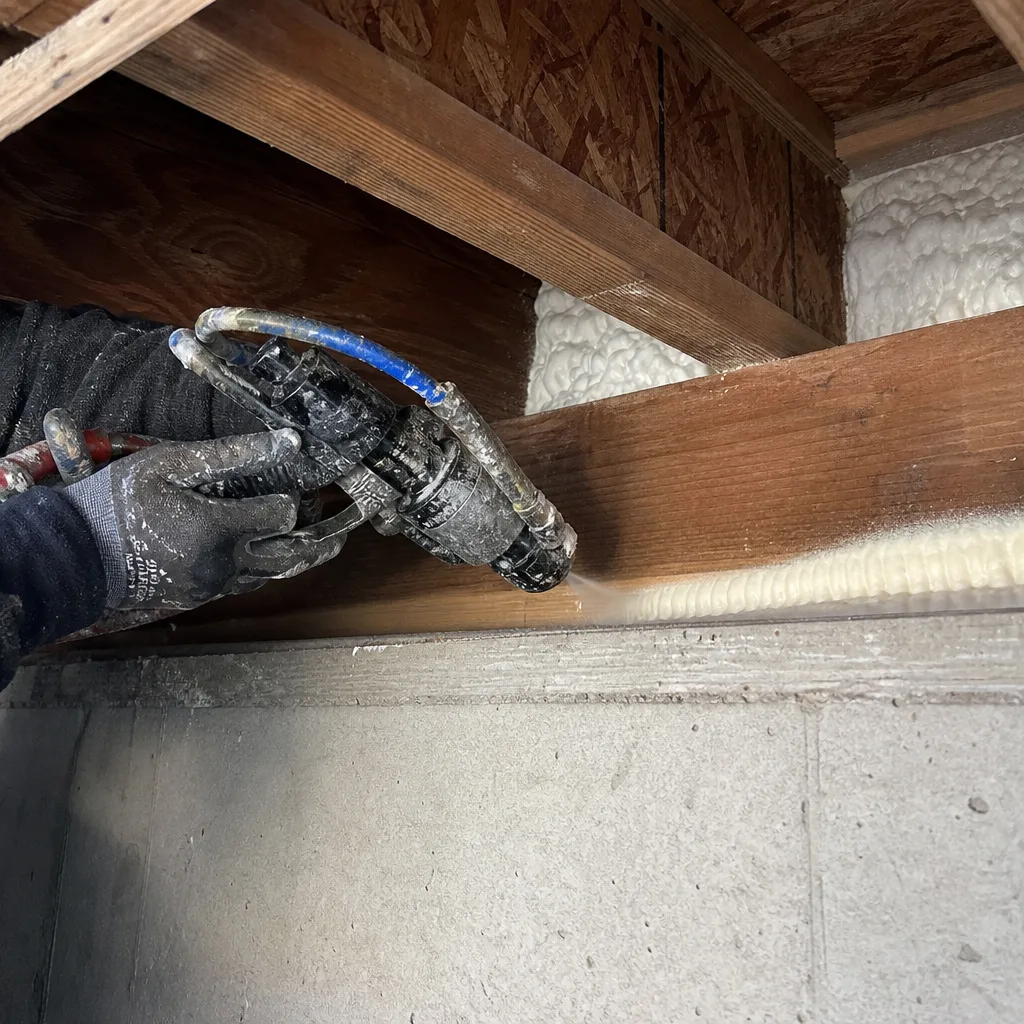
Rim joists. In original Lakewood Park construction, the rim joist where the walls meet the slab is a thin strip of wood with nothing behind it. Closed cell foam seals that gap and stops the floor-level drafts most homeowners blame on windows. It’s a smaller job, usually under $1,500, and it fixes a problem fiberglass batts never touch.
Crawlspace and garage ceiling applications also favor closed cell for one simple reason: closed cell does not absorb water. If a Lakewood home has had a past plumbing leak or recurring condensation near the foundation, open cell would hold moisture. Closed cell won’t.
Open Cell Spray Foam in Lakewood
Open Cell Spray Foam is the smarter spend for most Lakewood attic floors. It expands aggressively to fill odd-shaped rafter bays, seals around old top plates and wiring penetrations, and delivers strong air-sealing at a lower material cost than closed cell. For a typical 1,000-square-foot Lakewood Park attic, open cell applied to the attic floor or roofline runs $2,400 to $4,600 installed.
The critical distinction: open cell is vapor-permeable. That’s actually a benefit in an attic that won’t be sealed as a conditioned space, because any incidental moisture can dry rather than trapping itself against old framing. In a cold climate that permeability would be a liability. In Lakewood’s mild winters and hot inland afternoons, it’s the correct physics call for most vented attic setups.
Air sealing before R-value
The most meaningful comfort gain in a Lakewood duct-heated home usually comes from sealing the attic floor penetrations before adding any insulation mass. Open cell does both at once. It fills the gaps around old vent pipes, electrical boxes, and top plates, then builds insulation thickness on top. Single product, two jobs done.
For homes where the budget is tighter or the attic will eventually be remodeled, open cell on the attic floor with a ventilated roof above remains the standard we recommend. It performs consistently and doesn’t lock the homeowner into an unvented assembly.
Trusted Brands We Service in Lakewood
We install Icynene and Demilec spray foam specifically because both lines have decades of real-world performance data across coastal Southern California climate zones, and both maintain strict installer certification requirements. That matters when the foam is going onto 75-year-old framing with original wiring nearby. Our Lakewood customers also have access to our full material lineup, which includes Rockwool mineral wool for fire-rated and sound-dampening applications, CertainTeed and Johns Manville fiberglass for conventional attics and walls, and Knauf for budget-conscious fiberglass replacements. We stock parts and order material for Lakewood jobs on a project-by-project basis, so turnaround is measured in days, not weeks. No brand loyalty, just the right product for the specific attic, wall assembly, or crawlspace we’re treating.
Common Spray Foam Insulation Problems We See in Lakewood Homes
- Foam applied directly over knob-and-tube wiring. Original Lakewood Park attics often still contain active knob-and-tube circuits buried under decades of loose-fill. Spray foam over live, uninsulated wiring is a code violation and a fire hazard. The wiring must be replaced, decommissioned, or properly conduit-encapsulated before foam touches it. We flag this on nearly every 1950s attic we scope in Lakewood.
- Bath fans venting into the attic and then getting foamed over. A depressurized fan trapped under foam pushes moist air into the building assembly. Cool Lakewood nights condense that moisture on the ceiling drywall. The fix is an airtight fan cover and a duct run routed to the exterior before foam application. We see this constantly in 90712 and 90713 homes that had quick DIY insulation jobs years ago.
- Unvented roof deck foam that traps afternoon heat. Converting a shallow 1950s attic to a conditioned space changes the thermal profile of the roof. If the foam thickness and ventilation aren’t recalculated for Lakewood’s afternoons, which run about 10 degrees hotter than Long Beach, shingle temperatures climb and lifespan drops. We size foam thickness to the specific rafter depth and roofing condition, not a one-size table.
- Abandoned gravity furnace plenums still bleeding heat. Many original Lakewood homes have a hall-closet furnace with a short duct run through the attic. When the old furnace gets decommissioned, the boot and plenum are often left in place, leaking hot air or pulling attic dust into the living space. Foam installed over that mess seals the problem in permanently. We disconnect, cap, and air-seal these before spraying.
Pricing for Spray Foam Insulation in Lakewood, CA
Expect to pay $2.40 to $4.10 per board foot for open cell foam and $3.10 to $5.90 per board foot for closed cell in Lakewood’s current market. A standard 950 to 1,100 square foot tract attic with open cell on the attic floor typically lands between $2,800 and $4,600. Closed cell on the roof deck for the same home runs $5,000 to $7,500. Rim joist sealing for a typical slab-on-grade ranch is usually $900 to $1,400.
What moves the number: whether old loose-fill needs removal first, whether knob-and-tube wiring requires conduit encapsulation, whether bath fans need rerouting, and how much of the attic is actually accessible to a spray gun. Some Lakewood attics under original low-pitch roofs have barely 30 inches of clearance at the peak, and every board foot takes longer when the installer works on their knees. We quote honestly, and the estimate is free. Call (866) 271-1602 and we’ll send someone out to measure.
We Also Serve Cities Near Lakewood
Our crews run foam jobs through Spray Foam Insulation in Lakewood and the surrounding communities regularly. If you’re in Signal Hill, Bellflower, Long Beach, or Paramount and have a 1940s or 1950s home with the same shallow-attic construction, we cover you. The housing stock and climate patterns are similar enough that the prep sequence we follow in Lakewood applies directly.
Serving Lakewood, CA — Our Local Coverage Area
We’re based in the Lakewood area and know this community well. Use the map below to see our service coverage — if you’re nearby, we can almost certainly help.
FAQs About Spray Foam Insulation in Lakewood
No. Spray foam applied directly over live knob-and-tube wiring creates a fire hazard and violates electrical code. The wiring must first be replaced, permanently decommissioned, or encased in conduit per NEC standards, and only then can foam be installed. We handle that prep work as part of the project. Call (866) 271-1602 and we’ll tell you what your attic needs after a visual inspection.
It affects it significantly. That short plenum boot is often rusted, uninsulated, and leaking heated or cooled air straight into the attic. If it’s still connected to an active furnace, we air-seal the connections and insulate around the duct before any foam touches the surrounding area. If it’s an abandoned gravity furnace boot, we disconnect and cap it so you’re not paying to condition a dead duct. This step gets skipped by many foam crews. It’s standard on our Lakewood jobs.
Closed cell on the roof deck will change the attic’s thermal behavior, but it shouldn’t overheat the space if the foam thickness and ventilation design are calculated for your specific roof. The issue arises when a crew sprays an arbitrary two inches without accounting for Lakewood’s afternoon temperatures, which run about 10 degrees hotter than coastal Long Beach. We size foam depth to your rafter bays and roofing material, and we evaluate whether ridge ventilation or a conditioned-attic approach is appropriate before spraying. Get an assessment at (866) 271-1602.
Yes, in most cases. Old loose-fill in a Lakewood attic is frequently compacted, rodent-soiled, saturated with decades of dust from the hall-closet furnace, and hiding things like bath fans and wiring that need addressing. Spraying foam over that mess seals the problems in permanently. We remove the old material, assess what’s underneath, handle any wiring or duct issues, and then spray. The removal adds cost, but skipping it creates long-term liability.
Open cell is vapor-permeable, expands more, and costs less per board foot, making it the standard choice for attic floors and wall cavities where moisture drying is desirable. Closed cell is vapor-blocking, structurally reinforcing, and handles ground moisture, which is why we use it for rim joists, crawlspaces, and unvented roof deck assemblies. In a Lakewood 1950s ranch, most homeowners benefit from open cell in the attic and closed cell at the rim joist and any crawlspace areas. Call (866) 271-1602 for a site-specific recommendation based on your home’s exact construction.
On a 1951 Lakewood Park ranch off Clark Avenue, we found the original hall-closet furnace plenum still connected to a rusted, uninsulated duct boot that had been blowing hot air into a loose-fill-filled attic for decades. Before spraying closed-cell foam along the top plates and knee walls, we air-sealed the plenum, disconnected the abandoned gravity furnace boot, and encapsulated the old knob-and-tube wiring in conduit. The homeowner noticed fewer afternoon temperature swings within the first week, and the attic condensation stains stopped spreading. That’s the sequence Lakewood homes need, and it’s what we do every time.
Call Fontana Insulation for Spray Foam in Lakewood
If you own a Lakewood Park tract home, you don’t have a generic attic. You have a 1950s shallow attic with specific wiring, duct, and ventilation history that determines whether spray foam performs or fails. We’ve spent years learning exactly what that construction throws at an insulation crew. Noel Arredondo and the team at Fontana Insulation can scope your home, explain the prep sequence, and give you an honest quote for open cell or closed cell foam from Icynene or Demilec. Estimates are free. Call (866) 271-1602 and let’s get your attic fixed right.
Written by Noel Arredondo, Owner at Fontana Insulation, serving Lakewood and the surrounding Los Angeles County communities with spray foam, blown-in, and attic insulation since 2008.