
Fast, Reliable Spray Foam Insulation Across Lake Arrowhead
Spray foam insulation in Lake Arrowhead typically costs $2.50 to $6.50 per board foot installed, with most whole-cabin rim joist and wall projects landing between $3,800 and $11,000 depending on square footage and foam type. We service the entire 92352 zip code, from Lake Arrowhead Village up through the Palisades and over to the North Shore. Fontana Insulation sends fully equipped crews from Fontana to Lake Arrowhead regularly, so we know Highway 18 and the Rim of the World roads well. Call (866) 271-1602 and we’ll get someone to your cabin to assess the job and give you a straight number.
Why Fontana Insulation Is Lake Arrowhead’s Preferred Spray Foam Insulation Company
Noel Arredondo started Fontana Insulation because he saw too many crews pushing one brand of insulation onto every house they walked into. Lake Arrowhead’s stock of 1920s through 1980s cabins makes that approach a liability. Some A-frames near Grass Valley Lake need closed-cell foam for structural rigidity. A standard 2×4 wall cabin along North Bay Road might do better with a hybrid approach. We carry both Icynene and Demilec spray foam, so the recommendation comes from what your shell actually needs, not what’s loaded on the truck.
Our crews have been through enough Lake Arrowhead freeze-thaw seasons to know what fails. We see the same patterns every winter: settled fiberglass around rim joists, open-cell foam that soaked up snowmelt in a crawl space, and spray foam applied over old single-pane window frames without backer blocks. Knowing the failure modes before we open the walls changes how we quote a job. We’re not the cheapest bid. We’re the bid that accounts for what a 5,000-foot elevation does to a cabin that’s vacant from January to March.
If you’re comparing options, see how we think about Spray Foam Insulation as one tool among several, not a cure-all.
Spray Foam Wall Insulation in Lake Arrowhead
Spray Foam Wall Insulation in Lake Arrowhead means working with the 2×4 framing that defines most of the cabins along Daley Canyon Road and throughout the Palisades neighborhood. Closed-cell foam makes the most sense on these legacy walls because an inch of it delivers roughly R-7 and acts as a vapor retarder, which matters when snow sits against siding for months. A typical 1,200-square-foot cabin with 2×4 exterior walls runs $4,200 to $6,900 for closed-cell wall application. Open-cell wall foam costs less, usually $2,800 to $4,500, but it doesn’t give you the air sealing on its own, so we use it selectively.
One caution for Lake Arrowhead homeowners: foam sprayed over original single-pane window frames without backer blocks will crack as the wood expands and contracts through big temperature swings. We saw this on a cabin off Kuffle Canyon. The foam looked fine at first. By spring, hairline cracks ran along every window rough opening, and air was moving behind the foam. We now build out backer blocks as standard practice on any pre-1980 frame.
In short: walls in Lake Arrowhead need closed-cell foam for freeze resistance, open-cell for interior sound control on shared A-frame walls, and a proper backer detail regardless of which foam you pick.
When Closed-Cell Is the Right Call
Closed-cell on a 2×4 Lake Arrowhead wall gets you the R-value, yes, but more importantly it stops air from moving through the cavity. In a vacant cabin, that air movement is what lets cold reach the plumbing inside exterior walls. The foam itself doesn’t heat anything. It just removes the pathway. For intermittently occupied cabins, that’s the difference between pipes that survive a February cold snap and a $6,000 plumbing repair.
Open-Cell for Interior Separation Walls
A-frame ceilings and shared bedroom walls in older Arrowhead Woods cabins benefit from open-cell spray foam. It fills the odd angles and reduces noise from the living area below without adding vapor-blocking properties you don’t need inside the thermal boundary. Cost runs about $1.80 to $2.80 per board foot, so it’s a moderate step up from batts with much better coverage.
Rim Joist Spray Foam in Lake Arrowhead
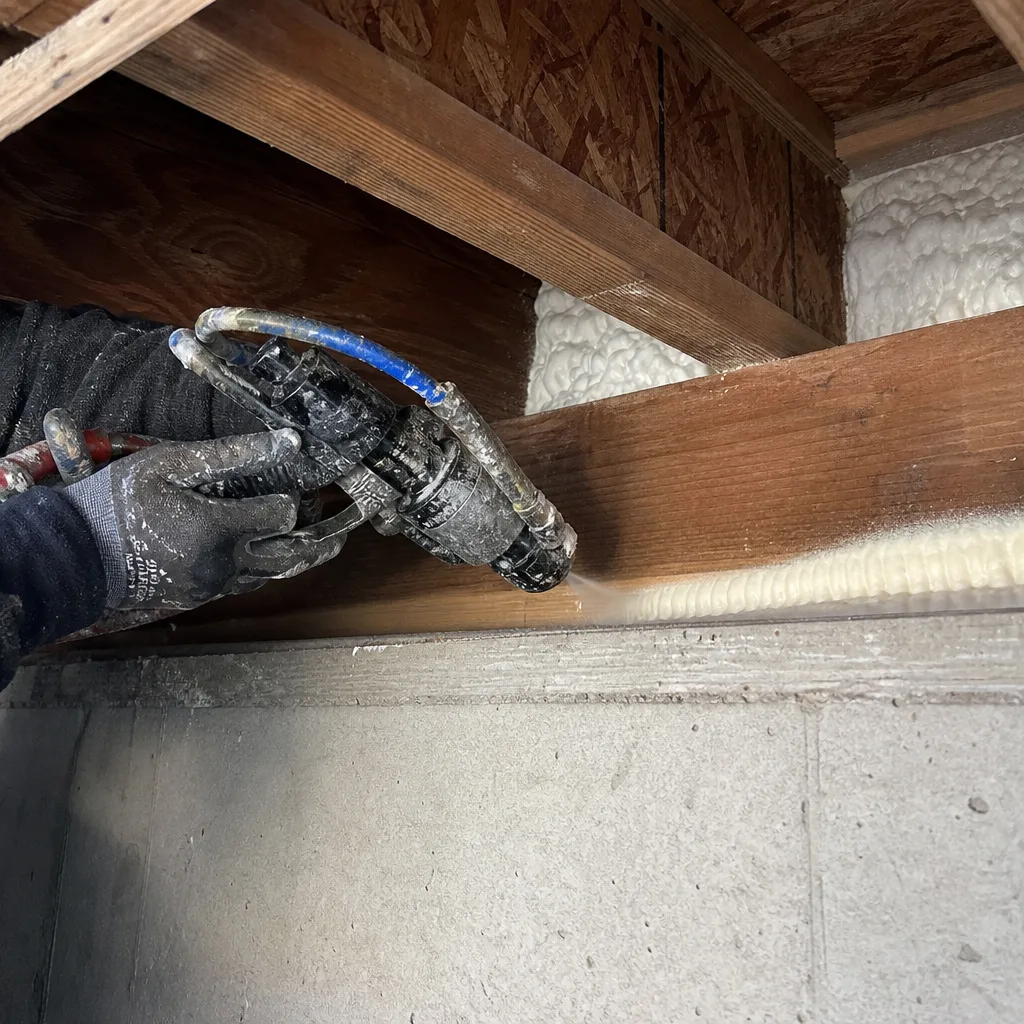
Rim Joist Spray Foam in Lake Arrowhead is the highest-leverage insulation job we do on legacy cabins, particularly homes built along Rim of the World Drive and near Blue Jay where crawl spaces sit barely off the ground. The rim joist, the band board that sits on top of the foundation wall, is where cold air enters a floor system in winter. In an unsealed crawl space, that area draws snowmelt moisture, and open-cell foam applied there absorbs it. In these unheated crawl spaces, open-cell foam loses R-value and can eventually rot the sill plate. We almost always specify closed-cell Icynene on rim joists in Lake Arrowhead.
A typical rim joist sealing job in Lake Arrowhead runs $1,900 to $3,400 depending on crawl space access and total linear feet. It’s the most cost-effective freeze protection you can buy for a cabin that sits empty for weeks. The freeze risk isn’t theoretical here. Many cabins are vacant for long stretches, and the heat is off or set low. A sealed rim joist keeps cold air from wrapping the floor assembly and reaching supply lines.
What We See Before Sealing
In old Lake Arrowhead cabins, the original rim joist detail is usually a fiberglass batt stuffed loosely into the bay. It’s often damp, matted, and hanging down. Sometimes there’s no insulation at all, just a bare board. We remove whatever’s there, check the sill plate for rot, then apply two inches of closed-cell foam directly to the band board. In a 1950s A-frame chalet near Lake Arrowhead Village, the owners had returned after a February cold snap to burst pipes. The original fiberglass had settled a full six inches in places and left the rim joist wide open to freeze-thaw cycles. We sealed it, then added freeze alarms with heat tape on the exposed supply lines.
What It Won’t Fix
Rim joist foam does not protect pipes that run through exterior wall cavities. The foam stops at the wall, but the plumbing chase goes where it goes. In walls where supply lines run upward along the exterior sheathing, we recommend moving those lines or insulating the chase itself. We flag this on every Lake Arrowhead rim joist quote because we’ve seen too many customers assume the rim job fixed everything.
Trusted Brands We Service in Lake Arrowhead
Fontana Insulation is an authorized installer for Icynene and Demilec spray foam, and those are the two lines we recommend most often for Lake Arrowhead’s climate. Icynene’s closed-cell formula handles the freeze-thaw demands of a mountain cabin shell. Demilec’s open-cell product gives us a lower-cost option for interior applications. We also work with Johns Manville and Rockwool for hybrid jobs where you want mineral wool’s fire resistance on a wood stove wall or a chase between floors. We stock common replacement supplies on our trucks when we come up the hill, so the foam, backer blocks, and air sealing materials arrive with us. You’re not waiting on a parts run down to San Bernardino.
Common Spray Foam Insulation Problems We See in Lake Arrowhead Homes
- Moisture-saturated open-cell rim joists: Snowmelt and freeze-thaw cycles in unheated crawl spaces pull moisture into open-cell foam. It loses R-value quickly and can rot the sill plate. We only use closed-cell on Lake Arrowhead rim joists.
- Cracked foam around legacy window frames: Single-pane wood windows from the 1960s and 1970s move with the seasons. Spray foam without backer blocks cracks along the rough opening, letting air pass behind the foam. We see this constantly in cabins near the lake’s north shore.
- Masked frozen pipe runs: Foam on an exterior wall looks complete, but supply lines inside the same cavity can still freeze because the foam doesn’t reach the plumbing chase. Vacation cabins with irregular heating are the worst hit.
- Foam over unsealed crawl space vents: Some older Lake Arrowhead cabins have foundation vents that owners closed up with foam to stop drafts. That traps moisture inside and accelerates rot on the sill plate. Vents should be handled with proper crawl space sealing, not spot foam. No two cabin failures are the same. When we assess a Lake Arrowhead home, we’re looking at what’s already gone wrong and what’s about to.
Pricing for Spray Foam Insulation in Lake Arrowhead, CA
For Lake Arrowhead’s market, closed-cell spray foam runs $2.50 to $4.50 per board foot installed, open-cell runs $1.80 to $2.90 per board foot, and rim joist sealing jobs land between $1,900 and $3,400 for the typical cabin footprint. Whole-cabin wall applications in 92352 range from $3,800 for smaller open-cell interior jobs to $11,000 for full closed-cell exterior treatment on a larger A-frame. What moves the number: crawl space access, how much old insulation we’re removing, whether backer blocks are needed around legacy windows, and whether we’re working through snow season. We give free estimates, and the price we quote is the price we work from. Call (866) 271-1602 and we’ll come up to Lake Arrowhead, walk the property, and give you a number based on your actual walls and crawl space, not a square-footage guess.
We Also Serve Cities Near Lake Arrowhead
Our crews regularly drive up from Fontana through Crestline, Running Springs, and over to Blue Jay and beyond. We run jobs in Highland and Muscoy on the way up the mountain. If you own a cabin outside the 92352 boundary but still deal with snow load and vacant-house freeze risk, ask us. The same closed-cell rim joist solutions apply throughout the San Bernardino mountain communities and the foothills below. For more on our broader coverage, see Spray Foam Insulation in Lake Arrowhead and the surrounding mountain towns.
Serving Lake Arrowhead, CA — Our Local Coverage Area
We’re based in the Lake Arrowhead area and know this community well. Use the map below to see our service coverage — if you’re nearby, we can almost certainly help.
FAQs About Spray Foam Insulation in Lake Arrowhead
Yes, but only when it’s applied to the right places with the right foam type. Closed-cell spray foam on rim joists and exterior walls stops the air movement that lets cold reach plumbing inside those cavities. The critical step is sealing the rim joist where foundation air enters the floor system and then treating the exterior wall cavities where supply lines live. Spray foam doesn’t generate heat. It removes the pathway for cold air. For vacant cabins, we also recommend freeze alarms and heat tape on exposed supply lines as a backup, because no insulation can protect a pipe when the indoor temperature drops below freezing for days. Call (866) 271-1602 to have us assess your cabin’s freeze risk.
Because open-cell foam is the wrong material for that location. Rim joists in Lake Arrowhead sit over crawl spaces that go through snowmelt and freeze-thaw cycles every winter. Open-cell foam absorbs that moisture, loses its R-value, and can hold water against the sill plate until it rots. Closed-cell foam doesn’t absorb water and acts as a vapor barrier. The failure we see most often is a contractor spraying open-cell on rim joists because it’s cheaper. It works for a season or two, then the moisture problems start. We only specify closed-cell on rim joists in Lake Arrowhead.
If the cabin is occupied full-time or used as a rental for much of the year, closed-cell spray foam is worth it. It seals air gaps that fiberglass will never close. If the cabin is a vacation home with irregular heating and you’re concerned about freeze protection, spray foam on exterior walls makes even more sense. But we won’t tell you to rip out decent fiberglass just to upsell you. Many Lake Arrowhead cabins can use a hybrid approach: spray foam on rim joists and problem wall cavities, then fresh batts or blown-in material in the rest. The right answer depends on your cabin’s actual condition. Come see us and we’ll talk through the trade-offs without pushing a single material.
Closed-cell spray foam handles it well because it’s rigid, it adheres to the framing, and it doesn’t absorb water. Snow sitting against siding for months, followed by daytime thaws and nighttime refreezes, is a brutal cycle for insulation. Open-cell foam is more vulnerable to moisture and shifts in the wall cavity. Spray foam also adds some structural rigidity to older 2×4 walls, which helps bear the snow load on roofs and reduces wall flex. For roof decks under heavy snow, closed-cell foam can also help prevent ice dams by keeping heat from escaping through the roof plane. That’s a job we do on many A-frames in the Lake Arrowhead area.
We’re authorized installers for Icynene and Demilec. Icynene’s closed-cell product is our default for rim joists and exterior walls because it handles the freeze-thaw conditions in Lake Arrowhead. Demilec’s open-cell foam is a good option for interior applications where you want sound dampening and air sealing without the higher cost. We also stock Johns Manville and Rockwool for hybrid and fire-resistant cavity work. Our truck carries what the job needs, not whatever a manufacturer’s rep told us to push that month. Call (866) 271-1602 for a free estimate and we’ll talk about which material is right for your place.
Written by Noel Arredondo, Owner at Fontana Insulation, serving Lake Arrowhead and the San Bernardino mountains since the company’s founding.