
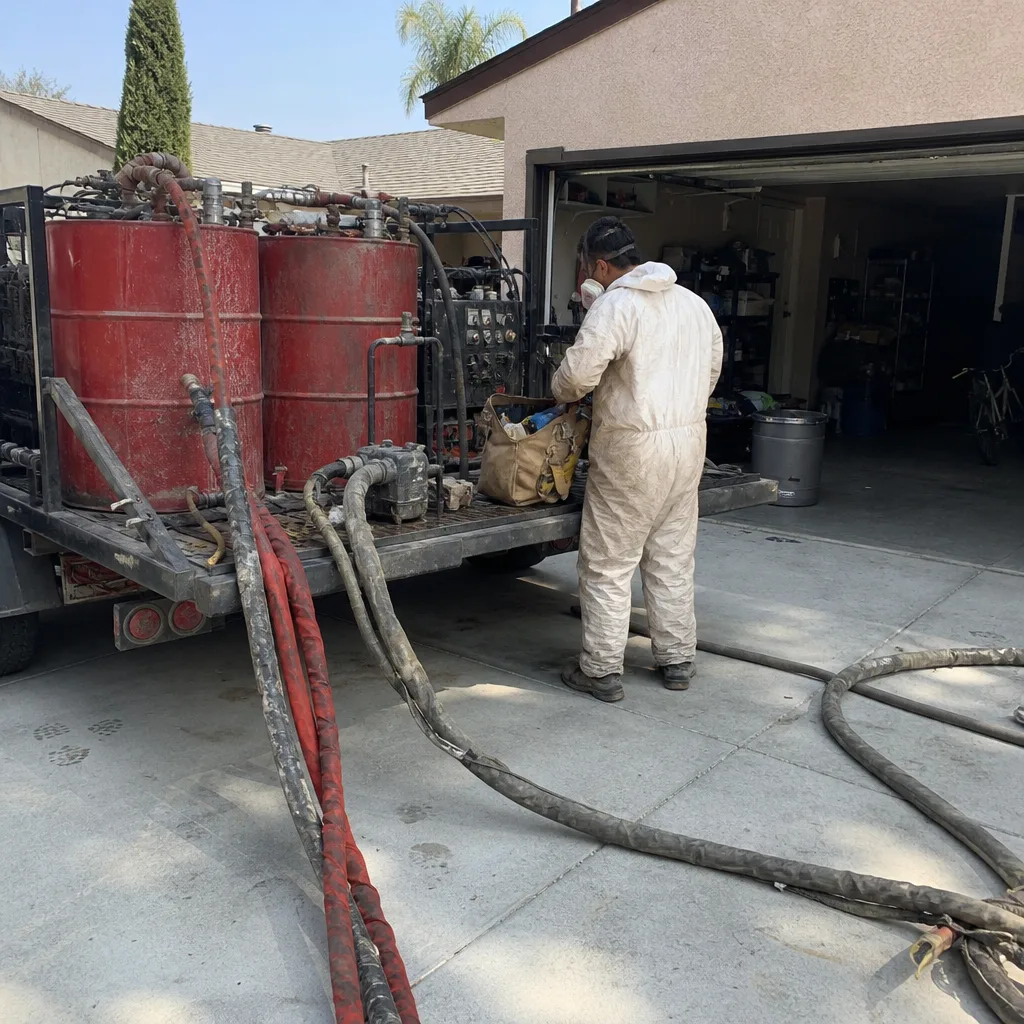
Fast, Reliable Spray Foam Insulation Across Crestline
Spray foam insulation in Crestline addresses a problem that’s unique to this mountain community: cabins and older homes at 4,500 to 5,000 feet that were never built for year-round comfort. Most of the housing stock here predates modern energy codes, and the result is drafty rooms, ice dams on vaulted ceilings, and heating bills that climb every winter. Our Spray Foam Insulation team works throughout the 92325 ZIP code, and we know what these legacy buildings need because we’ve opened enough walls and roof decks to see exactly where the heat is escaping. Call (866) 271-1602 for a free estimate, and we’ll send someone who understands Crestline construction, not a generic crew reading from a standard playbook.
Why Fontana Insulation Is Crestline’s Preferred Spray Foam Insulation Company
Crestline homeowners call us because we don’t walk in with one product and force it onto every job. We stock eight insulation brands across fiberglass, mineral wool, spray foam, and cellulose, and we’re authorized installers for Icynene and Demilec, two of the most performance-tested foam brands in North America. That matters here because a 1960s cabin off Highway 18 with vaulted ceilings and no ridge vent needs something very different from a 1990s ranch with a flat attic. We also carry Rockwool mineral wool for Crestline clients who want fire resistance alongside thermal performance, a real concern in a forested mountain community.
Noel Arredondo leads our team, and the approach is brand-neutral. We carry Johns Manville, Knauf, CertainTeed, and others because each material earns its place for a specific application. If closed-cell spray foam is the right tool for your roof deck, that’s what we’ll recommend. If your walls can’t take foam, we’ll say so and show you the alternative. That honesty is why Crestline homeowners keep referring us to neighbors who are tired of guessing at the fix.
Spray Foam Attic Insulation in Crestline
Spray Foam Attic Insulation in Crestline is the highest-impact upgrade you can make to a legacy cabin, because most of the attics here were either under-insulated from the start or covered with batts that have slumped and compressed over 40-plus years of mountain freeze-thaw cycles. The job involves sealing the roofline or attic floor with open- or closed-cell foam so that warm interior air stops leaking into a cold attic, where it condenses, freezes, and creates ice dams. For a typical Crestline attic with vaulted sections, closed-cell foam against the roof deck runs $3.50 to $6.50 per board foot, while open-cell is more in the $1.80 to $3.00 range. We’ll measure your actual rafter bays and give you a fixed number before any work starts.
Roof Deck Sealing for Ice Dam Prevention
At Crestline’s altitude, the snow that lands on your roof doesn’t just melt and drain. It refreezes at the eaves when heat from the living space leaks through the ceiling, and that’s how ice dams form. Spraying closed-cell foam directly against the underside of the roof deck, from the ridge to the soffit, moves the thermal boundary to the roof line and stops the warm air from reaching the snow pack. We’ve done this on cabins along Lake Gregory Drive and through the Crestline village area, and the difference in snow retention and indoor temperature is immediate.
Attic Floor Air Sealing Before Any Blown-In Work
If you plan to keep the attic unconditioned, the first step is always sealing the floor penetrations, wire chases, and top plates before any insulation goes in. In Crestline homes with older can lights and unsealed framing, a two-part foam seal at every penetration costs $800 to $1,500 for a typical 1,000-square-foot attic floor, and it’s the step that makes the insulation actually perform. Skipping it means you’re paying to insulate a leaky sieve.
Spray Foam Wall Insulation in Crestline
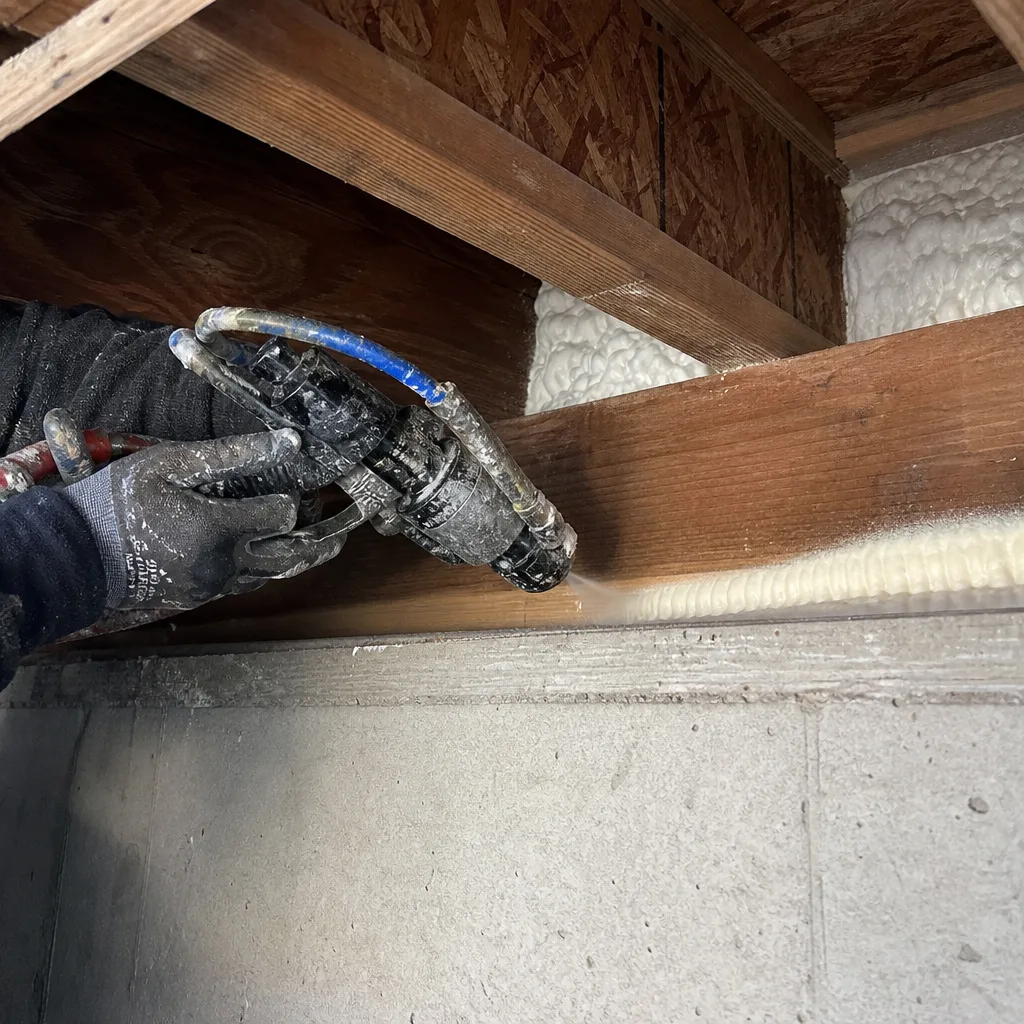
Spray Foam Wall Insulation in Crestline is how you fix the thin-walled, wood-frame cabins that dominate this housing stock. Many of these homes were built as seasonal getaways with 2×4 framing, no sheathing insulation, and sometimes no insulation in the wall cavities at all. When they became year-round residences, the result was cold rooms, frozen pipes at the wall plates, and condensation-driven rot at the base of the walls. Slow-rise closed-cell foam injected into existing wall cavities runs $4.00 to $7.00 per board foot on a retrofit basis, and it both insulates and air-seals in one pass. For new construction or open studs, open-cell is more economical at $1.50 to $2.75 per board foot.
Injection Foam for Existing Cabins Without Opening Walls
Most Crestline homeowners don’t want to tear out tongue-and-groove paneling or original shiplap to insulate their walls. Injection foam lets us drill small access holes from the exterior or interior and fill the cavities without a full gut. We did exactly this on a 1960s cabin off Highway 18 near the Crestline village, injecting slow-rise foam from the exterior into 2×4 wall cavities that had only thin fiberglass batts. The homeowner reported the great room holding heat for the first time in decades, and the siding stayed intact.
Sealing the Bottom of the Wall Against Freeze-Thaw Rot
Crestline’s day-night temperature swings mean moisture moves through walls constantly. When the base of a wall plate is uninsulated and unsealed, condensation forms right at the framing, and over years that breeds rot and mold. Spray foam applied at the rim joist and wall-to-floor connection creates an air and moisture break that stops that cycle. This is a $600 to $1,200 job for a typical single-story cabin, and it’s the cheapest insurance against structural damage you’ll never see until it’s too late.
Trusted Brands We Service in Crestline
We’re authorized installers for Icynene and Demilec spray foam, and we carry both because they serve different applications: Icynene for open-cell attic and wall work, Demilec for closed-cell roof decks and rim joists where you need higher R-value per inch. We also stock Rockwool mineral wool for Crestline homeowners who want a fire-resistant option in the wildland-urban interface, and we keep Johns Manville and CertainTeed fiberglass on the truck for jobs where foam isn’t the right call. Parts and materials aren’t special-ordered from a catalog; we maintain stock for Crestline projects so we can start work without a two-week lead time.
Common Spray Foam Insulation Problems We See in Crestline Homes
- Foam sprayed over unsealed knob-and-tube wiring in vaulted ceilings. This is common in pre-1960 cabins, and it’s a genuine fire hazard. The foam can’t bond properly around old wiring, and it traps heat against fabric-insulated conductors. We always inspect and flag this before any retrofit work begins.
- Open-cell foam on roof decks without an air barrier. In Crestline’s cold nights, moist interior air migrates into open-cell foam and condenses inside it, degrading the material and hiding moisture until the roof sheathing starts to rot. Closed-cell is the right call for most unvented roof decks at this altitude.
- Foam applied directly to single-pane window frames and uninsulated wall plates. The condensation that forms at the bottom of single-pane windows runs down and saturates the foam, and in freeze-thaw cycles that creates a wet band at the wall base. The window detail has to be addressed first or the foam fails from the bottom up.
- Uninsulated rim joists in cabins with crawlspaces. We see this constantly in Crestline’s older homes, where the floor stays cold and pipes freeze even after attic work is done. Sealing the rim joist with closed-cell foam is a $600 to $1,200 job that transforms floor comfort, and it’s the first thing we recommend for homes built on piers or short stem walls.
Pricing for Spray Foam Insulation in Crestline, CA
For a typical 1,200-square-foot Crestline cabin, expect to pay $4,500 to $8,000 to spray closed-cell foam on the attic roof deck, including air sealing and rafter bay work. Wall injection for the same home runs $3,500 to $7,000 depending on cavity depth and access. A rim joist sealing job is $600 to $1,200, and garage ceiling spray foam runs $800 to $1,600 for a single-car garage. Larger homes, vaulted ceilings with complex framing, and homes requiring lead-safe or knob-and-tube remediation all push the number higher. We give you a written, line-item quote before any work starts, and the estimate is free. Call (866) 271-1602 and we’ll come measure, not guess.
We Also Serve Cities Near Crestline
Our Crestline service area includes the mountain communities and foothill towns where we work most often: Lake Arrowhead, Muscoy, San Bernardino, and Highland. If you’re in a neighboring ZIP and dealing with the same legacy cabin issues, the same crew and the same material options are available to you. Call and we’ll schedule a walkthrough.
Serving Crestline, CA — Our Local Coverage Area
We’re based in the Crestline area and know this community well. Use the map below to see our service coverage — if you’re nearby, we can almost certainly help.
FAQs About Spray Foam Insulation in Crestline
Yes. Ice dams on Crestline vaulted ceilings are caused by heat leaking from the living space into the roof deck, melting snow, and then refreezing at the cold eaves. Spraying closed-cell foam directly against the underside of the roof deck from ridge to soffit moves the thermal boundary to the roof line and stops the warm air from ever reaching the snow. The fix involves removing any old batts above the ceiling, air sealing the rafter bays, and applying 2-plus inches of closed-cell foam. For a typical vaulted ceiling cabin, this runs $4,500 to $8,000. Call (866) 271-1602 and we’ll inspect your roofline before the next snow season.
Yes, spray foam is one of the fastest ways to bring an uninsulated addition up to a reasonable energy standard in Crestline, though code compliance depends on the addition’s framing, electrical, and fire separation details. We can insulate and air seal the walls, ceiling, and rim joists of an older addition without opening the finished surfaces, using injection foam for wall cavities and closed-cell foam at the roofline. What we can’t do is certify the electrical or structural work in an unpermitted addition, so if there’s knob-and-tube wiring or questionable framing, that has to be addressed first. Call (866) 271-1602 for an assessment.
Slow-rise closed-cell injection foam is the best spray foam for the older 2×4 wood-frame walls common in Crestline’s mid-century cabins, because it fills the cavity completely, air seals, and adds R-value without tearing out the original paneling or shiplap. Open-cell foam is not the right choice for those wall cavities, because it doesn’t provide the same moisture resistance at the exterior sheathing and can allow condensation in Crestline’s freeze-thaw cycles. Every wall gets a cavity inspection before we recommend the material. Call (866) 271-1602 and we’ll tell you what your walls actually need.
No, you don’t have to remove the original single-pane windows before spraying foam in Crestline, but you should address the condensation and rot at the window frames and wall bases before any foam is applied. Foam sprayed directly onto a rotting window frame or a wet wall plate will trap that moisture and accelerate the damage. In many cases we do the window-to-wall air sealing first, then spray the surrounding wall cavities. If the windows themselves need replacement, that’s a separate scope, but it doesn’t prevent us from insulating the walls now. Call (866) 271-1602 for a window-to-wall assessment.
No, spray foam is not safe to apply directly over old knob-and-tube wiring in a Crestline attic. The foam traps heat against the fabric-insulated conductors and prevents proper air circulation, which creates a real fire risk. Knob-and-tube wiring must be decommissioned or replaced by a licensed electrician before any insulation covers it. If we find live knob-and-tube during our site inspection, we’ll stop and flag it before any work proceeds. Call (866) 271-1602 and we’ll identify what’s in your attic before making any insulation recommendation.
Written by Noel Arredondo, Owner at Fontana Insulation, serving Crestline and the San Bernardino Mountains.