
Rockwool Attic Insulation in Fontana: A Homeowner’s Guide
Rockwool attic insulation in Fontana typically costs $2.20 to $3.10 per square foot installed, landing roughly 20 to 30% above comparable fiberglass batts. For most Fontana attics in the 1,200 to 1,800 square foot range, you’re looking at $2,600 to $5,600 total. But here’s the thing: Rockwool earns that premium in specific situations, and paying for it when those situations don’t apply is money that could stay in your pocket. If you’d rather skip the research and get a straight answer for your specific attic, call (866) 271-1602 and we’ll walk you through it.
We sell and install Rockwool alongside seven other brands at Fontana Insulation. No brand loyalty, no inventory pushing. Just the best fit for your attic. And Rockwool is a material with a very specific set of strengths, and a few weaknesses you should understand before writing the check.
- Rockwool costs 20 – 30% more than fiberglass – justified only when fire resistance, sound dampening, or dimensional stability matters for your situation.
- Class A fire rating matters most for Fontana homes near wildland-urban interface zones or with gas-fired HVAC sitting in unconditioned attic space.
- Rockwool holds its shape for decades – fiberglass sags, Rockwool doesn’t, which protects your R-value over time.
- Rockwool is not the right call for attics with existing moisture problems – you need air sealing first, regardless of material.
- The smartest installs pair Rockwool with spray foam at knee walls, attic hatches, and rim joists in older Fontana ranch homes.
What Rockwool Actually Is (and Why Most Contractors Don’t Stock It)
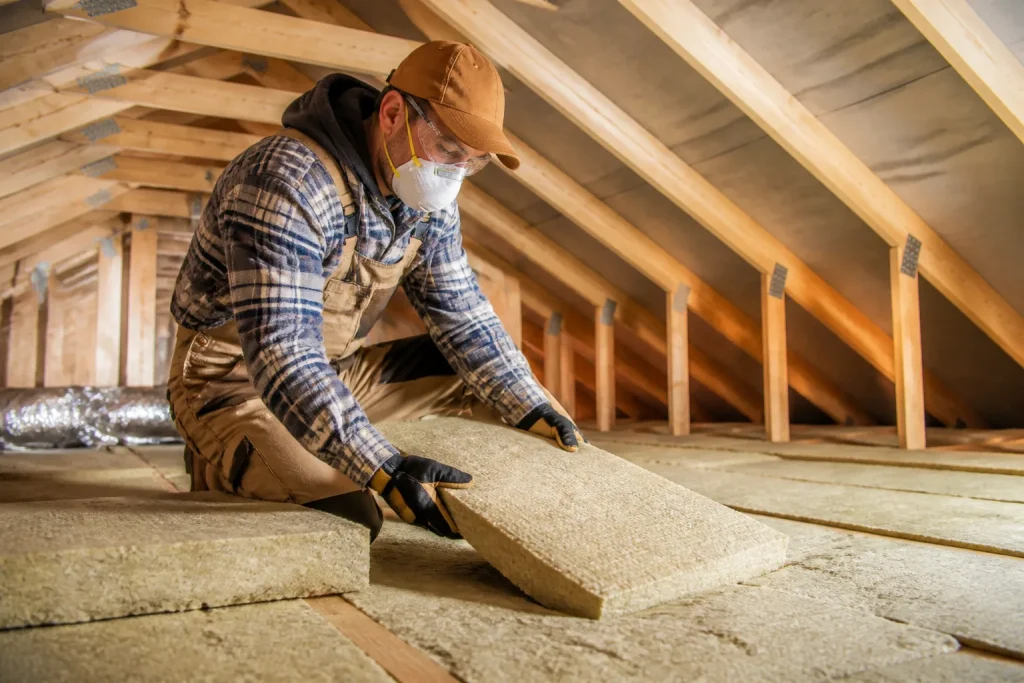
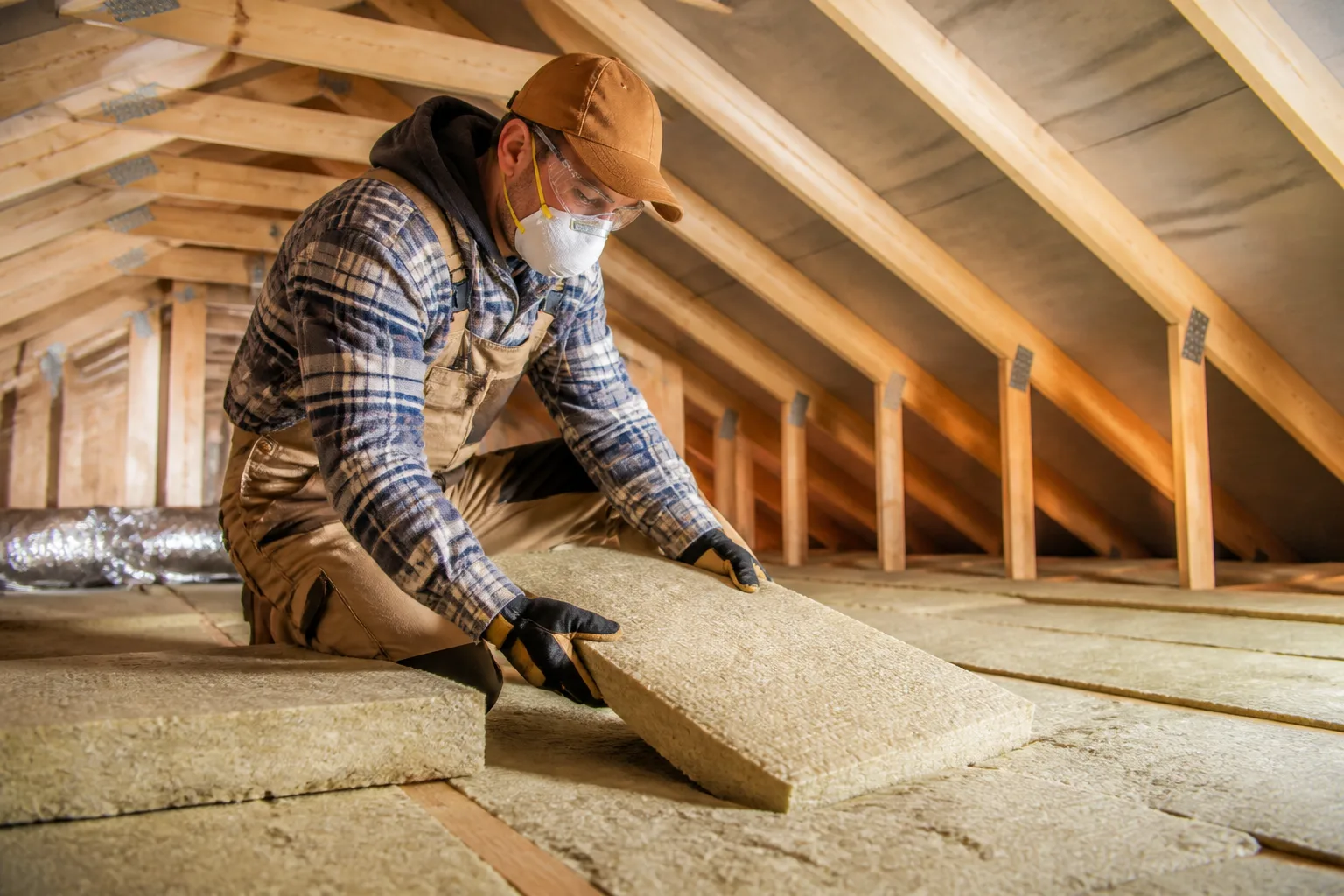
Rockwool is mineral wool insulation made from volcanic basalt rock and recycled slag, spun into dense batts. It’s not new. The material has been used in Europe for decades, and commercial builders in North America have specified it for years. What makes it relatively rare in residential attics is simple: it costs more to manufacture, which means it costs more to buy, which means most insulation contractors don’t want to tie up cash in inventory that homeowners haven’t asked for by name.
We stock it because some attics genuinely need what it does. When a Fontana homeowner tells us they want fire resistance, or they’ve got a bedroom above a garage and can hear every car door on the street, or they’ve got an older home where fiberglass batts have slumped and lost their loft, Rockwool becomes the honest recommendation. Not because it’s premium. Because it solves the problem.
We carry Rockwool alongside Johns Manville and CertainTeed fiberglass because material choice should follow the home’s needs, not what’s easiest for us to keep on the shelf. Some jobs call for the cheapest effective option. Some call for Rockwool. Our job is telling you which is which.
When Rockwool Earns Its Premium in a Fontana Attic
Let’s be specific about the three situations where we recommend Rockwool without hesitation.
1. Fire Resistance – and Why Fontana Geography Matters
Rockwool carries a Class A fire rating, which means it’s non-combustible and won’t contribute fuel to a fire. Fiberglass batts won’t ignite easily either, but the kraft paper facing on many fiberglass products can burn, and the material itself melts at high temperatures. Rockwool doesn’t melt until you hit roughly 2,150°F. For context, a typical house fire burns at 1,100°F to 1,800°F at the ceiling level.
Fontana sits against the foothills of the San Gabriel Mountains, and significant portions of the city fall within or near high-fire-severity zones mapped by Cal Fire. If your home is in the northern part of the city, up toward the Lytle Creek area or the neighborhoods backing against the hills, ember intrusion into attic vents is a real risk. A Class A rated material at the attic floor adds meaningful protection.
The less obvious fire consideration: many Fontana homes have gas-fired furnaces sitting directly in unconditioned attic space. When equipment is running in the same space as your insulation, a non-combustible material is simply the safer spec. We’ve pulled fiberglass batts out of Fontana attics where years of furnace cycling had left the facing brittle and brown. Rockwool doesn’t do that.
2. Dimensional Stability – R-Value That Stays Put
R-value is only as good as what’s actually in contact with your ceiling drywall. Fiberglass batts lose performance as they age because they compress under their own weight, shift during temperature cycling, and leave gaps at edges. In a Fontana attic, where daytime attic temperatures can swing from 40°F on a winter night to 140°F on a July afternoon, that cycling is relentless.
Rockwool batts are dense and rigid. They hold their manufactured dimensions for decades. No sagging, no slumping, no gaps opening at the soffit lines. What you pay for at install time is what you get twenty years later.
That said, dimensional stability doesn’t matter much if your attic is already tight and properly air sealed. It matters most on retrofit projects in older Fontana ranch homes, where existing fiberglass has gone flat and you’re pulling it out anyway. If you’re starting fresh and the budget is tight, properly installed fiberglass from CertainTeed or Johns Manville will do the job. We’ll tell you that straight.
3. Sound Dampening – the Overlooked Attic Benefit
Rockwool is roughly twice as dense as fiberglass, and that density translates directly into sound transmission reduction. In an attic application, that matters when you’ve got a bedroom above a garage, a home theater in a converted attic space, or you live near the 210 freeway and hate the constant road hum.
One job we did in the Southridge area last year: the homeowner converted a bonus room over the garage, and the noise from the garage door opener was loud enough to wake a sleeping kid. Rockwool batts in the floor cavity solved it. Fiberglass wouldn’t have moved the needle enough. That’s the kind of specific, problem-first recommendation that matters more than any brand logo.
Where Rockwool Falls Short – and the Honest Trade-Offs
Rockwool is not a miracle product. Here’s where it disappoints if you pick it for the wrong reasons.
Vapor Permeability: Rockwool Breathes, Which Isn’t Always Good
Rockwool is vapor permeable. That means moisture can pass through it rather than getting trapped. In walls, that’s generally a benefit. In a Fontana attic with a known moisture issue, like condensation on the underside of the roof deck during winter, or a bathroom fan venting into the attic instead of through the roof, that permeability means moisture reaches the roof deck more easily.
Every material fails when the building envelope has a hole in it. If your attic has moisture problems, the fix is air sealing and proper ventilation first, insulation second. Rockwool installed over an unsealed ceiling just lets warm, humid air move through it and condense elsewhere. This is one of the reasons our estimates in Fontana always start with a look at the attic’s ventilation and air sealing before we talk about which material goes on the floor.
Cost Comparison: Rockwool vs. Blown Cellulose vs. Fiberglass Batts
Here’s what we’re actually quoting on Fontana attics these days, broken down for a typical 1,500 square foot attic at R-38:
Installed Cost Comparison – 1,500 sq ft Fontana Attic, R-38 Target
- Blown cellulose (GreenFiber): $1.10 – $1.60 per sq ft installed, roughly $1,650 – $2,400 total. Cheapest path to R-38, and a solid performer in dry Fontana attics when installed to correct depth.
- Fiberglass batts (Owens Corning, Johns Manville, CertainTeed, Knauf): $1.70 – $2.20 per sq ft installed, roughly $2,550 – $3,300 total. The standard recommendation for most homes. Predictable, widely warrantied, easy to work around.
- Rockwool batts: $2.20 – $3.10 per sq ft installed, roughly $3,300 – $4,650 total. The premium option when fire resistance, sound dampening, or long-term dimensional stability is the priority.
- Spray foam (Icynene or Demilec, open-cell): $2.80 – $4.50 per sq ft installed, roughly $4,200 – $6,750 total. Not typically used as the primary attic floor material unless you’re building an unvented attic assembly, but common at kneewalls and hatches.
Those are real ranges we work within, not national averages pulled from a website. Your attic will land somewhere in there depending on access, existing insulation removal, and air sealing scope.
Knee Walls and Attic Hatches: Where Rockwool Plus Spray Foam Wins
Older Fontana ranch homes, we’re talking the 1960s and 1970s builds that run from the downtown grid up through the Cypress neighborhood and out toward Sierra Lakes, have a specific set of thermal leaks. Knee walls, the short vertical walls where roofline meets attic floor, often have no insulation at all. Attic hatches frequently have a piece of drywall with zero seal.
These aren’t places where you choose Rockwool OR spray foam. You use both.
The play: Rockwool batts in the knee wall cavities for fire resistance and dense fill, because knee walls are awkward to spray cleanly and often have electrical wiring running through them. Then a flash-and-batt approach on the hatch and rim joists, with closed-cell spray foam from Demilec or Icynene creating the air seal, and Rockwool filling the rest of the cavity for thermal performance.
That combination does what neither material does alone. Foam stops the air movement. Rockwool adds R-value without breaking the budget. If a contractor proposes only one material for a 60-year-old Fontana attic with knee walls, they’re leaving performance on the table.
When to call a pro: knee walls and hatches require careful detailing to avoid moisture traps, and adding insulation over knob-and-tube wiring (still present in some older Fontana homes) requires an electrician’s assessment first. If any of that sounds familiar, call us at (866) 271-1602 before you start.
Related services in Fontana: we handle attic insulation in Pomona and the surrounding area, plus spray foam insulation in Pomona for air sealing applications. If you’re comparing materials, our blown-in insulation in Pomona page breaks down cellulose and fiberglass options.
The Bottom Line
Rockwool is the right attic insulation for maybe 20 to 25% of Fontana homes. Fire-prone foothill locations, attics with gas-fired HVAC, noise-sensitive bedrooms over garages, and retrofit jobs where existing batts have failed. For everyone else, fiberglass or cellulose at the same R-value will do the job for less money. The material matters less than the install quality and air sealing.
That’s the honest answer. We carry eight brands because we’d rather recommend the right one than convince you the one we stock is the only option. The Fontana Insulation home page has more on our approach if you want to see how we think about material selection.
If you’re in Fontana and need help, Fontana Insulation offers free estimates – call (866) 271-1602.
Frequently Asked Questions
How much does Rockwool attic insulation cost in Fontana?
For a typical 1,500 square foot Fontana attic at R-38, Rockwool batts run $3,300 to $4,650 installed. That’s roughly 20 to 30% more than fiberglass batts at equivalent R-value. Call (866) 271-1602 for an exact quote – estimates are free.
Is Rockwool better than fiberglass for attic insulation?
Rockwool is better in three specific ways: it’s non-combustible with a Class A fire rating, it holds its shape and R-value longer without sagging, and it dampens sound much more effectively. For a standard attic with no fire risk, no noise issues, and good air sealing, fiberglass from brands like CertainTeed or Johns Manville performs just as well for less money.
Can Rockwool be installed over existing attic insulation?
Yes, Rockwool batts can be layered over existing insulation, but only if the existing material is dry, mold-free, and not compressed. We recommend removing failed batts first in most Fontana retrofit situations, because compacted insulation below Rockwool doesn’t recover its R-value. A quick attic inspection tells you which path makes sense.
Does Rockwool insulation mold or hold moisture?
Rockwool is inorganic, so it doesn’t support mold growth the way organic materials like cellulose can. But it is vapor permeable, meaning moisture passes through it. If your Fontana attic has existing moisture problems, install Rockwool only after air sealing and ventilation are addressed. Call (866) 271-1602 and we’ll check the attic before recommending any material.
Written by the team at Fontana Insulation, serving Fontana since 2011.
Need Insulation Help?
Call Fontana Insulation — licensed & insured, here with fast after-hours help in Fontana.
(866) 271-1602